


A Decade of Dignity: Inside CBA Foundation’s Quiet Revolution for Widows

 Quick Read
In many Nigerian homes, widowhood is not only a season of grief, it is the beginning of a long negotiation with hardship.
In many Nigerian homes, widowhood is not only a season of grief, it is the beginning of a long negotiation with hardship. The silence after loss is often filled with unpaid school fees, contested property, shrinking livelihoods and the slow erosion of dignity. For more than a decade, the Chinwe-Bode Akinwande (CBA) Foundation has chosen to stand precisely in that fragile space-steady, intentional and resolute, turning compassion into practical outcomes that last.
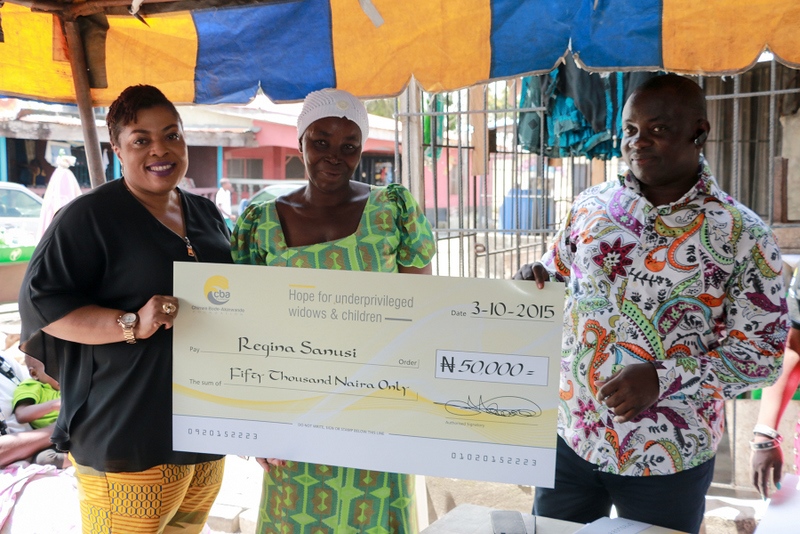
Established in 2015, Chinwe-Bode Akinwande Foundation was born from a clear moral instinct: widows and underprivileged children should not be left to navigate vulnerability alone. What began as an outreach effort has matured into a structured, impact-driven platform whose work now stretches across Lagos, Ogun and Anambra States, touching lives in ways both visible and quietly profound.
The Foundation’s philosophy is simple but demanding. Branded around the principle #CareIsAction, it rejects sympathy without structure. Food must be delivered, health must be restored, skills must translate into income, and education must resume, not someday, but now. Over the years, this approach has shaped programmes that respond to immediate needs while laying foundations for independence.
By 2025, the results were unmistakable. In that year alone, 565 underprivileged widows received direct support across three states, many of them women navigating loss alongside economic isolation. Beyond relief, 82 widows were financially empowered to either launch or stabilise small businesses, allowing skill and determination to evolve into sustainable livelihoods.
Across more than a decade of consistent work, the Foundation’s reach has expanded in depth as well as scale. Over 10,758 women have benefitted from empowerment and capacity-building initiatives designed to restore confidence, sharpen skills and strengthen economic agency. Health interventions have supported 6,150 widows, while nutrition programmes have delivered food assistance to 12,925 women confronting daily scarcity.
Education has remained a quiet but critical pillar. Through tuition support and targeted interventions, 180 underprivileged children have been reinstated in school, reclaiming classrooms that once felt permanently closed. In addition, 374 widows have been enabled to pursue self-employment through carefully structured financial support, moving from dependence to productivity.
Each figure tells a human story: a trader returning to the market with stock, a mother accessing medical care without fear, a child stepping back into uniform. The Foundation does not count impact in applause, but in households stabilised and futures reopened.

Material support alone cannot dismantle systems that perpetuate vulnerability. Recognising this, the Foundation has consistently paired intervention with advocacy, creating platforms that challenge harmful norms and promote legal protection for widows, including awareness around the Violence Against Persons Prohibition (VAPP) law.
This commitment found powerful expression in October 2025, when the Foundation convened a national conference titled “Empowering Widows in Nigeria: Breaking the Cycle of Poverty and Vulnerability” at Eko Hotel and Suites, Lagos. The gathering drew stakeholders from civil society, government, academia and the private sector, transforming lived experiences into policy-relevant dialogue.
Discussions centred on practical pathways, such as skill acquisition, microfinance, impact investing and rights-based advocacy, anchored by a keynote address from Amina Oyagbola of Women in Successful Careers (WISCAR) and a plenary session moderated by Hansatu Adegbite of WIMBIZ. More than an event, the conference marked a shift: widows were no longer subjects of conversation, but contributors shaping solutions.
Public engagement has also taken symbolic form. In November 2025, the Foundation led Walk4Hope, a five-kilometre sensitisation walk through Victoria Island, Lagos. Beginning at Eko Hotel & Suites, the walk drew individuals, organisations and business leaders into a shared act of solidarity.
The message was unmistakable. Support for widows must be communal, visible and sustained. The walk was not merely about awareness; it was a declaration that dignity can be restored when society chooses to show up step by step.
What distinguishes the CBA Foundation is its balance. Emergency relief is delivered with urgency, but never without an eye on tomorrow. Food distribution is paired with counselling. Medical support is reinforced with follow-up care. Business grants are structured to promote accountability and growth. Donors see transparency; beneficiaries experience respect.
At the centre of this ecosystem is a founder’s unwavering conviction that vulnerability should never erase potential. Chinwe Bode-Akinwande’s work reflects a belief in people who are willing to be resourceful if given the tools, the trust and the chance.
Now in its second decade, the Chinwe-Bode Akinwande Foundation stands as proof that meaningful social change does not need spectacle. It needs consistency. It needs empathy disciplined by structure. It needs people willing to remain present long after the headlines fade.
For the widows who have found footing, the children who have returned to school, and the women who now earn with dignity, the Foundation’s work is not abstract. It is daily life, improved.
And as long as care continues to move decisively, deliberately, hope will keep finding its way home.
Comments