



Explainer: Nine Misleading Claims Fueling Makoko Demolition Narrative

 Quick Read
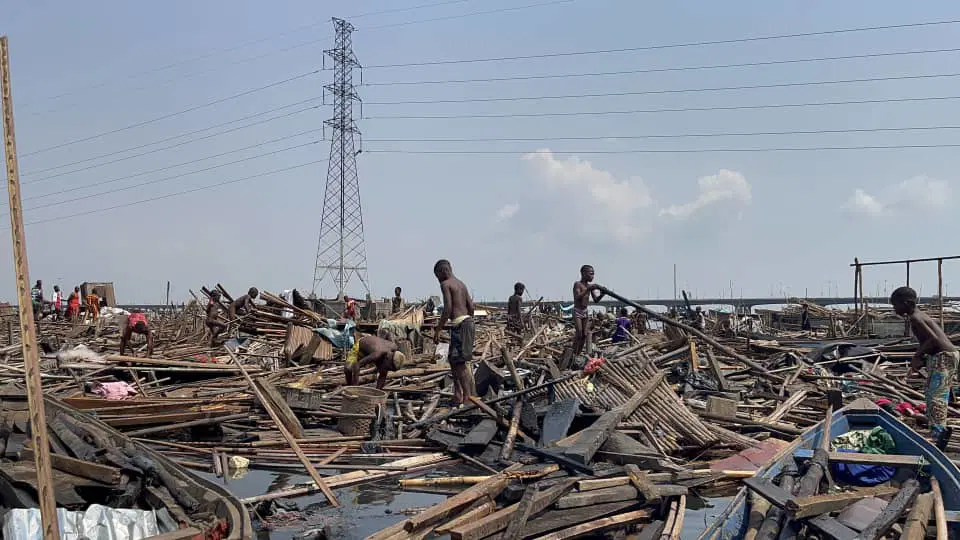
The recent demolition of some waterfront structures in Makoko, Lagos, has triggered widespread emotional reactions, and viral claims on social media.
The recent demolition of some waterfront structures in Makoko, Lagos, has triggered widespread emotional reactions, and viral claims on social media.
However, checks revealed that several dominant narratives around the exercise are either exaggerated or outright misleading.
Here is a fact-based explainer examining nine major claims often circulated about the Makoko demolition — and the true picture of things.
1. “Makoko was completely demolished”
Multiple sources and checks confirm this claim is false. Only structures directly under the power lines and those encroaching toward the Third Mainland Bridge were removed. The claims and counterclaims over an agreed 30–100 metres buffer clearance attest to this.
Makoko, as a community, remains intact.
2. “Residents were evicted overnight without warning”
Officials insist that notices were issued over time, particularly to occupants of structures built directly on waterways marked as unsafe or illegal.
Lagos Governor Babajide Sanwo-Olu disclosed that the exercise, initially scheduled for December 2024, was repeatedly delayed and extended throughout 2025 in the hope of voluntary compliance.
Other sources say there were initial warnings that predated the Sanwo-Olu administration.
3. “No compensation or resettlement was planned”
It is a general rule of government that structures built illegally on state-owned waterways do not qualify for compensation under existing laws — a detail often omitted in public narratives.
But Sanwo-Olu, in a viral video, declared that based on compassionate grounds, affected residents would be given palliatives and relocation stipends as compensation.
He stated: “I have instructed both local governments and the various ministries concerned to see how they also can give additional succour, palliatives, and relocation stipends to some of the people just to show compassion.
“And to say, you have done wrong, but the government can still show compassion and be compassionate about it.
“It is to ensure that we all can live in a safe and secure environment.”
4. “The demolition targeted the poor”
There are data that dispel this claim, reinforcing authorities’ position that enforcement actions are not class-based.
The data show that similar demolitions have occurred in both low-income and high-income areas when regulations are violated.
While much of the public focus has been on demolitions in informal, low-income settlements like Makoko and Oworonshoki, it is on record that enforcement has also been carried out in more established, higher-income neighbourhoods such as Ikeja GRA and areas connected to Ikoyi/Banana Island.
Checks revealed “illegal structures” in Ikeja GRA and Ikoyi/Banana Island particularly suffered the same fate in the first quarter of 2025.
5. “Makoko residents legally own the land and water”
This position is contrary to constitutional provision. The state disputes this narrative with the assertion that lagoons and waterways are public assets, and insists that the demolished structures lacked legal title or planning approval.
Under Section 44 of the 1999 Nigerian Constitution and the Land Use Act (1978), all land in Lagos, including waterways and lagoons, vests in the Governor in trust for the public. Structures without legal title or planning approval breach the Lagos State Urban and Regional Planning Law, giving authorities the legal right to remove unauthorized buildings to protect public safety, drainage, and navigation.
6. “The governor personally ordered the demolition”
Officials say the exercise followed standing urban planning, environmental, and safety regulations, carried out by relevant agencies rather than a personal directive.
With sources insisting there were earlier warnings to those affected, predated Sanwo-Olu’s administration, the governor said the decision of the government was based on the collective interest of Lagos State and the residents and not for any ulterior motive.
7. “There was no safety or environmental reason”
Experts describe Makoko as not just a community — but a dense human ecosystem built around water, wood, and survival.
But beneath its fragile resilience lies an invisible threat Lagos authorities say they could no longer ignore: high-tension power lines running through tightly packed waterfront homes, where a single fault could spiral into mass tragedy.
Urban safety experts note that disasters linked to power infrastructure in dense informal settlements are rarely contained.
A single spark can ignite wood-and-fuel structures, overwhelm narrow waterways, disable power across districts, and trap sleeping residents before help arrives.
Government cites fire hazards, flooding risks, blocked navigation routes, pollution, and security concerns as key reasons for clearing waterfront structures.
8. “Children were abandoned with no support”
Authorities counter this claim with the explanation that many viral images used to push this narrative lacked context, and that some community groups, NGOs, and institutions are furthering self-serving ends.
“We have our responsibility. We know what we are meant to do. Sometimes you see some NGOs who are collecting thousands of dollars from donor countries, going around to make videos of two or three children, saying, ‘You miss school today, you miss school tomorrow,’ just for their pecuniary rewards. It is a shame.
“I want people to be rest assured that we are not about taking anything away from anybody; we are just trying to make life better for our people,” Sanwo-Olu addressed the issue recently.
9. “The land is being cleared for luxury development”
Government has denied any approved private development plans for the cleared zones, describing them as strictly “buffer areas” meant for environmental and maritime safety.
The state has vigorously pushed back against claims that the exercise was designed to clear land for elite development, alleging that some local and international NGOs have profited from portraying Makoko as perpetually unsafe without delivering promised interventions.
End Note
While the demolition has undeniably caused hardship, government officials argue that much of the public conversation has been shaped by emotion-driven narratives that overlook legal, environmental, and safety considerations.
Comments