On 28 January, ten days after the end of the 2025 African Cup of Nations, the Confederation of African Football (CAF) came baring its fangs as it imposed stiff penalties on the football federations of Senegal and Morocco, the Senegalese coach, Pape Bouna Thiaw, and some players in the football teams of both nations.
The sanctions came after strident and relentless screams of blue murder across the continent by football fans who were sorely disenchanted by the spate of malpractices that pervaded the tournament hosted by Morocco. This was an irony of sorts because the host nation had been commended for its high-standard stadiums, well-organised transport network, quality hotels and state-of-the-art broadcast facilities, among others.
All of these soon mattered little as the tournament became marred by controversial refereeing decisions, unruly behaviour by fans, ill-treatment of some goalkeepers and allegations of favouritism levelled against CAF.
Controversial refereeing decisions that shaped matches
Refereeing was certainly AFCON’s most toxic talking point. Several matches were dominated not by footballing excellence but by contentious officiating calls that were believed to have altered outcomes.
There were questionable penalties, soft red cards and disputed offside rulings which sparked outrage from players and coaches. In at least two knockout fixtures, teams openly charged match officials with poor performance. Post-match press conferences descended into refereeing tribunals.
For example, in the semi-final encounter between the Atlas Lions of Morocco and the Super Eagles of Nigeria, there were a number of controversial decisions by the Ghanaian centre referee, Daniel Nii Ayi Laryea, who was on duty. One of his calls that made jaws drop was the yellow card shown to Nigerian defender Calvin Bassey in an incident where many observers felt Moroccan attacker Brahim Díaz exaggerated contact, with replays suggesting minimal contact.
In that match, Laryea booked only Nigerian players, while Morocco went through the entire game without a caution despite numerous fouls, to the chagrin of Nigerian fans. Supporters and commentators flagged several moments where appeals for fouls, penalties or dangerous play against Moroccan defenders were waved away, yet similar physical play against Nigerians was penalised.
The final match between Morocco and Senegal was no less marred by controversy. In stoppage time of the AFCON final, Senegal appeared to score from a corner when Ismaïla Sarr bundled the rebound into the net after a header by Abdoulaye Seck. However, the referee, Jean-Jacques Ndala of DR Congo, whistled for a foul before the ball crossed the line, disallowing what many believed was a legitimate goal.
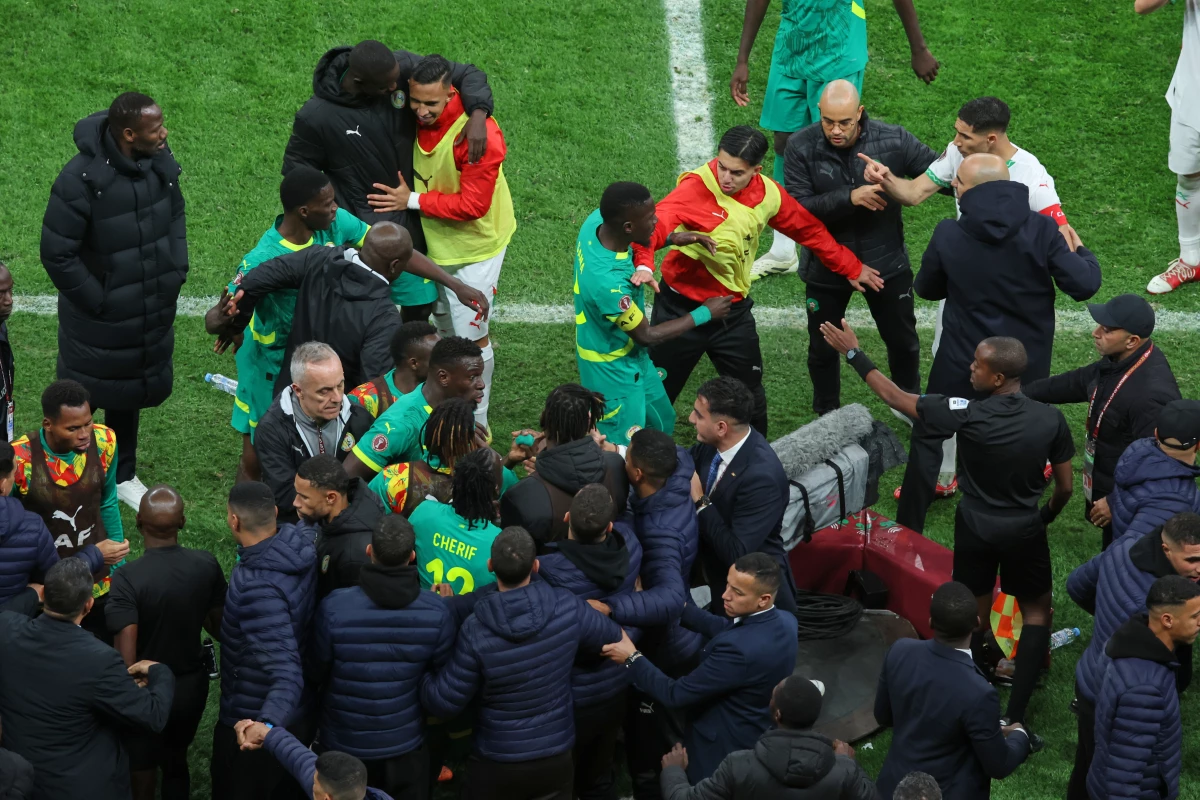
Shortly after the disallowed Senegal goal, Morocco were awarded a late penalty after a VAR review for a foul by Senegal defender El Hadji Malick Diouf on Brahim Díaz. Senegal players felt the foul was too soft and that the call was ill-timed at such a crucial moment. This development triggered the Senegal coach, who ordered his players off the pitch in protest, causing a delay of between 14 and 17 minutes in the final.
Loss of confidence in VAR
The Video Assistant Referee (VAR), a system in which match officials use video footage to review and assist with key decisions made by the on-field referee, was introduced to football to foster confidence. However, at the last AFCON, it deepened mistrust. Inconsistencies in its use, seen in long delays, unclear replays and selective intervention, left fans baffled. Identical incidents were alleged to have been judged differently across matches, reinforcing the perception of arbitrariness rather than fairness.
Unruly behaviour by fans
The crowd lost control on some occasions. In several venues, fans threw objects onto the pitch during heated moments. During the delay in the final match, some Senegalese supporters clashed with security and attempted to enter the pitch. Chairs and other objects were thrown, and security personnel struggled to contain them behind the barriers.
After Nigeria’s 2-0 win over Algeria in the quarter-final match in Marrakesh, crowd trouble erupted as some Algerian supporters attempted to storm the pitch after the final whistle. Flares were thrown towards security personnel, and there were reports of vandalism and confrontations between fans and stewards inside the stadium. Even referees required security escorts after the match due to protests from the Algerian team.
The mind-boggling goalkeeper towel controversy
Perhaps nothing at AFCON was as unfunny as the stealing of goalkeepers’ towels. It was one of the most bizarre incidents of the tournament.
One of the victims of towel grabbing was the Senegalese goalkeeper, Edouard Mendy. Several towels placed near him were repeatedly taken or thrown away while it was raining, disrupting his attempts to dry his gloves and face. Morocco captain and highly rated footballer, Achraf Hakimi, did not cover himself in glory. Video footage showed him picking up and throwing away one of Mendy’s towels.
Ball boys, along with some Moroccan players and officials, appeared to snatch towels from Mendy’s goal area. This prompted substitute Senegalese goalkeeper, Yéhvann Diouf, to remain near the goal to protect and return towels throughout the match.
Earlier in the tournament, during the semi-final match between Morocco and Nigeria, Super Eagles goalkeeper Stanley Nwabali had to keep replacing his towels after they went missing. Moroccan ball boys and stadium staff were implicated in taking Nwabali’s towels.
Allegations of favouritism and sanctions by CAF
Outraged fans did not spare CAF. They speculated that the Patrice Motsepe-led body allowed matters to degenerate in order to tilt the competition in favour of Morocco.
CAF, however, wielded its big hammer, announcing sanctions that affected only Senegal and Morocco. Senegal’s head coach, Pape Bouna Thiaw, received a five-match suspension for unsporting conduct and was fined USD 100,000. Senegalese players Iliman Ndiaye and Ismaïla Sarr were each banned for two matches. The Senegalese Football Federation was also hit with fines.
On the Moroccan side, defenders Achraf Hakimi and Ismaël Saibari received suspensions, with one of Hakimi’s matches suspended on probation, as well as fines. The Fédération Royale Marocaine de Football was fined for multiple offences related to the final.
However, critics remained unsatisfied. Questions persisted over why referees who made questionable calls were not punished.
CAF must put its house in order
There is no denying the fact that confidence in CAF is at a very low ebb. The African football governing body needs to establish transparent referee assessment and accountability systems. It must standardise VAR usage with clear public protocols and find ways to strengthen crowd control, stadium security and steward training.
CAF must commit to applying sanctions consistently, and erring match officials must not be spared. It must also improve communication with teams, the media and fans during crises.
The integrity of African football must be protected, and CAF has a lot to do to ensure that this happens.


 Quick Read
Comments