


Concept of Circular Economy inspires Lagos to reclaim wasted value – Sanwo-Olu

 Quick Read
Describing the theme of the event, “Turning Challenges into Markets,” as apt, he said it reflects the state’s view of sustainability not as a distant aspiration but as a practical pathway to competitiveness, resilience and inclusive growth.
Lagos State Governor, Mr. Babajide Sanwo-Olu, on Monday said the concept of circular economy has inspired the state to adopt innovative approaches aimed at reclaiming value from resources previously wasted.
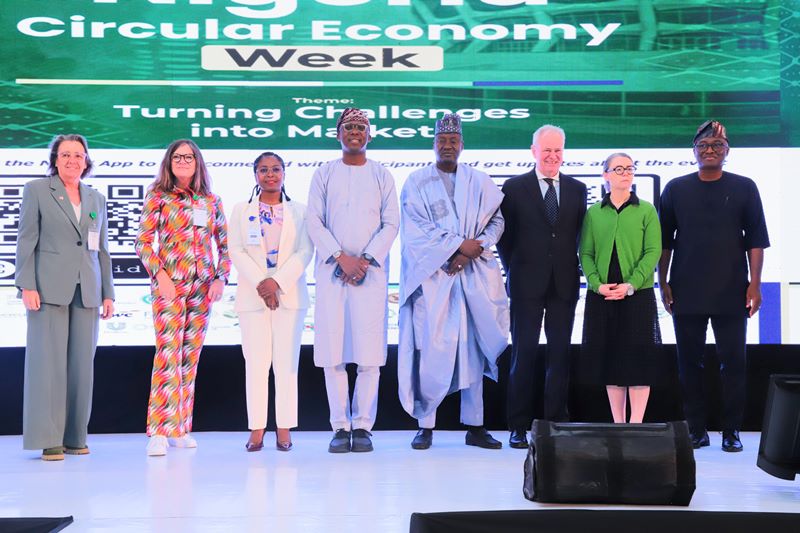
The Governor, represented by the Commissioner for the Environment and Water Resources, Mr. Tokunbo Wahab, spoke at the 2026 Nigeria Circular Economy Week held at the Lagos Continental Hotel, Victoria Island.
He stated that the goal is to build systems that will outlast the present administration and entrench sustainability as a governance principle.
Sanwo-Olu said the circular economy framework has enabled Lagos to create systems that keep materials in circulation and build markets that convert environmental responsibility into economic opportunities.
Describing the theme of the event, “Turning Challenges into Markets,” as apt, he said it reflects the state’s view of sustainability not as a distant aspiration but as a practical pathway to competitiveness, resilience and inclusive growth.
“Our journey has taught us a crucial lesson, circularity starts with good governance. Before we can reuse materials, we need functioning systems in place. Before new markets can develop, we must restore order. Before investments can flow, we need safe and predictable environments,” he said.
The Governor noted that the state had taken decisive steps to restore order in urban areas by clearing illegal structures under bridges, removing blockages along drainage channels and reclaiming public land that had become unsafe and environmentally hazardous.
He said these actions were necessary for public safety, flood prevention and environmental protection, while also representing a deeper effort to reclaim land and infrastructure as valuable public assets.
According to him, clearing drainage channels extends the lifespan of roads and public works, while removing encroachments restores natural water flow and reduces flood risks.
He added that reclaiming under-bridge spaces opens up opportunities for structured public use, including transport hubs, markets, green areas and community facilities.
Sanwo-Olu stressed that environmental enforcement aligns with circular economy principles by restoring productivity to spaces and systems that had lost economic value.
He said the next phase is to transform enforcement successes into economic opportunities, explaining that demolition and clearance exercises often yield recoverable materials such as metals, timber and plastics. Reclaimed spaces, he added, can serve as hubs for repairs, recycling and green enterprises.
He further stated that flood-resilient infrastructure reduces material loss and replacement costs, safeguarding public investments. Integrating informal waste workers into organised recovery systems, he noted, would enhance livelihoods while strengthening material supply chains.
Wahab explained that the state is consolidating progress by strengthening regulatory clarity to support Extended Producer Responsibility frameworks and expanding recycling infrastructure through public-private partnerships.
He added that the government is supporting small and medium-sized enterprises that convert waste into marketable products, aligning public procurement with recycled and sustainable materials, and formalising pathways for recovering materials from demolition and clearance activities.
While noting that government sets direction, he emphasised that collaboration builds markets, inviting investors to back circular enterprises poised for growth.
He also encouraged manufacturers to design products with reuse and recyclability in mind, and urged researchers to move innovations from laboratories to commercial production.
The Commissioner called on development partners to sustain support for frameworks that connect environmental sustainability with economic opportunity.
Speaking during a panel session, Wahab disclosed that Lagos enacted a ban on the production, distribution and sale of single-use plastics in 2022.
Represented by the Director of Climate Change and Environmental Planning, Mr. Michael Bankole, he said the ban covers items such as plastic bags, straws and cutlery, aimed at reducing plastic pollution and promoting sustainable alternatives.
In his remarks, the Netherlands Ambassador to Nigeria, Bengt Van Loosdrecht, said the Nigeria Circular Economy Programme, commissioned by the African Development Bank and supported by the government, seeks to integrate circular principles into national policies targeting high-impact sectors including agriculture, energy, waste management and industrial processes.
He noted that the Netherlands worked closely in developing the Nigeria Circular Economy Programme launched by the Federal Ministry of Environment in 2024, with Lagos identified as an initial pilot model for circularity.
Van Loosdrecht reaffirmed the Netherlands’ commitment to partnering with Nigeria in scaling holistic and sustainable solutions to address what he described as the triple climate crisis — climate change, biodiversity loss and pollution.
Comments