


“Anti-democratic,” Opposition leaders fume on new Electoral Act, demand amendment

 Quick Read
According to him, the implementation of the new Act will undermine electoral transparency and the sanctity of the ballot, both of which are fundamental to free, fair and credible elections and the bedrock of participatory democracy.
By Emmanuel Oloniruha
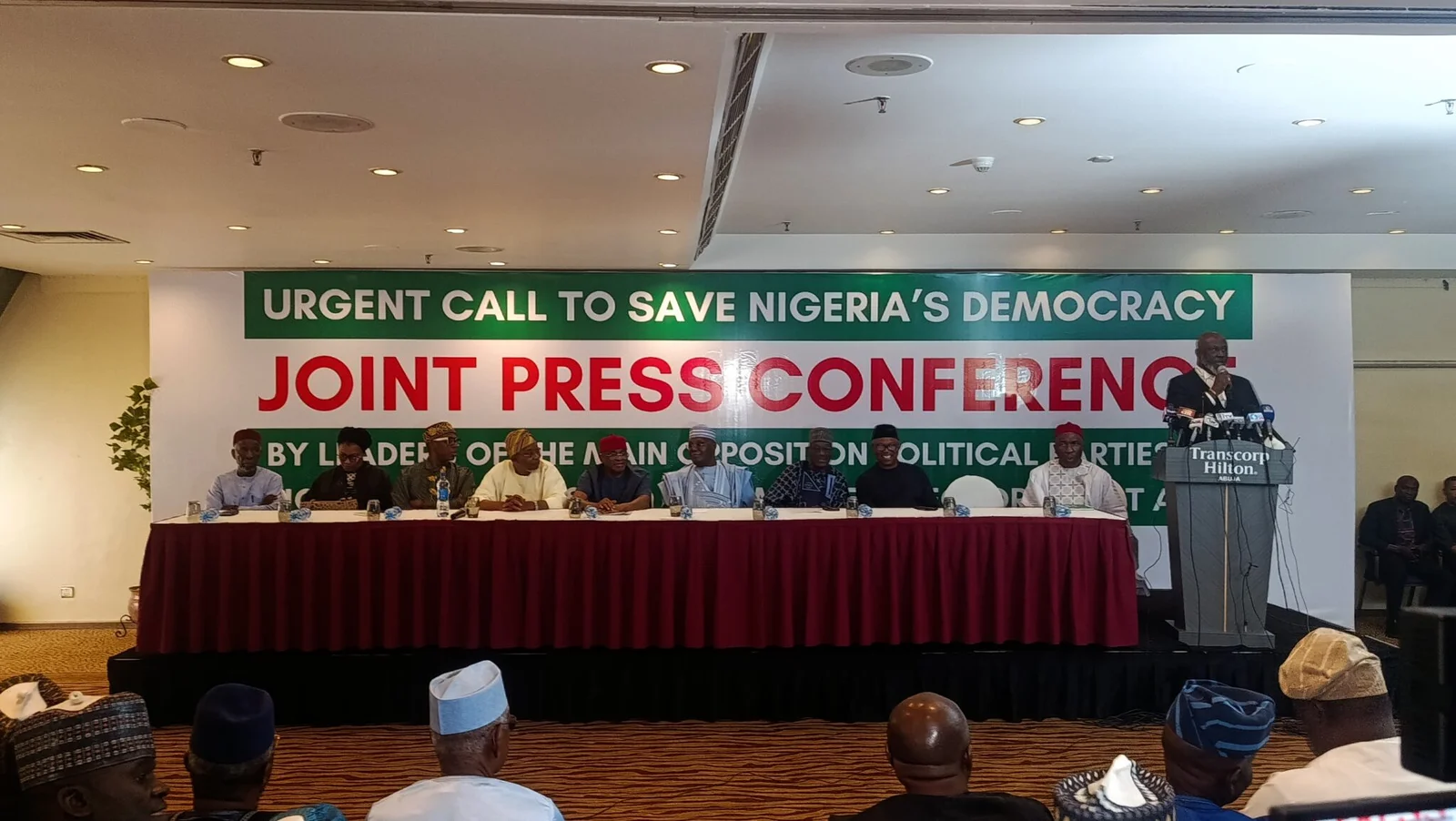
Major opposition political parties in the country have said several provisions of the Electoral Act amendment Bill 2026 signed into law by President Bola Tinubu on Feb. 18 were an attempt to subvert the will of the people in the 2027 general elections and install a one-party state.
The leaders of the opposition parties said this at a joint news conference in a speech read on their behalf by the National Chairman of New Nigeria People’s Party (NNPP), Dr Ahmed Ajuji.
The opposition parties described the new Electoral Act as “anti-democratic” while demanding that the National Assembly immediately commence a fresh amendment to reflect the yearnings of Nigerians.
Ajuji said that the opposition considered several provisions of the Electoral Act amendment Bill 2026 signed into law by President Bola Tinubu on Feb. 18 as an attempt to subvert the will of the people in the 2027 general elections and install a one-party state.
According to him, the implementation of the new Act will undermine electoral transparency and the sanctity of the ballot, both of which are fundamental to free, fair and credible elections and the bedrock of participatory democracy.
“Therefore, we, as patriotic leaders, standing shoulder to shoulder with Nigerians, reject the new Electoral Act,” he said.
Ajuji said the opposition parties were concerned over Section 60(3) which grants “undefined discretionary powers” to presiding officers regarding the electronic transmission of results.
He said that the section negates the purpose of introducing electronic transmission of election results from polling units.
“This negation is unambiguously intended to provide a blank cheque to those who seek to manipulate election results by delaying the electronic transmission of results from the polling units to the INEC Results Viewing Portal (IREV) on the pretext of network failure.
“The premise of the proviso in Section 60(3) is the unavailability or possibility of network failure. We find this premise dubious and inconsistent with reality,” he said.
Ajuji cited data from the Nigerian Communications Commission (NCC) that indicates over 95 per cent 2G coverage across the country.
He added that the immediate past INEC Chairman, Prof. Mahmud Yakubu, had once said that the Bimodal Voter Accreditation System (BVAS), which operates offline, had worked with over 90 per cent success rate across the nation.
“Yakubu also noted that in the event of network failure at the point of transmission, the transmitted results would be delivered successfully whenever network is available,” he said.
Ajuji said that the opposition also rejected the provision in Section 84 which limits political parties to direct primaries and consensus for the selection of candidates.
He described the move as an “overreach” on the constitutionally-guaranteed autonomy of political parties, alleging it was designed to cause chaos within the opposition ranks ahead of 2027.
He insisted that the mode of nominating candidates should be strictly the internal affairs of political parties.
“The National Assembly cannot hide under the provision of Section 228(b) of the Constitution to restrict political parties to only two methods of nomination.
“There is nothing undemocratic about indirect primaries which create an electoral college for the selection of candidates in an objective, transparent and orderly manner.
“As a matter of fact, recent experience has shown that indirect primaries have been the most democratic of the trio provided in all the past Electoral Acts,” he said.
The NNDP national chairman said there were many instances where, during direct primaries, the winning candidates were allocated votes that eventually exceeded the total number of votes cast in the subsequent general elections.
Ajuji said that the opposition leaders had vowed to explore all constitutional means to challenge the Act, urging civil society groups and Nigerians to join them in “saving the nation’s democracy.”
He also condemned the recent Federal Capital Territory (FCT) Area Council elections, describing the process as a test-run for what Nigerians should expect in the 2027 general elections.
Highlighting the issue of voter apathy, Ajuji noted that the low turnout in recent elections signified a “gradual erosion of people’s confidence” in the electoral system.
“We believe that the only solution to voter apathy is to convince the people once again that their votes will not be stolen and elections would not be manipulated.
“But more importantly, for the government to truly commit to improving the lives of citizens so people can believe that democracy comes with real benefits,” he said.
Ajuji said that the opposition equally decried the recent attack on leaders of the African Democratic Congress (ADC) in Edo, reiterating that no political grievance could justify the use of violence, the shedding of blood and killing of citizens.
Ajuji, while noting that Nigeria judiciary was in dire need of reform and deep cleansing, called on the on the arm of government to reclaim its independence.
“Electoral outcomes must be decided by the people, and not the courts.
“The judiciary must, therefore, re-discover its capacity for impartiality and neutrality, and regain the intrinsic trust of citizens in its judgments,” he said.
Also speaking, former Vice-President Atiku Abubakar, said that the speech delivered at the conference would be sent to all embassies in Nigeria.
Abubakar, an ADC leader, called on all other opposition parties yet to join the movement to do so in the interest of Nigeria’s democracy.
“In the event, we must succeed to restore true democracy in Nigeria. That was what we all fought for,” he said.
The ADC National Chairman, Sen. David Mark, also assured Nigerians that the opposition would stand for the truth as well as free and fair election.
“The questions we need to ask are: What is the problem with real time transmission of election results? Why did the National Assembly dabble into the mode of primaries for political parties?” he queried.
A former Minister of Transportation, Rotimi Ameachi, called on the opposition parties to wake up and not to give in to the antics of the ruling party.
He said that the ruling party or Mr President was not the problem of the country, but the opposition that needed to come together.
The Labour Party 2023 presidential candidate, Peter Obi, now an ADC leader, also emphasised the need for opposition parties ‘to come together and save Nigeria’s democracy’.
Other opposition leaders at the news conference were former Governors Rauf Aregbesola and Liyel Imoke of Osun and Cross River, Sen. Ireti Kingibe, Secretary of NNPP Board of Trustees, Buba Galadima and the immediate past National Chairman of ADC, Ralph Nwosu.
(NAN)
Comments