


Between IGP Disu and DIG Mba: A Personal Reflection

 Quick Read
In some quarters, a narrative of over‑ambition is being projected onto Mba. From my vantage point, this is far from the truth. Both men are professionals who have served the Republic with distinction. However, in the tradition of the Force, when a junior or a peer is elevated to the pinnacle, veterans often consider “leaving the stage while the ovation is loudest.” This is not a sign of failure but a mark of ultimate sacrifice for institutional harmony. Whether Mba continues to serve under this new dispensation or seeks a new horizon, his legacy as Nigeria’s most effective communicator in uniform is already secure.
By Yushau A. Shuaib
“Disu has saved many lives, especially those of youths and young graduates, who could have found themselves either as victims or engaged in fraud and other criminal activities.”
Those words were not written today. They are a direct quote from my August 2021 article, “Abba Kyari: The Celebrated Super Cop and the Unsung Heroes.” In that piece, I examined the meteoric rise of Abba Kyari—a man whose celebrity status, amplified by media hype and institutional indulgence, ultimately became his undoing. I argued then that fame and public adulation, when not tempered by institutional discipline, can become a dangerous liability for any security officer.
In contrast to the “Super Cop” phenomenon, I highlighted a cadre of “Unsung Heroes”—officers who carried out high‑stakes, dangerous operations with quiet efficiency and no appetite for publicity. Among them were AIG Bala Ciroma, known for discreet but effective interventions; CSP Olabisi Davies, a disciplinarian female DPO who patrolled at night and rehabilitated young offenders; DCP Kolo Yusuf, who captured over 100 kidnappers yet declined award nominations, recommending his junior officers instead; twin officers Hassan and Hussaini Gimba, famed for expert interrogations and recovering sophisticated weapons from bandits; and a then‑DCP Tunji Disu, who had emerged as Kyari’s successor at the Intelligence Response Team (IRT). Disu’s approach was defined not by media theatrics but by preventive impact—saving young people from drifting into crime rather than amplifying his exploits.
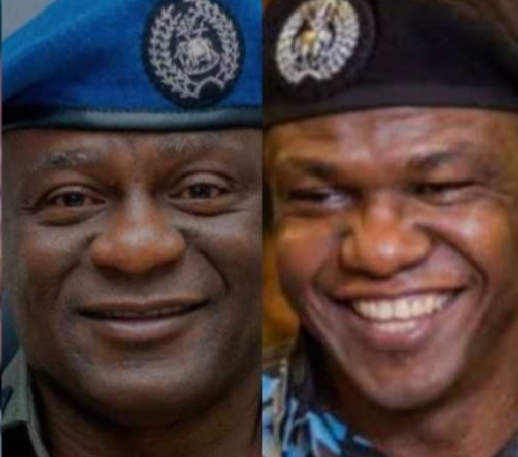
Today, as Tunji Rilwan Disu assumes office as Acting Inspector‑General of Police, and as public debate swirls around the fate of DIG Frank Mba—the most senior Deputy Inspector‑General—it is necessary, from a public relations standpoint, to offer context.
It is a remarkable coincidence that both Tunji Disu and Frank Mba joined the Nigeria Police Force on the same day: May 18, 1992. Both men represent a rare breed of “scholar‑practitioners”—officers who have balanced the rigours of operational command with serious academic pursuit.
Disu is not merely an operational tactician; he is also a trained martial artist and a disciplined strategist. His academic profile includes an MSc in Entrepreneurship (2023), an MSc in Criminology and Security Studies (2022), and a Bachelor’s degree in English Education (1990). His assignments have ranged from transforming the Lagos RRS into a model anti‑crime unit, to leading the Intelligence Response Team after Kyari’s suspension, to serving as Commissioner of Police in Rivers State and the FCT, and most recently as AIG in charge of the Force CID Annex, Alagbon.
Frank Mba’s academic trajectory is equally formidable: an LLB (Hons) from the University of Lagos, an LLM from the University of Dundee, his call to the Nigerian Bar in 2002, and a recently defended PhD thesis at the University of Ibadan. He served three times as Force PRO and held key operational roles including Commissioner of Police in Ogun State and the Border Patrol Force, as well as AIG at the FCID Annex. His international service in the United Nations Peacekeeping Mission in Liberia earned him a UN Medal.
My professional relationship with Frank Mba dates back to the formative days of the Forum of Security and Response Agencies (FOSSRA), established in 2013 under the Office of the National Security Adviser, then chaired by Major General Chris Olukolade (Rtd). At that time, inter‑agency rivalry—particularly between the police, the military, and the NSCDC—often resulted in conflicting public narratives during national crises.
It was Mba, as Force Public Relations Officer, alongside interventions from then‑Customs spokesperson (now Comptroller‑General) Adewale Adeniyi, who helped align institutional messaging. For a period, security agencies spoke with one voice during national emergencies—a rare but reassuring development in Nigeria’s security communication landscape.
Beyond his intellectual depth, Mba is disarmingly humorous—a trait that often diffuses tension in difficult moments. During my own challenging period at NIPSS, he showed quiet concern and support. I have never perceived him as driven by reckless ambition. If anything, he understood the weight of perception in public service.
My first encounter with the new IGP Disu began on a somber note in 2017. I watched him handle a disturbing case in Lagos, where a group of innocent young men were on the verge of being framed for an offence they knew nothing about while he served as Commander of the Rapid Response Squad (RRS). Disu did not merely order an investigation; he took a bold personal risk to protect them and later spent his own resources to rehabilitate their lives. The then spokesperson to Governor Akinwunmi Ambode, Habib Haruna Life, was fully aware of those interventions and humanitarian gestures. It is therefore unsurprising that many beneficiaries of his quiet benevolence—within Nigeria and abroad—have been reaching out to express their gratitude following his elevation.
Since his decoration, IGP Disu has signalled a reform agenda anchored on discipline and human rights. His rise is a testament to the fact that one does not need to be a “Super Cop” on social media to become the “First Cop” of the nation.
In the world of Public Relations, we believe that the brand of an institution is only as strong as the unity of its leadership. As Disu takes the reins, a question lingers about the seniority of DIG Frank Mba and other coursemates.
In some quarters, a narrative of over‑ambition is being projected onto Mba. From my vantage point, this is far from the truth. Both men are professionals who have served the Republic with distinction. However, in the tradition of the Force, when a junior or a peer is elevated to the pinnacle, veterans often consider “leaving the stage while the ovation is loudest.” This is not a sign of failure but a mark of ultimate sacrifice for institutional harmony. Whether Mba continues to serve under this new dispensation or seeks a new horizon, his legacy as Nigeria’s most effective communicator in uniform is already secure.
IGP Disu has the vision; he now needs the support of his peers to translate that vision into a safer Nigeria. He has already signalled a reform agenda centred on discipline, human rights compliance, and anti‑corruption measures. For that agenda to succeed, he will require not only the cooperation of subordinates but the goodwill of peers and seniors alike.
Institutional maturity demands that when the ovation is modest, one exits with dignity—and when leadership beckons, one accepts with humility. The challenge now is not who rises or who retires. It is whether the institution rises above ego, perception, and speculation.
Yushau A. Shuaib is the author of* “An Encounter with the Spymaster “and can be reached via [email protected].
—
Comments