



Davos 2026: Infrastructure and Inclusion Overtake Crypto Speculation

 Quick Read
While headlines at Davos may focus on political posturing and strategic reserves, the enduring legacy of this era will likely be the integration of blockchain as a boring, reliable backend for the global economy. The normalization of digital assets means they are ceasing to be a novelty and starting to function as they were intended: as an inclusive, efficient layer of the global financial stack.
While price action and political speeches often dominate the airwaves, the defining narrative of the 2025-2026 cycle is not found in chart candles but in the efficiency gap that cryptocurrency is finally closing.
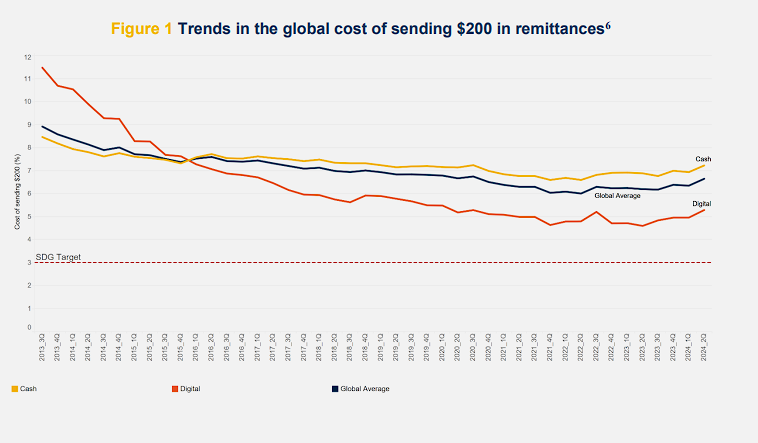
Friction has defined the global financial system for decades. The World Bank reports that sending remittances still costs a global average of 6.65%, while fees for smaller transfers often jump to between 15% and 20%. These costs effectively act as a tax on populations.
Financial leaders at the World Economic Forum in Davos seemed to ignore the speculation that once defined crypto events. On the one hand, political speeches definitely captured the headlines. But the real dialogue focused on utility and regulatory frameworks.
Binance’s trajectory mirrors this broader trend. The company’s data shows how crypto is becoming a core component of the global financial infrastructure instead of serving as the primary tool for speculation.
Looking Behind the Headlines
President Donald Trump’s special address defined the macro-political atmosphere at Davos 2026. His push to position the US as the crypto capital and establish a strategic Bitcoin reserve fueled media coverage and bullish market sentiment. However, industry veterans know the actual progress is happening away from the cameras. While reserves dominate political debate, market participants are executing on utility and integration.
Binance Co-CEO Richard Teng highlighted this evolution when discussing the industry’s path forward during Davos, “Crypto is no longer just an asset class, it’s becoming financial infrastructure,” Teng noted. “Bitcoin ownership is shifting from retail to institutions, with exchange-held BTC at a five-year low and institutional holdings rising, signaling reduced volatility and more stable market cycles.”
Much of this stability stems from clearer regulations. Legislation such as the GENIUS Act and the CLARITY Act has provided the necessary guardrails for traditional finance to engage. Institutions are moving from tentative pilot programs to full operational workflows, validated by clear rules of engagement.
Capital flow data confirms this trend. JPMorgan analysts estimate that nearly $130 billion entered digital assets in 2025, which is a figure driven primarily by institutions rather than retail speculators. This volume indicates the market has left its wild west era for a phase of structured growth. And regulatory clarity encouraging larger players to deploy capital.
Solving the Remittance Crisis
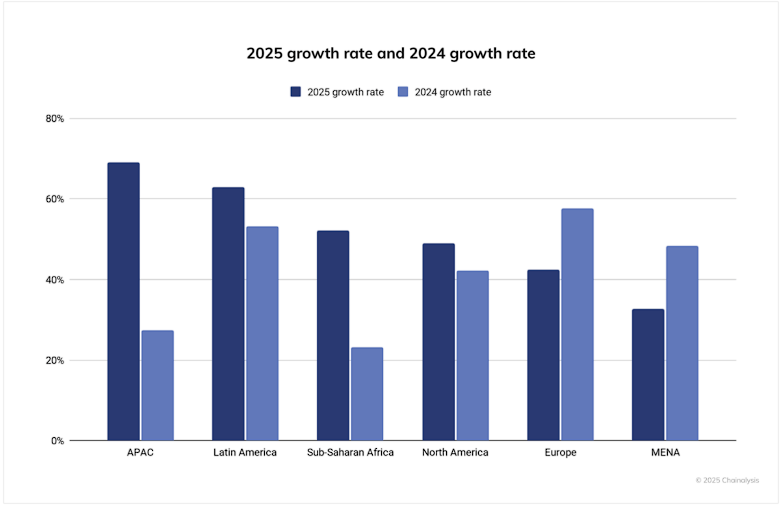
Cross-border payments show the clearest impact of this maturation as traditional banking rails remain slow and costly. They create friction that hits emerging economies the hardest. The Chainalysis 2025 Global Adoption Index shows grassroots usage peaking in India, Pakistan, and Vietnam. These are all markets where crypto serves as a necessary tool for value transfer rather than just a trading vehicle.
Binance’s own data reflects this utility. From 2022 to 2024, the platform handled $26 billion in user-to-user crypto remittances. By using blockchain rails instead of traditional methods, users saved an estimated $1.75 billion in fees.
This utility also has a distinct demographic impact. Over 500,000 female users sent more than $4 billion in crypto remittances in 2024 alone. Digital assets are bypassing systemic barriers to provide direct financial access in a world where nearly 2.4 billion women globally do not have the same economic rights as men.
For users in emerging markets, stablecoins and crypto assets are often tools for capital preservation against currency devaluation and a means to avoid predatory transaction fees—rather than instruments of speculation.
Institutional Infrastructure & Market Maturity
For mass adoption to take hold, the backbone of the financial system must be accessible and robust. It is not enough to build the technology; the industry must also build the user base’s capacity to navigate it.
In the company’s end-of-year report, Binance CMO Rachel Conlan stressed the importance of user literacy, “If crypto is going to reach the next billion users, education must evolve alongside the product,” Conlan stated. “This commitment ensures that as the ecosystem grows, users have access to high-quality, accessible education that empowers them to participate confidently and responsibly.”
Professionalization is evident in the data. Wintermute’s 2025 OTC report highlights a concentration of liquidity in BTC and ETH and this behavior aligns with institutional strategies that prioritize precision over fleeting market trends.
Complementing this trend, Binance recorded a 21% year-on-year growth in institutional trading volume and a significant 210% surge in OTC fiat trading volume. This data supports the thesis of a “convergence” where traditional finance and decentralized finance merge. The fact that Binance became the first global exchange to secure full authorization under the ADGM framework further solidifies the role of regulated entities in bridging these two worlds.
A New Era of Financial Pragmatism
Crypto’s adolescence appears to be ending in the 2025-2026 cycle. With the US passing the GENIUS and CLARITY Acts (in the House) and the industry recording $1.75 billion in remittance fee savings, the sector is pivoting decisively toward pragmatism. Major institutional capital is no longer testing the waters; it is building the harbor.
While headlines at Davos may focus on political posturing and strategic reserves, the enduring legacy of this era will likely be the integration of blockchain as a boring, reliable backend for the global economy. The normalization of digital assets means they are ceasing to be a novelty and starting to function as they were intended: as an inclusive, efficient layer of the global financial stack.
Comments