


Sanwo-Olu declares Lagos living proof of Africa’s vast economic possibilities

 Quick Read
According to him, the state has accelerated the development of a multimodal transport system, including the commencement of passenger operations on the Blue Line Rail and the inauguration of the Red Line Rail, alongside investments in roads, bridges, bus reforms and water transport.
Governor Babajide Sanwo-Olu has declared that Lagos stands as a powerful symbol of Africa’s potential, saying the megacity demonstrates how sub-national governments can drive economic growth and global influence.
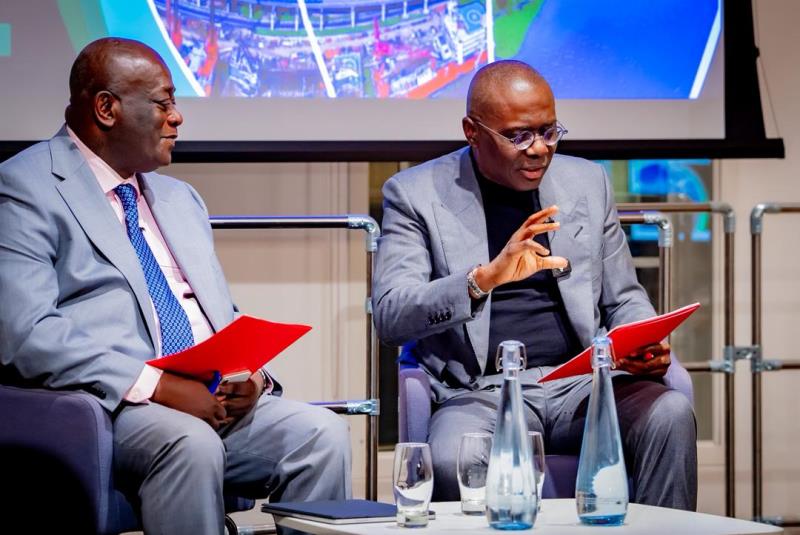
Speaking at Africa Week 2026 hosted by King’s College London in the United Kingdom, the governor described Lagos as one of the continent’s most economically consequential urban centres despite occupying a small fraction of Nigeria’s landmass.
Sanwo-Olu said Lagos had evolved into Africa’s second-largest city economy, with an estimated GDP of about $259 billion on a purchasing power parity basis, making it Nigeria’s principal commercial gateway and a major destination for investment, enterprise and talent.
Addressing participants at the closing ceremony of the event organised by the African Leadership Centre, the governor noted that Lagos has shown how policy, innovation and enterprise can combine to shape not only local development but also regional and global economic conversations.
He said the theme of the conference, “Exercising Agency beyond the Nation-State: Debating Change and Transformation in the Global City, Lagos,” was particularly relevant at a time when cities are increasingly influencing development outcomes beyond national governments.
Sanwo-Olu pointed to Lagos’ emergence as Nigeria’s technology hub, noting that the city hosts over 2,000 startups and has produced five unicorns in fintech and digital commerce, while recently being ranked among the world’s fastest-growing technology ecosystems.
According to the governor, his administration’s development philosophy since assuming office in 2019 has been to treat Lagos not as a challenge to be managed but as a platform to be unlocked.
He said this vision is reflected in the state’s THEMES+ agenda, which focuses on transport and traffic management, health and environment, education and technology, urban development, tourism, security, governance, and social inclusion.
Sanwo-Olu said the framework has guided Lagos through multiple global shocks, including the COVID-19 pandemic, rapid population growth, climate risks and a significant infrastructure financing gap.
He noted that transport reform has remained central to the government’s strategy to improve productivity and urban mobility.
According to him, the state has accelerated the development of a multimodal transport system, including the commencement of passenger operations on the Blue Line Rail and the inauguration of the Red Line Rail, alongside investments in roads, bridges, bus reforms and water transport.
“These are not isolated projects but part of a deliberate attempt to transform how a city of Lagos’ scale functions,” he said.
The governor also listed key achievements of his administration, including the delivery of over 3,000 affordable housing units, deployment of 250 patrol vehicles to strengthen security operations, and acquisition of 62 fire trucks to enhance emergency response capacity.
He added that the state has also invested in education infrastructure and food security initiatives, including the Imota Rice Mill, while strengthening logistics and supply systems.
Sanwo-Olu further disclosed that Lagos’ 2026 budget of ₦4.44 trillion reflects the government’s determination to continue investing in infrastructure, social services and economic competitiveness.
He said Lagos accounts for a significant share of capital importation and internally generated revenue in Nigeria, noting that a strong Lagos ultimately strengthens the national economy.
The governor also spoke on the importance of the creative economy, describing culture as an essential driver of economic growth in the state.
According to him, industries such as music, film, fashion, design and digital content have turned Lagos into a major creative hub, with Nollywood and the global success of Nigerian musicians projecting African creativity on the global stage.
Sanwo-Olu also stressed the urgency of climate resilience, warning that rising sea levels, flooding and rapid urbanisation pose significant challenges for coastal cities like Lagos.
He said the state launched the Lagos Climate Adaptation and Resilience Plan in 2024 and has continued to pursue climate-focused investments, including green bonds and projects in drainage, waste management, clean mobility and solar energy.
The governor said Africa’s future development would depend on stronger collaboration between governments, cities, investors, universities and development partners.
“Effective leadership today must be distributed across multiple levels,” he said, adding that cities must play a critical role in shaping economic and social transformation across the continent.
Sanwo-Olu said Lagos would continue to work with private investors, multilateral institutions and academic partners to build a resilient city capable of sustaining Africa’s future growth.
Comments