


Ramadan: Lagos deputy governor urges repentance, moral renewal

 Quick Read
According to him, Islam teaches that one cannot be a good Muslim unless one’s neighbours can live and sleep in peace.
By Oluwatope Lawanson
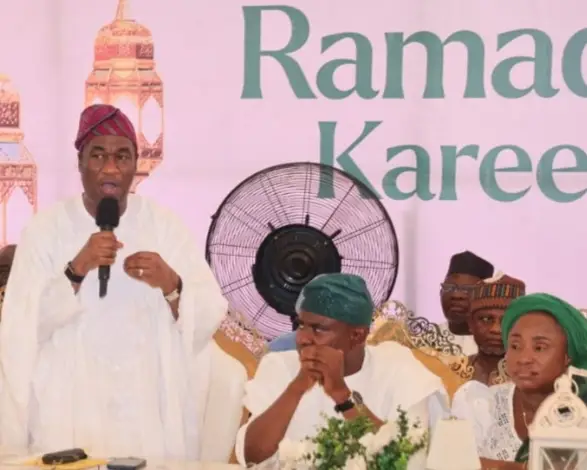
Lagos State Deputy Governor, Dr Obafemi Hamzat, has urged Nigerians to use the fasting period for repentance, moral reflection and restoring family values.
Hamzat spoke on Sunday at the 19th Annual Ramadan Lecture organised by Mr Abdul-Kabir Ogungbo, Special Adviser on Taxation and Revenue, in honour of his late parents.
The lecture, with the theme ‘Divine Justice: Repentance, Restitution and Re-Alignment’, was held in Ibeju-Lekki, Lagos, attracting religious leaders, community members and government officials.
According to him, true peace in society begins when individuals obey God’s teachings and treat neighbours with respect and compassion.
“For me, repentance and restitution are very important. It is not when you are about to die that you should seek repentance from God.
“When you still have the strength and energy, repent and stop whatever wrong you are doing,” Hamzat said.
He noted that insecurity and distrust persisted because many people ignore the teachings of the Qur’an, the Bible and shared societal values.
According to him, Islam teaches that one cannot be a good Muslim unless one’s neighbours can live and sleep in peace.
Hamzat added that respecting others and avoiding actions that disturb them were essential for harmony and societal wellbeing.
He emphasised the role of parents in guiding children to distinguish between right and wrong and to respect elders.
Hamzat urged parents to instil discipline and moral values in their children to help build a responsible future generation.
He also called on fathers to fulfil their responsibilities by providing for their families and offering proper moral guidance.
“If we do this, our society will be stronger and more peaceful,” he said.
Earlier, Ogungbo said the Qur’an reminds believers that Allah commands justice, fairness and accountability in all human affairs.
According to him, justice in Islam is not merely legal but a moral and spiritual duty guiding relationships between humans and Allah, and among people. (NAN)
Comments