


Nigeria’s Inflation falls to 15.06% but monthly cost surge sparks concern

 Quick Read
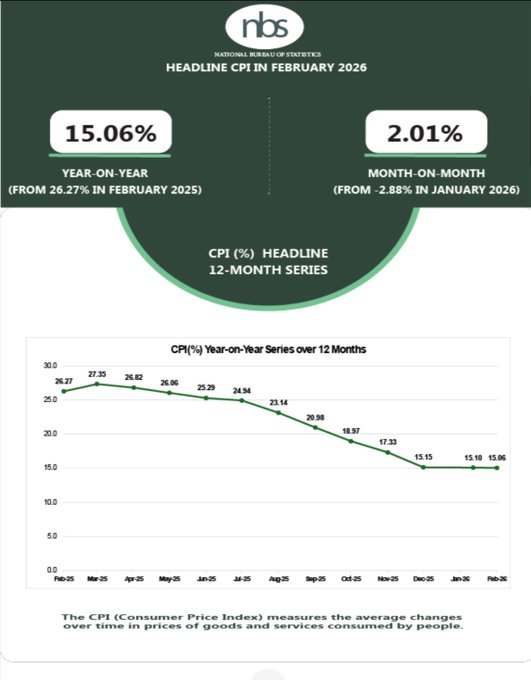
The NBS noted that on a year-on-year basis, inflation showed a significant decline compared with the 26.27 per cent recorded in February 2025, reflecting a reduction of 11.21 percentage points over the 12-month period.
By Kazeem Ugbodaga
Nigeria’s headline inflation rate moderated slightly in February 2026, easing to 15.06 per cent, according to the latest Consumer Price Index (CPI) report released by the National Bureau of Statistics (NBS).
The figure represents a marginal decline of 0.04 percentage points from the 15.10 per cent recorded in January 2026, indicating a modest slowdown in the general rise in consumer prices.
The NBS noted that on a year-on-year basis, inflation showed a significant decline compared with the 26.27 per cent recorded in February 2025, reflecting a reduction of 11.21 percentage points over the 12-month period.
Despite the slight easing in the headline rate, the report indicated that price pressures intensified on a month-on-month basis.
The inflation rate in February stood at 2.01 per cent, which was 4.89 percentage points higher than the –2.88 per cent recorded in January 2026.
The NBS explained that this means the average price level rose faster in February than it did in January, signalling renewed short-term pressure on the cost of goods and services.
Further analysis of the CPI data showed that the average inflation rate for the twelve months ending February 2026 increased to 21.03 per cent, representing a 3.02 percentage point rise compared with 18.01 per cent recorded in February 2025.
Disaggregated data revealed that urban inflation stood at 15.53 per cent year-on-year in February 2026, which was 12.96 percentage points lower than the 28.49 per cent recorded in February 2025.
On a month-on-month basis, however, urban inflation rose to 2.55 per cent, representing an increase of 5.27 percentage points compared with the –2.72 per cent recorded in January 2026.
The 12-month average urban inflation rate was 21.25 per cent in February 2026, 1.81 percentage points higher than the 19.44 per cent recorded in February 2025.
For rural areas, the inflation rate in February 2026 was 13.93 per cent on a year-on-year basis, which was 8.80 percentage points lower than the 22.73 per cent recorded in February 2025.
On a month-on-month basis, rural inflation rose to 0.71 per cent, an increase of 4.00 percentage points compared with the –3.29 per cent recorded in January 2026.
The 12-month average rural inflation rate stood at 20.28 per cent in February 2026, representing a 3.80 percentage point increase from the 16.47 per cent recorded in February 2025.
Overall, the NBS report indicates that while Nigeria’s inflation has slowed significantly compared with the same period last year, short-term price pressures remain evident, particularly in monthly price movements across both urban and rural areas.
Comments