


Bizarre! Trump celebrates ex-FBI Director Mueller’s death: ‘I’m glad he’s dead’’

 Quick Read
"Robert Mueller just died. Good, I'm glad he's dead. He can no longer hurt innocent people!" Trump wrote on Truth Social.
By Kazeem Ugbodaga
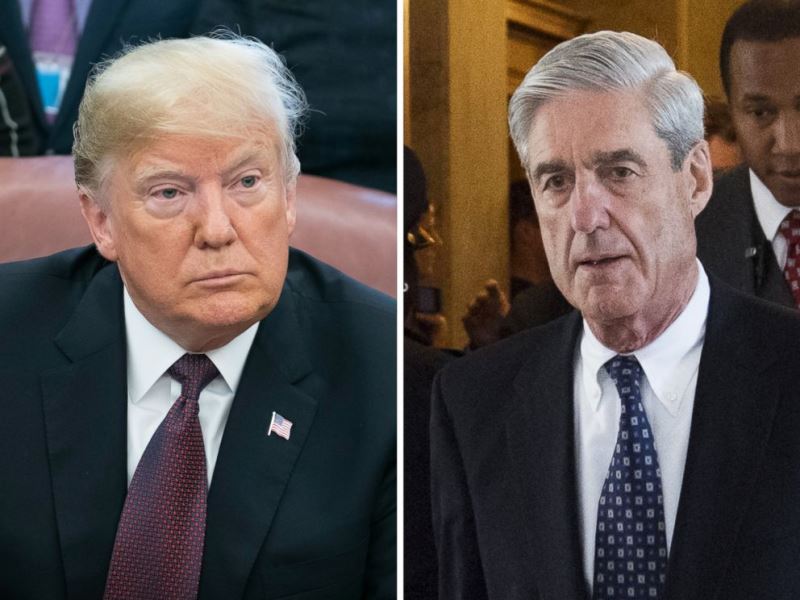
President Donald Trump marked the death of former FBI Director and Special Counsel Robert S. Mueller with a caustic social media post on Saturday, writing “Good, I’m glad he’s dead” just hours after the family announced Mueller had died at age 81.
“Robert Mueller just died. Good, I’m glad he’s dead. He can no longer hurt innocent people!” Trump wrote on Truth Social.
The post concluded with “President DONALD J. TRUMP” in all caps.
Mueller died on Friday night, his family said in a statement released Saturday. No cause of death was given, though Mueller had been diagnosed with Parkinson’s disease in 2021 and retired from public life the following year.
“With deep sadness, we are sharing the news that Bob passed away last night,” the family statement read. “His family asks that their privacy be respected.”
Trump’s reaction drew immediate condemnation across social media platforms. Critics described the post as “truly awful” and “disgusting,” with one commentator calling it “moral bankruptcy on full display.”
Mueller’s legacy is defined by two transformative periods in American public life. As FBI director from 2001 to 2013-the second-longest tenure in the bureau’s history after J. Edgar Hoover, he took office just one week before the September 11 attacks and oversaw the agency’s historic shift from domestic crime-fighting to counterterrorism.
Under his leadership, the bureau reassigned 2,000 agents to national security and underwent what he later called “long-term, strategic change” to meet 21st-century threats .
But it was his second act in public service that cemented his place in contemporary political history. Appointed special counsel in May 2017 by Deputy Attorney General Rod Rosenstein, eight days after Trump fired FBI Director James Comey, Mueller was tasked with investigating Russian interference in the 2016 election and any links between the Trump campaign and Moscow.
The 22-month investigation produced 37 indictments, seven guilty pleas or convictions, and a 448-page report that documented what U.S. intelligence agencies described as a sweeping Russian campaign of hacking and propaganda designed to boost Trump’s candidacy and harm Democratic opponent Hillary Clinton.
The report detailed numerous contacts between Trump campaign associates and Russians but did not establish a criminal conspiracy .
On the question of obstruction of justice, Mueller’s report offered a conclusion that fueled political debate for years: “If we had confidence after a thorough investigation of the facts that the president clearly did not commit obstruction of justice, we would so state. Based on the facts and the applicable legal standards, we are unable to reach that judgment.”
Mueller declined to indict Trump, citing longstanding Justice Department policy that a sitting president cannot face criminal charges. But he explicitly noted that his report “does not exonerate” the president, a distinction Trump has repeatedly obscured in the years since.
The investigation became a constant target of Trump’s public wrath. During Mueller’s tenure, Trump repeatedly denounced the probe as a “witch hunt,” a “scam,” and a “hoax,” language he revived in Saturday’s post celebrating Mueller’s death.
Mueller maintained a strict public silence throughout the investigation, holding no news conferences and making no public appearances even as Trump and his allies attacked his credibility. His demeanour, described by colleagues as “stern” and “taciturn” matched the gravity of the investigation he quietly conducted for nearly two years.
A decorated Vietnam War veteran, Mueller enlisted in the Marines in 1968, serving as a rifle platoon leader and earning a Bronze Star with “V” for valor, a Purple Heart, and two Navy Commendation Medals. He later called his military service the proudest time of his life.
Before leading the FBI, Mueller built a career as a federal prosecutor in San Francisco and Boston, later heading the Justice Department’s criminal division, where he oversaw high-profile prosecutions of Panamanian dictator Manuel Noriega and New York crime boss John Gotti.
His 12-year FBI tenure was not without controversy. The bureau faced criticism over surveillance practices and struggled with costly technology failures. But Mueller also earned bipartisan respect for his independence, famously standing with then-Deputy Attorney General James Comey in a 2004 hospital confrontation with Bush administration officials over a warrantless wiretapping program they considered unlawful.
In his final years, Mueller retreated from public view. His family disclosed his Parkinson’s diagnosis in August 2025, noting he had retired from law practice at the end of 2021 and taught briefly at his University of Virginia law school alma mater in 2021 and 2022.
The reaction to Trump’s post revealed the deep divisions Mueller’s investigation carved into American politics, divisions that appear no closer to healing with his death.
“Robert Mueller was a national treasure. Trump is a con man and an idiot,” one person posted on X. “Every Republican needs to stand up for Mr. Mueller.”
Mueller is survived by his wife, Ann Cabell Standish, whom he married in 1966, and their two daughters.
Funeral arrangements have not been announced.
Comments