



Trump, the Pope and the Strait

 Quick Read
It has been 46 days since the US-Israel war with Iran began in the Middle East on February 28, plunging the world into fresh anxiety and gradually evolving into a broader clash of civilisations marked by bloodshed, destruction, regional tension and a grave assault on diplomacy and global peace.
By Reuben Abati
It has been 46 days since the US-Israel war with Iran began in the Middle East on February 28, plunging the world into fresh anxiety and gradually evolving into a broader clash of civilisations marked by bloodshed, destruction, regional tension and a grave assault on diplomacy and global peace. When a two-week ceasefire was announced on April 7, the relief was immediate. Benchmark Brent crude and US West Texas Intermediate fell below $100 per barrel, while Japan’s Nikkei 225, South Korea’s Kospi and major US indices all rose, lifting investor confidence. Reports that the US and Iran had agreed to send delegations for Pakistan-brokered talks in Islamabad added to the optimism. War is never a bargain for anyone, and, as this Middle East conflict has shown, its consequences often extend far beyond the battlefield.
Over the weekend, however, the Islamabad talks collapsed. The American delegation, led by Vice President JD Vance, walked away, while the Iranian side, headed by Parliament Speaker Mohammed Ghalibaf, insisted Tehran would not “surrender under threats”. What had been projected as a swift military campaign, dubbed Operation Fury by the US and Operation Rising Lion by Israel, is now turning into a prolonged and costly confrontation. Wars may be easy to start, but no one can predict with certainty how or when they will end. The talks were always unlikely to succeed. There was no trust among the parties, little common ground between the Americans’ 15-point proposal and Iran’s 10-point counter-plan, and the negotiations themselves took place amid continued Israeli bombardments in Lebanon, escalating hostilities across the region and a glaring absence of good faith. It was, in essence, a conversation conducted under the shadow of bombs, drones and guns.
Iran accused the United States of “maximalism, shifting goalposts, and threat of blockade”, while President Donald Trump blamed the failure of the talks on Tehran’s refusal to abandon its nuclear ambitions. By Sunday evening, threats were already escalating. Trump vowed to block the entire Strait of Hormuz and Iran’s coastline, barring vessels from entering or leaving by 10:00 ET on Monday. Yesterday, US Central Command enforced that order, warning that unauthorised vessels would be subject to interception, diversion and capture. The USS Abraham Lincoln aircraft carrier has since been positioned at the edge of the Gulf of Oman, backed by the destroyers USS Frank E. Petersen Jr and USS Michael Murphy. The conflict has clearly entered a more dangerous phase. Iran’s Parliament speaker has responded with equal defiance: “If they fight, we will fight.”
The Islamic Revolutionary Guard Corps has also threatened to destroy any military vessel approaching the Strait of Hormuz. The international community, meanwhile, is calling for freedom of navigation, with the overriding concern centred on the global oil supply and the economic consequences of any prolonged disruption. There are no easy answers. Much will depend on whether the blockade proves effective, how long it lasts, whether shipping disruption intensifies, and whether diplomacy can still be revived. Pakistani Prime Minister Shehbaz Sharif, who has sought to mediate, says efforts are continuing, but it remains unclear whether diplomacy can make any meaningful difference in the immediate term. Iran insists on its sovereignty over the Strait, while Trump argues Tehran must stop collecting tolls and extorting vessels, signalling a strategy aimed at choking a key source of Iranian revenue and forcing its leaders back to the negotiating table. Yet Trump also says he does not care whether Iran returns to talks or not. That is a dangerous posture. In truth, it is very much in his interest to keep the diplomatic door open.
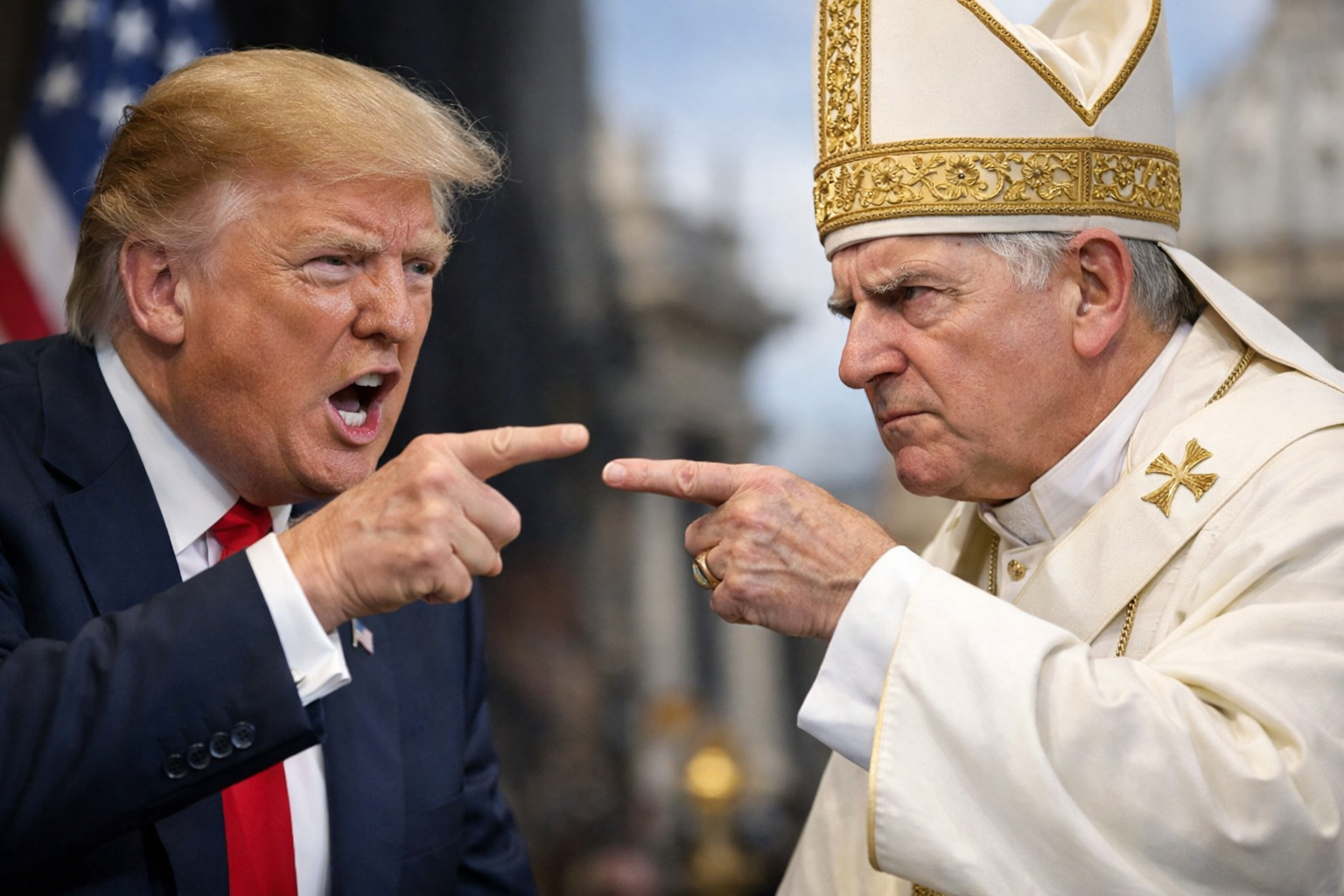
Trump is already under pressure at home, where his popularity is slipping ahead of the crucial November midterm elections. Abroad, his position is weakening as well. Countries across Asia, the European Union and the United Kingdom have opposed the blockade, warning of the enormous risks involved. Would the United States attack or detain Chinese vessels, or ships linked to Russia, India or Pakistan? The world is watching nervously. In such a moment, more voices of reason are needed. Pakistan has tried and intends to keep trying. Pope Leo XIV has emerged as perhaps the most forceful moral voice in the crisis, but even he has not escaped Trump’s ire. Trump’s remarks towards the Pope have been astonishingly disrespectful, evoking the kind of disdain once associated with dictators such as Joseph Stalin.
Pope Leo XIV, the first American Pontiff, has consistently called for peace since Easter and urged those driving the region towards catastrophe to abandon what he described as “the madness of war”. Trump, however, fired back, telling the Pope to “focus on being a great Pope, not a politician”. He even suggested Leo should be grateful, claiming that without him in the White House, Leo would not be in the Vatican. Trump further accused the Pope of being weak on crime, nuclear weapons and foreign policy. Pope Leo, currently on a major African tour covering Algeria, Cameroon, Angola and Equatorial Guinea, has wisely declined to engage in a direct debate with the US President. Italian Prime Minister Giorgia Meloni, reflecting the outrage of Catholics across the world, defended the Pontiff, describing Trump’s comments as unacceptable and insisting that the Pope is right to call for peace and condemn war in all its forms. Trump may now be learning that the Pope is not a figure he can bully like a NATO ally or a UN official. He cannot threaten the Vatican, nor can he diminish the spiritual authority of the Catholic Church.
If anything, Trump’s conduct suggests a growing inability to recognise limits. On Truth Social yesterday, he and his team reportedly posted an AI-generated image portraying him as a Christ-like figure, radiating light while saving a man in a hospital bed. The post drew immediate condemnation, including from members of his own conservative base, and was later removed. That image, however, says much about the self-image Trump appears to project and perhaps helps explain his contempt for the Pope’s moral authority.
Meanwhile, international efforts to contain the crisis continue. On March 19 and again on April 2, UK Prime Minister Keir Starmer announced the formation of a coalition of 35 to 40 countries to discuss the Strait of Hormuz and secure safe passage for trade and shipping. Led by the UK and France, the coalition includes Germany, Italy, Japan, the Netherlands, South Korea, Canada, Somalia, Albania, Montenegro, Portugal, Sweden, Finland, Denmark, New Zealand, Greece and Nigeria, among others. Nigeria’s presence in that room matters. It is vital that the country is represented whenever global decisions with far-reaching consequences are being debated. The coalition’s initial statement focused on Iran’s threats to commercial shipping and stressed that freedom of navigation is a fundamental principle of international law. But with Trump now threatening to shut the Strait completely, the time has come for the same coalition to speak with equal clarity against the United States and Israel. Iran may have used the Strait as leverage, but Trump is now doing what he once condemned.
The legal questions are equally grave. Although the United States is not a party to the United Nations Convention on the Law of the Sea, customary international law still imposes obligations regarding freedom of navigation. Article 3(c) of UN General Assembly Resolution 3314 defines the naval blockade of another state’s coasts or ports as an act of aggression. No state has the unilateral right to block the high seas, even during armed conflict. The Strait of Hormuz, through which roughly 20 per cent of the world’s energy supply passes, is governed by the principle of transit passage. At just 33 kilometres wide, with shipping lanes of barely three kilometres in either direction, it is one of the world’s most strategically fragile waterways. The consequences of its closure are already being felt: shipping insurance premiums have surged, transportation has been disrupted, crude oil prices have risen sharply, and the cost of fertiliser and household goods has increased. US inflation rose in March to its highest level in two years. The global economy is shrinking, jobs are under threat, inflation is spreading, and the possibility of a prolonged recession is becoming more real by the day. Diplomacy looks battered, international relations increasingly fragile, and national self-interest has again taken precedence over collective peace.
It is the morning after the blockade. There are still no clear answers. The world is adrift.
-Reuben Abati, a former presidential spokesperson, writes from Lagos.
Comments