



Nigeria cannot develop with Politics of rivalry, Policy summersaults – Banire

 Quick Read
Legal luminary and former Commissioner in Lagos, Dr. Muiz Banire, has warned that Nigeria’s democratic growth and development will remain stunted unless political leaders abandon governance driven by ego, rivalry and the habitual abandonment of projects inherited from previous administrations.
Legal luminary and former Commissioner in Lagos, Dr. Muiz Banire, has warned that Nigeria’s democratic growth and development will remain stunted unless political leaders abandon governance driven by ego, rivalry and the habitual abandonment of projects inherited from previous administrations.
Banire stated that the country’s progress would continue to suffer if governance remains centred on personal ambition rather than institutional continuity and sustainable reforms.
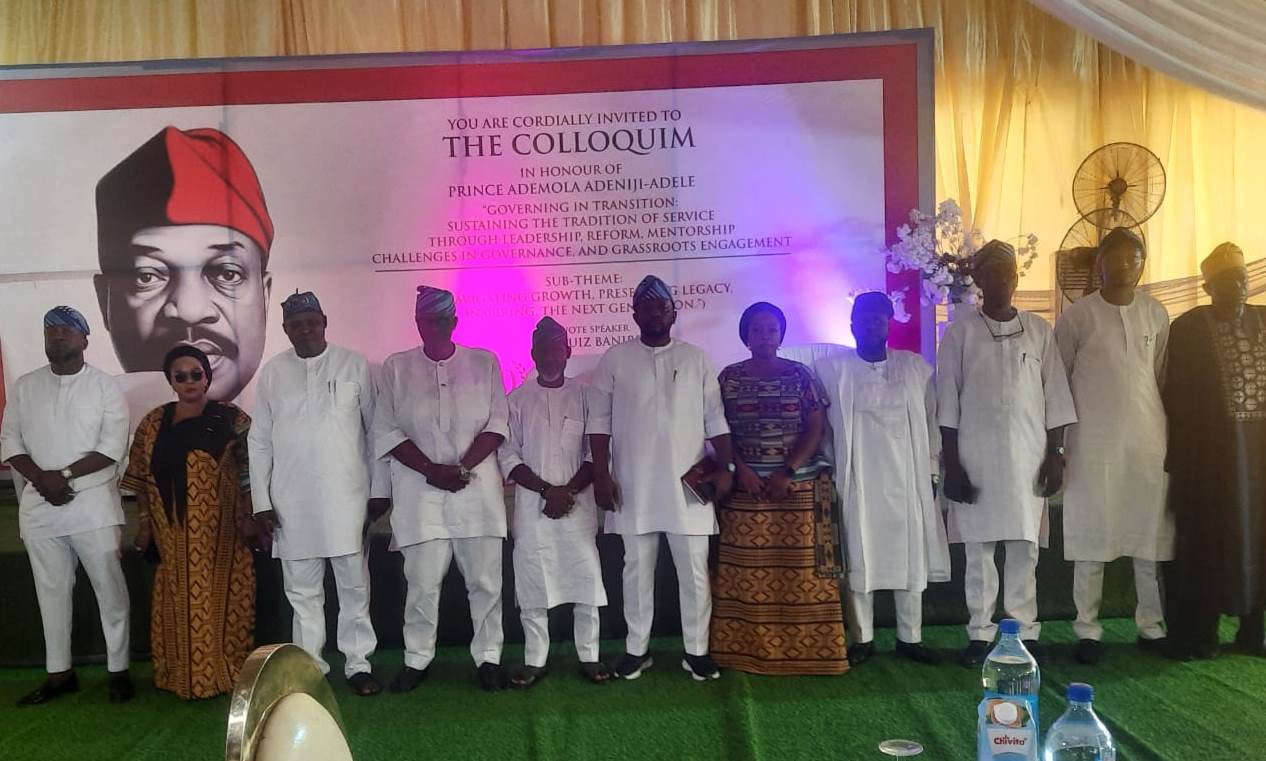
Speaking on Thursday at a colloquium held in honour of the late Ademola Adeniji-Adele, themed “Governance in Transition: Sustaining the Tradition of Service Through Leadership, Reform, Mentorship, Challenges in Governance and Grassroots Engagement,” Banire lamented what he described as a deeply entrenched culture of discontinuity in governance across Nigeria and Africa.
According to him, successive administrations often assume office as though development begins with them, leading to the abandonment of viable projects and policies initiated by their predecessors.
He noted that once dominant political figures leave office, the structures and programmes built around them frequently collapse because they were designed around personalities rather than institutions.
Banire argued that governance should be viewed as a continuum anchored on institutional memory and public interest, not political supremacy or personal legacy.
He said the repeated scrapping of ongoing projects has created waste, slowed development and left abandoned projects scattered across the country.
“Of course, what I mean by this is that somebody becomes a governor today or becomes a president, everything that has been done midway will be abandoned and he starts his own project,” he said.
“As if he is the one brought to develop the whole nation or the entire state. That ought not to be because governance ordinarily should be continuous. It is a continuum.
“But here, and in Africa by extension, what we find is that the way we perceive government is tied to individual freedom and personal control. Leaders approach governance as though national development commenced with their emergence in office. Projects initiated by predecessors are abandoned,” Banire stated.
The former Chairman of the Asset Management Corporation of Nigeria (AMCON) warned that reforms are increasingly politicised, with incoming governments discarding existing frameworks simply to assert authority or distance themselves from former administrations.
On leadership culture, Banire criticised what he described as transactional politics, where loyalty to individuals often takes precedence over competence, integrity and public service.
According to him, such a culture has weakened mentorship and leadership development within the political system, as young people are largely mobilised for elections but excluded from meaningful governance and decision-making afterward.
He further argued that political godfatherism has replaced merit-based leadership recruitment, resulting in declining institutional quality and mediocrity in public administration.
“The answer, like I said, is good examples of what we saw elsewhere. In the United Kingdom, for instance, there is increasing emphasis on youth inclusion, civic participation and local government engagement in democratic discourse,” he said.
“Although challenges still remain, British political institutions generally provide clearer pathways for participation through councils, party structures, student unions and several other democratic platforms.”
Banire called for a renewed national commitment to institution-building, accountability, grassroots governance, structured mentorship and policy continuity.
He maintained that sustainable development can only thrive when governance becomes institutional rather than personal, ethical rather than transactional, and service-driven rather than power-focused.
The senior lawyer also paid glowing tribute to the late Ademola Adeniji-Adele, describing him as a political colossus whose contributions to grassroots politics, democratic governance and public service remain indelible in Lagos State and Nigeria’s political history.
“Today, we are not gathered merely to mourn his absence, as mortals often do when confronted with the inevitability of death. Rather, we are here to celebrate a legacy,” he said.
“A legacy woven into the political, democratic and social fabric of Lagos State and Nigeria. We are gathered to remember a man fondly called the ‘Prince of Hope,’ a man who represented a rare fusion of royalty, intellect, simplicity, courage, political sophistication, humility and uncommon accessibility to the masses.”
Comments