



Why paper trading is the most underrated step in a trader’s education


 Quick Read
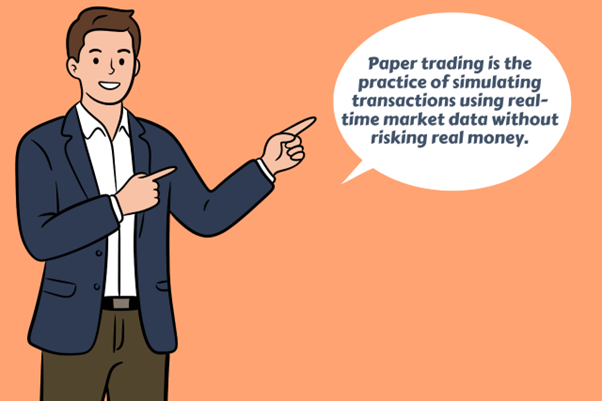
Paper trading is the practice of simulating transactions using real-time market data without risking real money. Prices shift, spreads change, and positions open and shut in real market conditions, much as in an actual investment account. Only the money is virtual.
Paper trading rarely gets the recognition it deserves. Most beginners focus on strategies, indicators, and the appeal of live markets, treating simulation as a formality to pass through rather than a discipline to develop. That instinct is understandable, but it tends to come at a cost. Traders who skip this stage often discover its value later, measured in real losses rather than structured learning.
This article argues that paper trading is not a warm-up exercise. It is a core stage in building real investing competence, and traders who take it seriously develop a meaningfully stronger foundation.
What Is Paper Trading Actually?
Paper trading is the practice of simulating transactions using real-time market data without risking real money. Prices shift, spreads change, and positions open and shut in real market conditions, much as in an actual investment account. Only the money is virtual.
The practice goes by several names — virtual, demo, and sim trading — but the purpose is the same across all of them. What paper trading is not is passive observation. Done with real intention, it is a structured rehearsal: a space where habits form, strategies are tested, and execution skills develop before real stakes enter the picture.
The Simulation Phase and Learning Acceleration
Execution Is a Skill, Not Instinct
Most traders entering live markets for the first time encounter the same surprise: knowing what to do and doing it correctly under real pressure are two entirely different things. Reading about stop-loss orders takes minutes. Placing them accurately, at the right level, during a fast-moving session — that takes deliberate, repeated practice.
Paper trading provides exactly that, without financial consequences. Traders work on entry timing, order types, and position sizing while the emotional weight of real losses does not distort their judgment. Over time, the mechanical side of investing becomes more automatic, which frees mental capacity for the harder analytical decisions.
Day trading in particular demands execution clarity that only develops through repetition. Intraday approaches — whether trading the S&P 500 or a major forex pair during peak session hours — require both speed and a grounded plan. Simulation builds that combination safely, without the pressure that can force premature decisions in live markets.
Strategy Testing Before Capital Commitment
Beyond execution, paper trading gives traders a genuine environment for testing strategies. A setup that looks compelling on a chart can perform very differently when simulated across varied market conditions and session windows. That gap between theoretical edge and actual behavior surfaces through repetition, and it is far less costly to discover it during simulation.
Furthermore, traders who commit to this phase tend to arrive at live markets with a clearer sense of which setups fit their schedule, style, and risk tolerance. They have already filtered out the approaches that worked better in theory than they did in practice.
What Serious Traders Focus On During Simulation
The simulation phase delivers its full value only when approached with genuine intention. Treating every session as real preparation — not a low-stakes activity — is what separates traders who develop real skills from those who simply fill time. A structured approach to what gets practiced and how performance gets reviewed afterward makes a significant difference in how much a trader takes from this phase.
Here is what focused traders consistently work on during paper trading:
- Order placement precision: Applying limit orders, market orders, stop-loss levels, and take-profit targets correctly across different asset classes and market conditions.
- Session and timing awareness: Identifying which market hours generate the most relevant price action for a chosen instrument.
- Risk and position discipline: Practicing consistent trade sizing and resisting the urge to overtrade, even when no real capital is at stake.
- Platform familiarity: Building full comfort with charting tools, indicators, and order management features before those skills are needed under live conditions.
- Performance review habits: Analyzing closed trades after each session to spot patterns, mistakes, and repeatable strengths.
Each of these habits, built carefully during simulation, transfers directly into live investing. The transition to a live account then becomes a shift in stakes, not a shift in method.
How Do You Build a Paper Trading Routine That Actually Prepares You?
Treating paper trading like a real endeavor is the single most important principle here. That means using a realistic virtual balance, following a documented plan for every session, and reviewing results consistently. Traders who approach simulation casually rarely extract its full value.
A practical structure for the simulation phase looks like this:
| Practice Area | What to Focus On | Recommended Frequency |
| Order execution | Entry, stop, and target placement | Every session |
| Session timing | Trade only during relevant market hours | Daily |
| Risk per trade | 1 to 2 percent of the virtual account per position | Every session |
| Strategy review | Compare results against the original trading plan | Weekly |
| Platform tools | Charts, indicators, and trade analytics | First two weeks |
It is useful to monitor emotional inclinations during simulation in addition to mechanics. Traders frequently observe impatience, overconfidence following a successful run, or the desire to recoup a bad session too aggressively, even in the absence of actual money. One of the most useful ways to prepare before going live is to identify such patterns early on.
Consistent practice across all of these areas benefits significantly from a purpose-built simulation environment. And that is precisely what traders find at WRtrading.com — a browser-based simulator running on real-time data across forex, stocks, indices, commodities, and crypto, with no sign-up required and no cost involved.
Paper Trading in High-Volatility and Emerging Markets
The value of structured simulation is not limited to any single market type. It becomes especially relevant, however, for traders entering environments where conditions shift quickly, and local regulatory frameworks add an additional layer of complexity. In those contexts, arriving at live investing already prepared is not just an advantage — it is a practical necessity.
For traders preparing to operate in dynamic regional markets, platform selection at the simulation stage is itself a meaningful decision. A detailed analysis of the best trading app for Nigerian traders highlights just how important it is to identify a platform that supports both educational development and execution quality before committing real capital. Paper trading provides exactly the kind of low-stakes evaluation period that makes that decision more informed.
Markets defined by currency volatility and complex regulatory conditions place additional demands on preparation. A thorough look at forex trading in Nigeria outlines the specific challenges traders face: significant Naira volatility, Central Bank of Nigeria policy requirements, and brokerage conditions that differ substantially from more established global markets. Navigating those conditions is considerably more manageable for traders who have already built solid execution habits and a tested risk management framework in simulation.
The broader principle scales globally. Traders who arrive at live markets having practiced across volatile and varied conditions carry a meaningful advantage, regardless of their region, asset class, or strategy style.
When Is a Trader Ready to Go Live?
With that foundation in place, the natural question becomes: when is it actually time to transition? There is no universal answer, but certain signals suggest a trader has genuinely prepared well. Moving too early undermines the purpose of simulation entirely, while waiting indefinitely limits the growth that only real-market exposure can provide. The goal is not to trade in simulation forever; it is to use it long enough to build a genuine foundation.
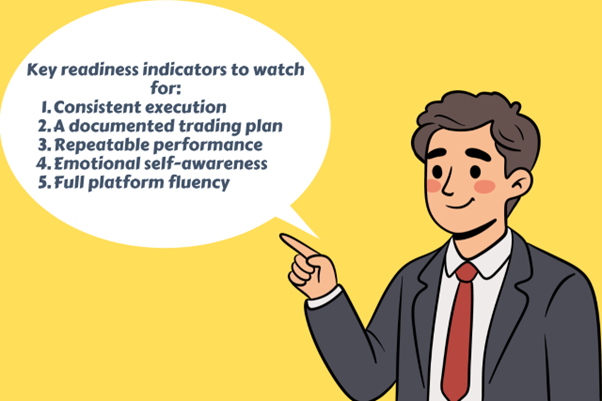
These are the key readiness indicators to watch for:
- Consistent execution: Entries, stops, and targets are placed accurately and without hesitation across every simulated session.
- A documented trading plan: A clear set of rules governs every trade decision, covering entry conditions, risk per position, and session parameters.
- Repeatable performance: Results across multiple sessions reflect a disciplined process rather than occasional fortunate outcomes.
- Emotional self-awareness: The trader recognizes their own behavioral tendencies under simulated pressure and has practical strategies for managing them.
- Full platform fluency: Every feature of the chosen trading interface — charting, indicators, and order management — is completely familiar and comfortable.
Meeting these conditions does not guarantee success in live markets. What it does mean is that a trader enters with a genuine foundation, built through deliberate practice rather than assumptions about how markets behave.
Closing Thoughts on Paper Trading
Paper trading does not replace live experience, but it builds the technical foundation, strategic clarity, and behavioral discipline that live investing demands. The simulation phase builds more realistic expectations. Traders who spend meaningful time practicing in a structured environment learn that not every setup will work, that drawdowns are a normal part of the process, and that consistent discipline matters far more than any single outcome. That perspective holds up considerably better under live-market pressure than the expectations carried by traders who skipped this stage entirely.
The traders who take paper trading seriously arrive at live markets with a clear process, tested strategies, and a working understanding of their own tendencies. They are not starting from scratch when real capital enters the equation.
The habits, the discipline, and the self-knowledge built during the simulation phase are exactly what the live market rewards, and paper trading is where that groundwork is laid through consistent and deliberate practice.
Comments