



EDITORIAL: Recycled Leaders, Recycled Problems

 Quick Read
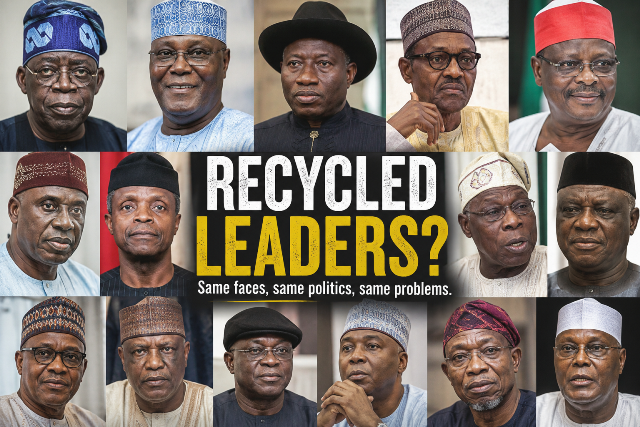
As Nigeria gradually drifts into another election season, one familiar pattern has already resurfaced: the recycling of the same political faces. Former governors become senators. Former ministers return as presidential aspirants.
As Nigeria gradually drifts into another election season, one familiar pattern has already resurfaced: the recycling of the same political faces. Former governors become senators. Former ministers return as presidential aspirants. Political veterans move from one party to another while maintaining dominance over party structures, delegates and power negotiations. Meanwhile, younger politicians continue to struggle at the edges of relevance.
It raises an uncomfortable but necessary question: can a country truly change when the same political class continues to rotate power among itself?
Nigeria is one of the youngest countries in the world demographically. More than 60 per cent of the population is made up of young people, yet the nation’s political architecture remains firmly controlled by older elites. The contradiction is impossible to ignore. A youthful population is trapped inside an ageing political structure.
The problem is not necessarily age itself. Experience in leadership matters. Wisdom matters. Institutional memory matters. The deeper issue is the culture of political gatekeeping that prevents renewal, suppresses merit and rewards loyalty over competence.
Every election cycle comes with the same political vocabulary: “wait for your turn,” “party consensus,” “step down for the leader,” and “party supremacy.” Beneath those phrases lies a troubling reality, democracy increasingly operates like a private club where access is controlled by political godfathers, financial power and elite networks rather than fresh ideas or public credibility.
Many younger Nigerians who attempt to enter politics quickly discover that popularity alone is not enough. The cost of nomination forms remains outrageously high in many parties. Delegate systems are often manipulated. Internal party democracy is weak. Political structures are tightly guarded by entrenched interests. Even the celebrated “Not Too Young To Run” reforms have not significantly dismantled the barriers keeping young people away from real power.
The result is predictable: the same personalities dominate elections repeatedly while new voices remain spectators.
Ironically, many of Nigeria’s biggest problems today are symptoms of leadership stagnation. Youth unemployment, weak institutions, insecurity, economic instability and poor public trust all thrive in environments where political renewal is limited. When the same political thinking circulates for decades, innovation suffers. Governance becomes repetitive. National conversations stop evolving.
Across the world, countries making rapid political and economic progress are increasingly embracing generational transition. Senegal recently drew global attention after younger political actors disrupted traditional power structures. Other African nations are gradually opening political space to younger reform-driven leadership. Nigeria, however, still appears trapped in an endless cycle of political recycling.
This recycling culture also weakens accountability. Politicians simply migrate between parties without ideological differences. Alliances change overnight. Former rivals become allies. Citizens are left wondering whether Nigerian politics is truly about ideas or merely about access to power.
Perhaps the most dangerous consequence is the growing political apathy among young Nigerians. Many no longer believe the system rewards competence or integrity. Some retreat into online activism. Others focus entirely on leaving the country. A generation that should be driving national renewal increasingly feels disconnected from governance itself.
Democracy cannot thrive where political competition is restricted to familiar names and inherited structures. Nations grow when leadership pipelines remain open, competitive and merit-driven.
Nigeria does not necessarily need younger leaders simply because they are young. It needs a political culture that allows capable people, regardless of age, to emerge without waiting endlessly for elite permission.
The real tragedy is not that older politicians still participate in politics. Democracies benefit from experience. The tragedy is that too many younger Nigerians with ideas, energy and competence never get meaningful opportunities to compete fairly.
If the same political class continues to dominate every electoral cycle, Nigerians may continue hearing new campaign slogans while experiencing the same old problems.
A nation cannot expect transformational outcomes from a political system designed mainly to reproduce itself.
Comments