



Abdulsalami reveals mysterious events before Abacha’s death

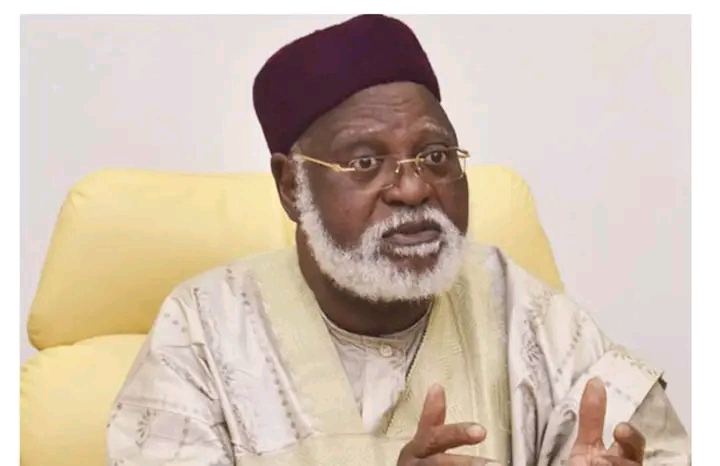
 Quick Read
Former Head of State, Gen. Abdulsalami Abubakar (retd.), has revealed dramatic new details surrounding the death of Gen. Sani Abacha, describing the circumstances leading up to the announcement as suspicious and saying he was left with the feeling that “something was fishy.”
Former Head of State, Gen. Abdulsalami Abubakar (retd.), has revealed dramatic new details surrounding the death of Gen. Sani Abacha, describing the circumstances leading up to the announcement as suspicious and saying he was left with the feeling that “something was fishy.”
Abubakar disclosed that he and the late Chief of Army Staff, Lt.-Gen. Ishaya Bamaiyi were unknowingly locked inside a waiting room at the Presidential Villa for nearly an hour on June 8, 1998, before they were informed that Abacha had died.
The startling revelation is contained in Call of Duty, the former Head of State’s autobiography, unveiled on Saturday during activities marking his 84th birthday in Abuja.
The event, themed “The Legacy of a Statesman @84,” was attended by President Bola Tinubu, represented by Vice President Kashim Shettima, as well as former leaders, diplomats, and top government officials.
In the memoir, Abubakar recounted that the day began with uncertainty over his future in the military. After 35 years of service, he had received indications that retirement might be imminent.
According to him, he received an early-morning call suggesting he would be assigned to attend an ECOWAS summit in Togo on behalf of the Head of State.
“I quietly prayed that he would not send me to Togo. I was tired of travelling everywhere,” he wrote.
Shortly afterwards, another call came directing him to report immediately to the Presidential Villa because Abacha wanted to see him.
The urgency of the invitation, he said, prompted him to leave home without wearing his military uniform.
“I wore a tracksuit and slippers and proceeded to the Presidential Villa,” he recalled.
However, upon arrival, he was informed that Abacha was not in his office. What followed, he said, remains one of the most puzzling experiences of his military career.
Abubakar said he was instructed to wait in a room and was later joined by Bamaiyi. The two senior officers remained there for nearly an hour without explanation.
As the delay continued, Abubakar became increasingly uneasy.
“Something kept telling me that something was wrong, but I could not place a finger on it,” he wrote.
The situation became even more unusual when he discovered that the waiting room had been locked from the outside without their knowledge.
“I asked Bamaiyi if he was aware that we had been locked inside,” he recalled.
Eventually, the door was opened—not by an aide or military officer—but by the then Inspector-General of Police, Ibrahim Coomassie.
According to Abubakar, Coomassie simply instructed them to follow him.
As they made their way through the Villa, Abubakar said he was informed for the first time that Abacha had died.
“It was at this stage that he informed me that Abacha was dead. I was shocked,” he wrote.
The former Head of State said he immediately requested to see Abacha’s body.
“When we got to the residence, I asked to see Abacha’s body. I was told it was inside. I entered the room, removed the covering and saw him. I prayed for him and left the room,” he recounted.
Abubakar said attention quickly shifted from mourning the late leader to discussions about who would succeed him.
Among those present, he recalled, were former Chief Justice of Nigeria, Justice Muhammadu Uwais; former Secretary to the Government of the Federation, Babagana Kingibe; and key security officials.
According to him, Justice Uwais advised that a new Head of State should be appointed immediately to prevent a constitutional vacuum before the public announcement of Abacha’s death.
The former military ruler alleged that some influential figures within Abacha’s inner circle appeared more concerned about succession arrangements than burial preparations.
“It then occurred to me that some of those we met at the Villa were more interested in who would become the next Head of State than in preparing for Abacha’s burial,” he wrote.
Abubakar further claimed that efforts were already underway to influence the succession process before many members of the Provisional Ruling Council (PRC) had even been formally informed of Abacha’s death.
As the Chief of Defence Staff and the most senior serving military officer following the removal of Gen. Oladipo Diya, Abubakar said he presided over the crucial PRC meeting convened after the announcement.
He informed council members of Abacha’s death, the family’s wish to bury him in Kano, and the advice of the Chief Justice that the country could not be left without a Head of State.
The discussions, he said, soon became contentious as competing interests emerged over who should lead the country.
A trip to Kano for Abacha’s burial followed, but Abubakar claimed it later became apparent that some individuals may have sought to use the period to advance alternative succession plans in Abuja.
“Little did we know that the burial was just a decoy to perfect whatever they had up their sleeves,” he stated.
According to him, some officers favoured the then Chief of Naval Staff, Admiral Mike Akhigbe, while others supported Lt.-Gen. Bamaiyi.
Abubakar said he eventually emerged as the consensus choice after consultations and voting among senior military officers and members of the PRC.
“I won the vote. That was how I became the 11th Nigerian Head of State,” he wrote.
Abacha died on June 8, 1998, after nearly five years in power. He had taken control of the country in November 1993 following the political crisis triggered by the annulment of the June 12, 1993 presidential election.
Abubakar succeeded him and went on to oversee Nigeria’s transition to democratic rule, culminating in the handover of power to former President Olusegun Obasanjo on May 29, 1999.
The autobiography, Call of Duty, was unveiled alongside two other books in honour of the former Head of State and forms part of a broader reflection on his role in Nigeria’s political history and democratic transition.
Comments