



World Cup: Why VAR decision to book Almiron for diving was wrong

 Quick Read
Under the rule, VAR can intervene when a referee has clearly penalised the wrong player for an offence.
A controversial VAR intervention in the 2026 FIFA World Cup match between the United States and Paraguay has raised fresh questions over the new rules being used at the tournament.
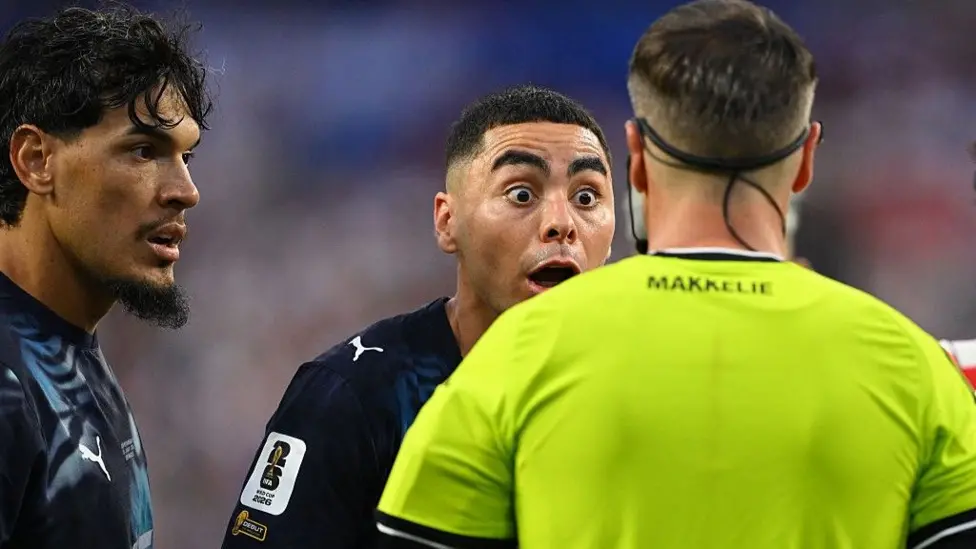
The incident happened during USA’s 4-1 victory over Paraguay when referee Danny Makkelie initially booked USA captain Tim Ream for a foul on Paraguay forward Miguel Almiron.
However, the Dutch referee was later sent to the pitchside monitor by Spanish VAR official Carlos del Cerro Grande.
After reviewing the incident, Makkelie cancelled Ream’s yellow card and instead booked Almiron for simulation.
The decision appeared popular with many viewers because replays showed that Ream had not touched Almiron.
Former players and pundits also welcomed the move, arguing that diving should be punished more firmly.
But according to BBC Sport, well-placed sources have said the decision was wrong under the laws and VAR protocol, even though many felt the outcome was fair.
The confusion is linked to the new “mistaken identity” provision.
Under the rule, VAR can intervene when a referee has clearly penalised the wrong player for an offence.
However, the law is understood to apply only when the same offence is involved.
In this case, Ream was initially punished for a foul, while Almiron was later punished for simulation.
That means VAR was not simply correcting mistaken identity, but effectively changing the offence itself.
BBC football issues correspondent Dale Johnson said the situation had exposed confusion created by the number of new rules introduced for the tournament.
He noted that FIFA’s head of refereeing, Pierluigi Collina, had previously explained the mistaken identity rule using an example from the Euro 2016 final, where the wrong player was booked for the same handball offence.
The USA-Paraguay incident was different because the caution was changed from a foul to diving.
There was also another problem.
According to VAR protocol, a review should not take place after play has already restarted.
In this case, the referee had appeared to restart play with a Paraguay free-kick before the review took place.
The incident has now left fans unsure whether VAR can intervene to punish diving during the World Cup.
FIFA is expected to provide clarification on the matter.
The tournament has also introduced other rule changes, including mandatory three-minute hydration breaks in every match, regardless of weather conditions.
USA coach Mauricio Pochettino had questioned the need for such breaks when the weather is not extreme.
However, coaches are allowed to use the pauses to give tactical instructions to players.
Former England defender Phil Jagielka said the breaks could have a major impact on matches, especially when a team is struggling and the coach needs to pass instructions in a noisy stadium.
Broadcasters have also been using the hydration breaks for adverts, raising further debate over whether the stoppages are purely for player welfare.
Another rule causing confusion is the five-second throw-in countdown.
Under the rule, if a referee believes a player is wasting time before taking a throw-in, he can raise his hand and begin a countdown.
If the player fails to take the throw-in quickly enough, possession is awarded to the opposing team.
Bosnia-Herzegovina defender Sead Kolasinac was caught out by the rule during his country’s 1-1 draw with Canada in Toronto.
The changes are part of efforts to speed up the game and reduce time-wasting, but the early matches of the World Cup have shown that players, coaches, fans and even officials are still adjusting.
Comments