



How Peter Mbah is aligning Enugu with Tinubu’s $1 trillion economy target

 Quick Read
While President Tinubu is aiming at $1 trillion dollar by 2030, Mbah is working to ensure that $30 billion of that expected growth in the Nigeria's GDP would be contributed by Enugu State.
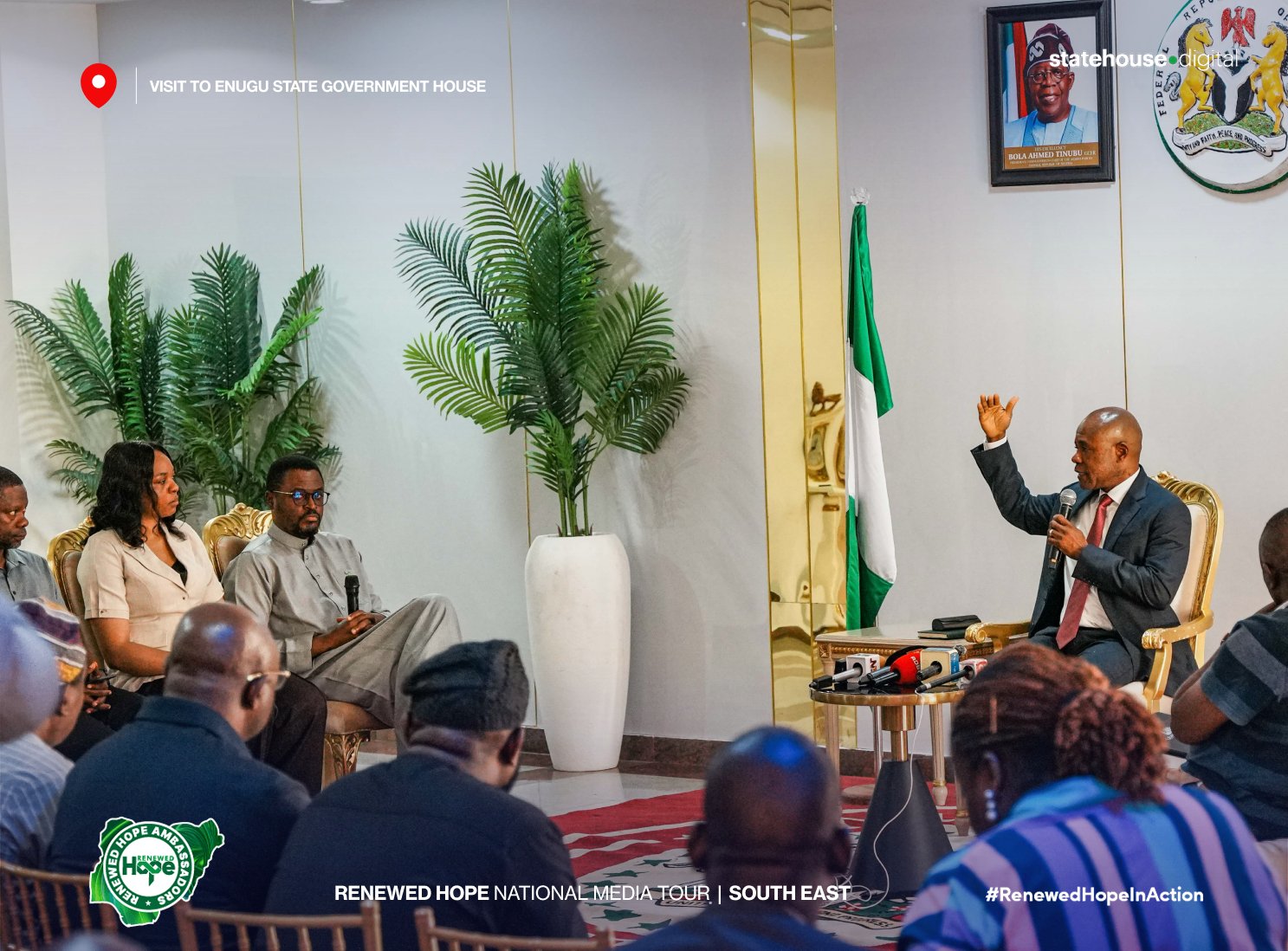
Enugu governor, Peter Mbah, aligns projects, initiatives with President Bola Tinubu’s $1 trillion economy target as discovered during recent Renewed Hope National Media Tour in the South- East region.
By Ayorinde Oluokun
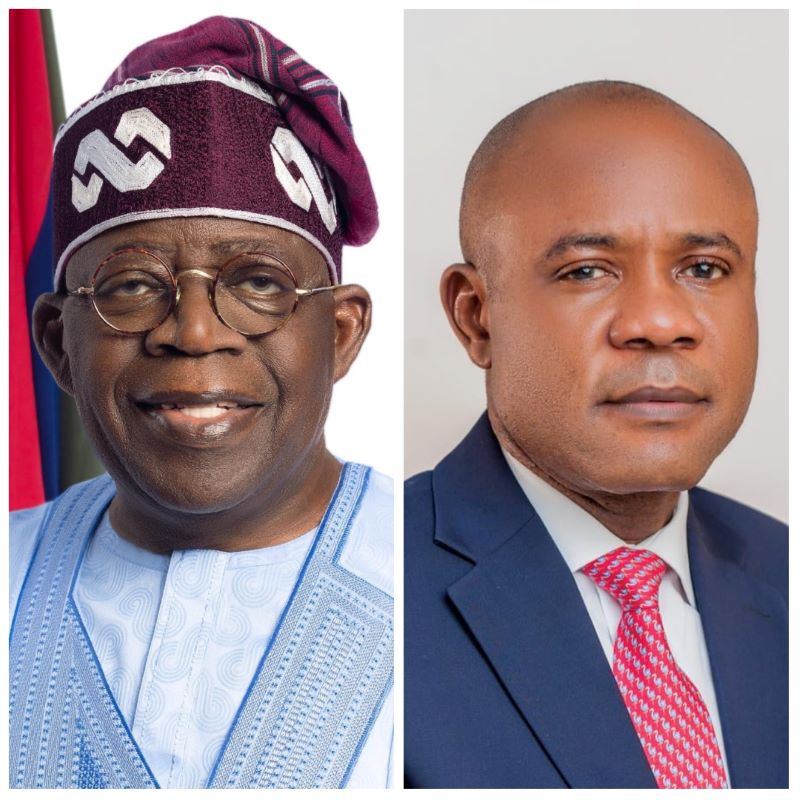
President Bola Ahmed Tinubu has left no one in doubt that the essence of his reforms, initiatives and investments in quality infrastructure were pathways for eradication of poverty, engendering sustainable development and achievement of his administration’s $1 trillion economy target by 2030 as laid out in his Renewed Hope Agenda. Enugu governor, Peter Mbah, is in alignment with that ambition as confirmed by a group of journalists and presidential team who were on Renewed Hope Ambassadors sponsored tour of the federal and state projects in his state recently. While President Tinubu is aiming at $1 trillion dollar by 2030, Mbah is working to ensure that $30 billion of that expected growth in the Nigeria’s GDP would be contributed by Enugu State. But with Enugu’s economy estimated at $4.4 billion and poverty rate at 58 per cent at the time he took over in 2023, the Governor realized that he has to do things differently or what he called “quantum disruptive innovation” to lay the groundwork for the bold ambition though it is going to be private sector led.
As confirmed by a group of more than 50 journalists and the presidential media team on the tour of projects in the South-East recently, the quantum disruptive innovations that are bound to certainly change the fortunes of Enugu forever are ongoing in forms of audacious projects and initiatives of the Mbah’s administration. The projects, though spanning different sectors, are well structured, intentional investments designed to make the Enugu number one destination for tourism, living, business and investment for the overall goal of growing the state’s economy from $4.4 billion to $30 billion, Mba told journalists.
Key among such initiatives was the establishment of the Command-and-Control Centre, a technology-based initiative designed to provide safe environment investors and residents of the state. The Centre is the fulcrum of Mbah’s coordinated security intervention that integrate technology, boots on the ground as well as kinetic, non-kinetic methods. He complimented the initiative with the establishment of Security Trust Fund to provide funding and ensure the sustainability. Thus, it was not a surprise that Enugu is now regarded as one of the safest states in the country.
Mbah told journalists that the investment was informed by what he inherited on assumption of office as well as the need to create conducive atmosphere for investment in the state: “First, we identified the biggest elephant in the room as the security challenges. We came in, we had the sit- at -home thing – people were told the days of the week they have to sit at home and the days of the week they have to go to work. That wasn’t acceptable to us. So, we had to put in place security measures, working with the security agencies, investing hugely in technology, at least bringing that so-called sit at home thing to an end and making sure that we provide a safe environment for this private capital to flow.”
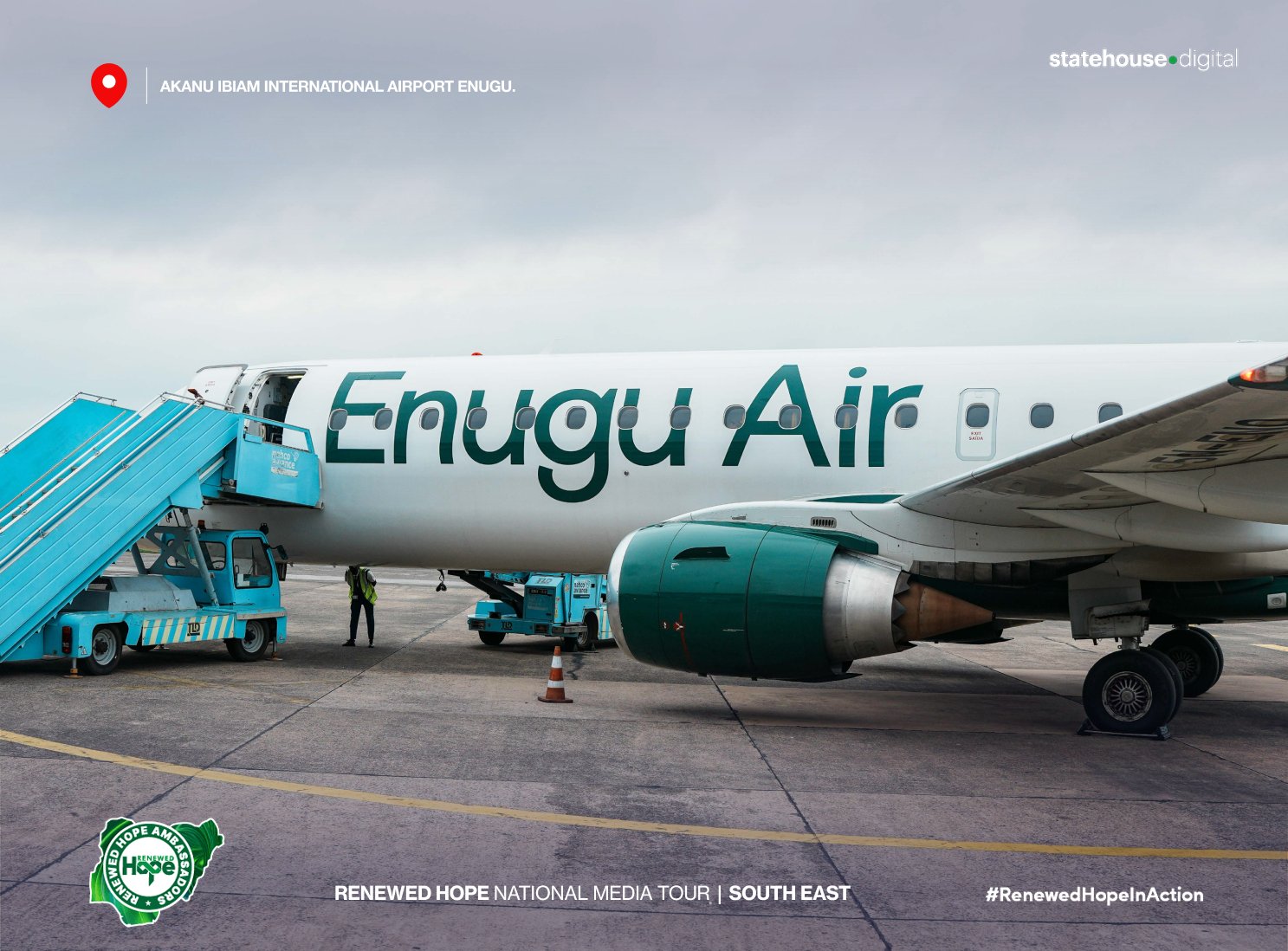
To facilitate investments needed for the boost of the economy, Mbah had aligned with the Federal Government to hand over the Akanu Ibiam International Airport (AIIA), Enugu to a private investor, to Aero Alliance Ltd. under a 30-year Public-Private Partnership (PPP) Concession Agreement. His administration also set up Enugu Air which is now operating close to 20 flights daily from the Akanu Ibiam International Airport. “Again, it’s part of connecting the dots and growing the economy exponentially.
“Our target is to bring in three million visitors to Enugu if you look at our manifesto. Three million visitors mean you would have to operate at least 100 aircrafts landing into Enugu Airport every day. And we’re talking about an airport that takes, at the time we came in, maybe four or five aircrafts landing here. And we just didn’t have the facility to even take more and all that. e So, we felt that we need to have our skin in the game. We want to first create the pull factors,” Mbah said.
He revealed that part of the plan to pull people into the state include ongoing development of four massive tourism sites by the state government, including the longest zipline in Africa: “And if you have to do that, you also have to start thinking about assets. How will people be able to access the state? Again, we felt just get into this game. We had to set up our own airline. And then, of course, we now have regular flights. You have close to 20 flights coming into Enugu on a daily basis now. Our target is to move that number to 100, but you have to also pull the passengers. And then we’re also looking at bringing in the diaspora, attracting those foreign travelers. And even the investors, they also want to be able to have direct flight to their state or the location of investment. We got involved with an investor who is interested, because as you know, federal government won’t concession to a state. That’s the rule. So, we worked with an investor to ensure the successful concessioning of the Akanu Ibiam Airport and to also make sure that it becomes operational,” said Enugu governor.”
Mbah gave the credit to President Tinubu for facilitating the concession of the airport. “The entire Southeast, I must say, is grateful that this has happened, because very soon, we’re going to have a functional international airport for the people of the Southeast. Our target is December this year. We’ll be able to get a direct flight from Enugu to the U.S. and from Enugu to the U.K. to China, to Guangzhou from here. So that’s the objective, just making sure we achieve our target of bringing in three million people to Enugu,” he said.
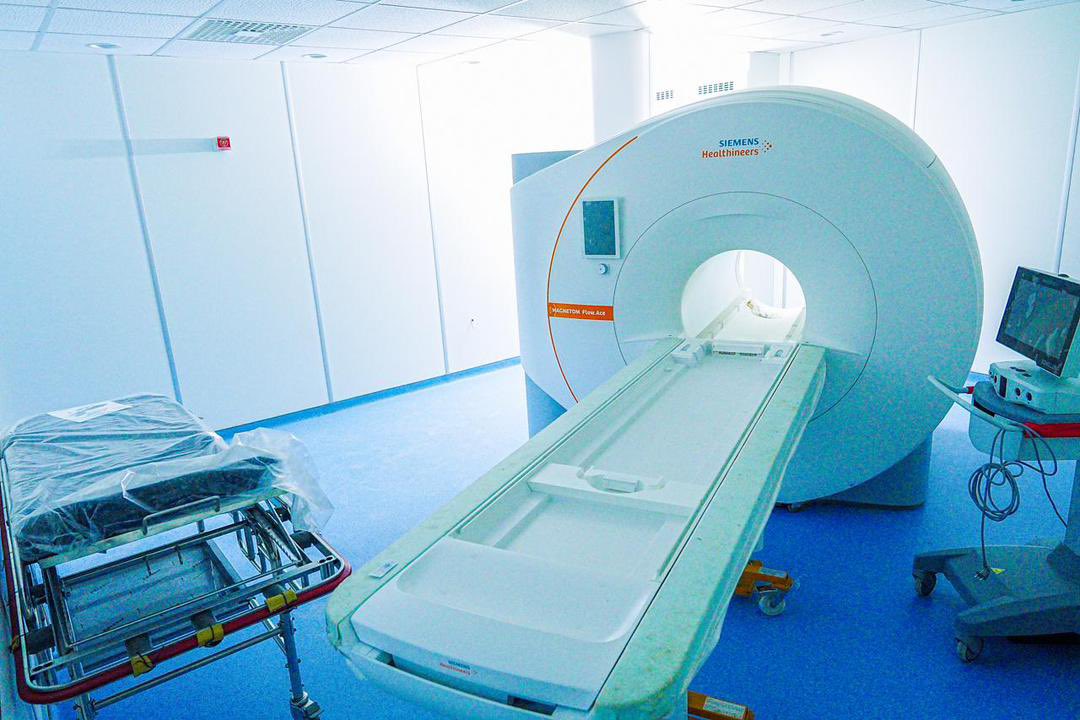
Yet, another dot of the $30 billion exponential economy growth ambition is the massive investment in the health sector by the state government. Mbah’s government has invested to expand and upgrade its primary healthcare centres, general hospitals, and its teaching hospitals to be very functional. But the state is also at the verge of completing its Enugu international hospital where the state of art medical facilities and medical education will be available. The 300-bed specialist quaternary hospital, according to Professor Chidiebere Onyia, the Secretary to the Enugu State Government is part of the bigger tourism plan for the state.
Enugu Commissioner for Health, Prof George Ugwu told journalists on the media tour that that hospital is being built and equipped to “treat and take care of the health care of even presidents across Africa” and will soon begin operation: “We’re planning to have a partnership so that the best hands in the world will work with our local hands and give us the very best possible. This is one of the wonders of Governor Peter Mbah in the health sector.”
While linking the gargantuan healthcare infrastructure to his bid to grow Enugu’s economy to $30 billion, Mbah said: “If you’re bringing an investor here, he would be worried about two things, basically. One is security. The next thing is if I’m sick, where do I go to? And if you look at our manifesto, our objective has been to capture some of the market of the medical tourism. We’re talking about the market size of about $2 billion annually. And our plan was, okay, if you can do something very attractive and you’re able to capture just 10% of that market, you’re talking about $200 million. That’s huge.”
He added that the world-class hospital would be equipped staffed with top-notch professionals to ensure that its operation is well run enough to capture the target market. “The international hospital here is going to be able to provide you the opportunity to carry out your SPECT scan and your PET scan. There are only a few locations where you can do that. That’s like advanced oncology center, where you can do all your diagnoses and also your therapeutics.”
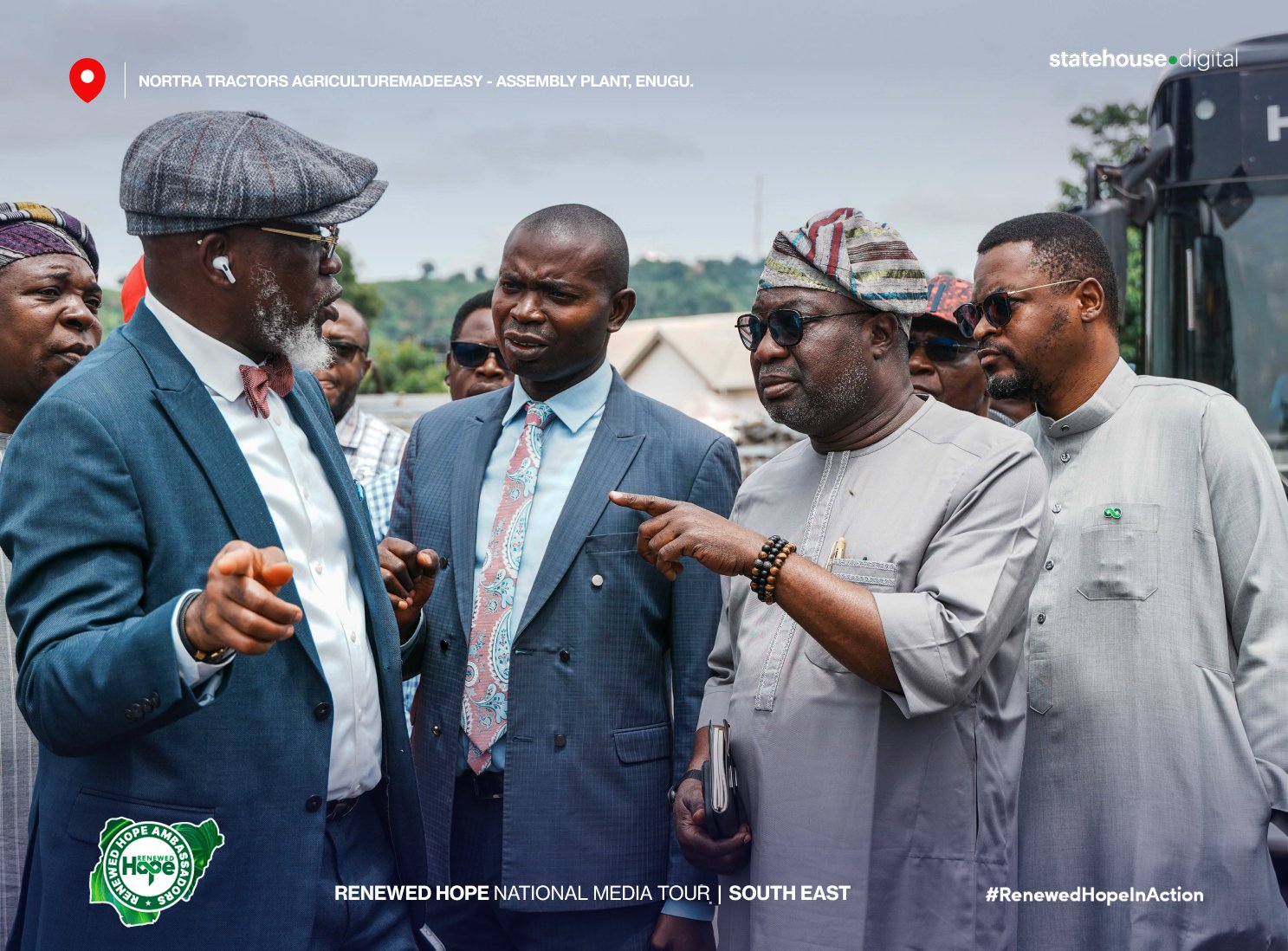
Also in the loop of the $30 billion economy target is the ambitious new Enugu City project being developed not only to decongest the old Enugu city, but with infrastructure and global outlook similar or even better than cities in advanced places. “We are creating an alternative investment destination in Nigeria from what traditional investors know. This is going to be the premier investment destination in Nigeria in the next 18 months,” Managing Director of the New Enugu City Development Authority, Mrs. Nkeiru Arum told journalists during the media tour.
According to her, infrastructure for the new city include six- kilometre dual carriage, underground cable electricity, water supply, dedicated fibre optics network, central sewage among others. “We are dedicating 10 megawatts of electricity off grid to this place. It is going to have electricity 24/ 7. We are dedicating a cooking gas pipeline. You’re not going to come here with cooking gas canisters. It’s all metered. We are dedicating water production for the city. What you’re going to have is metered water consumption. So, it cuts your capex to zero where you’re moving and building in this city extension. You don’t need your generators. You don’t need boreholes. You don’t need to be your own government because we have gone ahead of you to create all the facilities you need for a smart city,” Arum said.
She added that the Mbah administration’s expenses on infrastructure for the new city are recoverable revenue from private sector investors. “It’s for us to create a market that can now attract investors, big scale investors, residential building, everybody that is willing to stay in this city.”
Giving further details on the ambitious project, Enugu State Commissioner for Works and Infrastructure, Engr. Ben Osy Okoh said the new city is being built on a total of 10,000 hectares of land and is bigger than the entire phase one of FCT: “We have phase one, 3,000 hectares, divided into three. Phase one A, phase one B, and Phase one C. Where we are now is phase one A, which is 1,000 hectares. And 1,000 hectares is the size of Victoria Island in Lagos times two. We have done the primary road which we are standing on now, 6.5 kilometres. We have awarded contract for the construction of the secondary and tertiary roads, which is almost 100 kilometres of road networks and is currently going on. I don’t think there is any district in Abuja that has a network of roads that is up to 100 kilometres. What we are doing currently, and will be delivered by December this year, is 100 kilometres of road network. That’s why I say this is the most ambitious infrastructure development to be undertaken by any state government.”
Okoh assured that phase one and phase two of the project, which is over 6,000 hectares will be completed before the end of tenure of the Mbah’s administration. “You are going to be seeing a full-blown city that is functional,” he said.
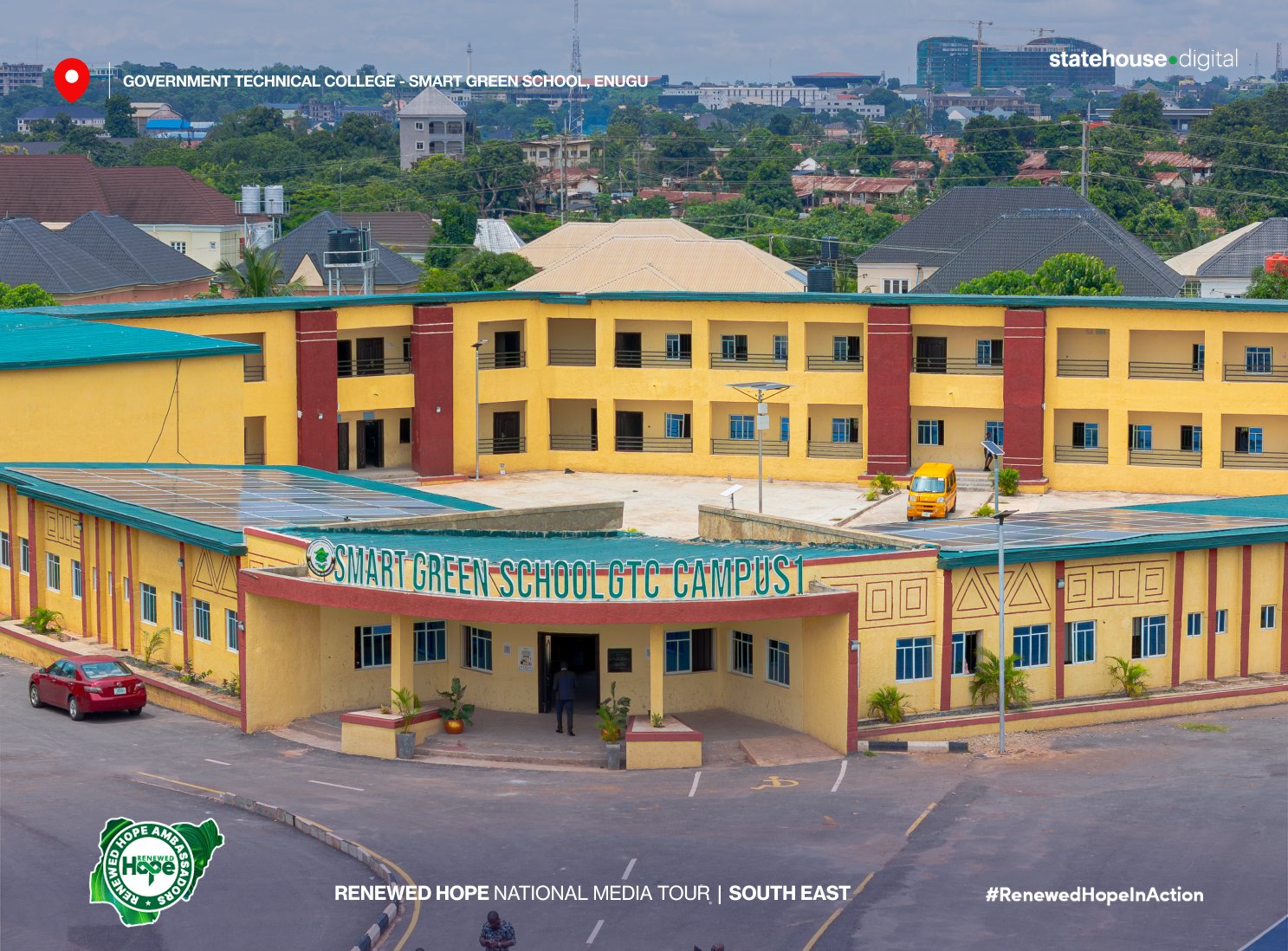
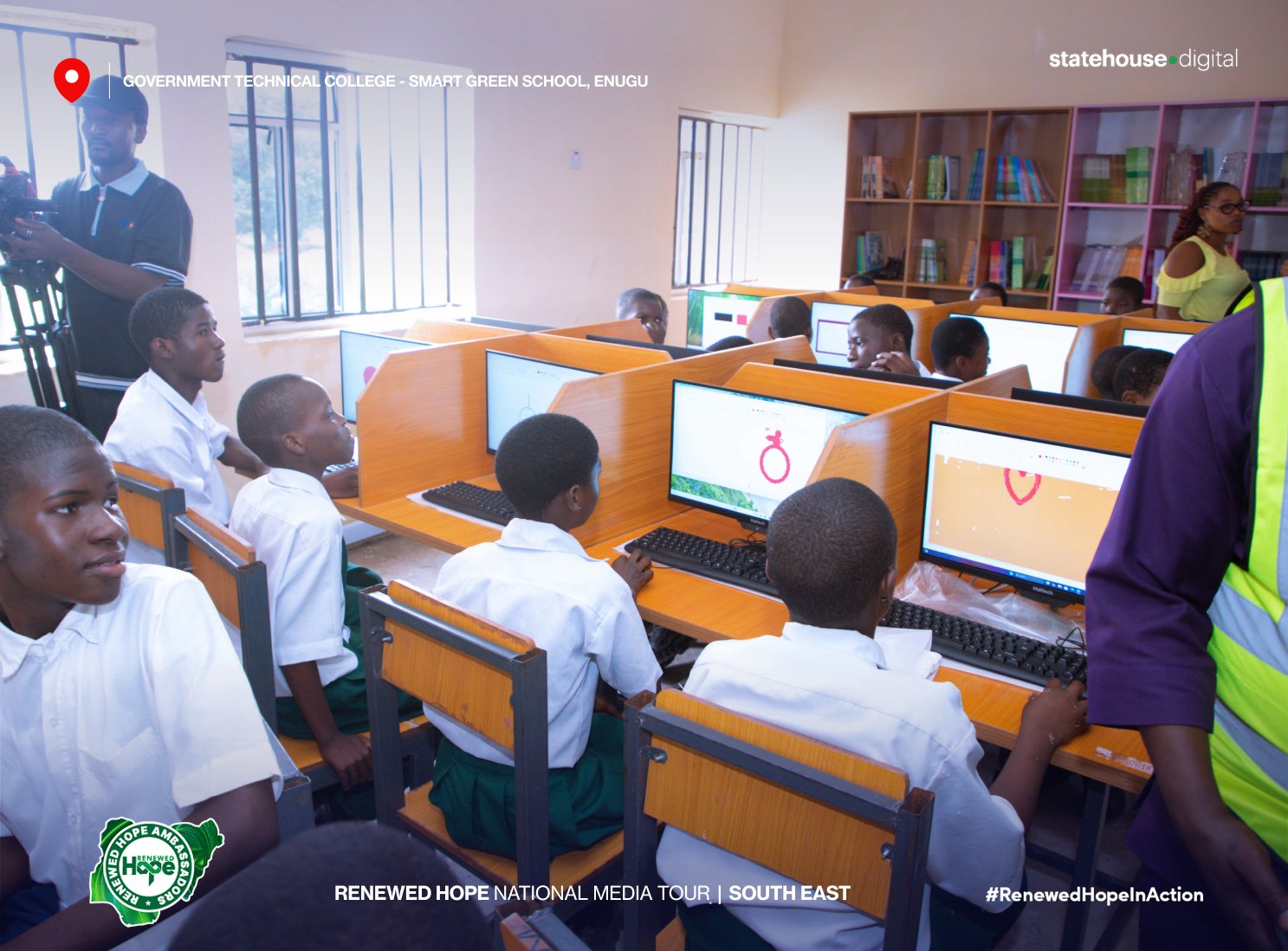
As part of his bid to eradicate poverty and build a pipeline of skillfully equipped youths for the development of the state, the Mbah administration is also investing massively in education. Indeed, the Governor had at inception set out a model for smart green schools, technical and vocational education curriculum with modernized pedagogy.
At GTC Enugu, journalists and members of the presidential media team witnessed the realization of that vision with three different smart green schools with a capacity of about 900 students in a cluster. “Here, students are able to be involved in things like mechatronics, artificial intelligence, augmented reality. These are things that prepare our students as skill sets while they address the federal government curriculum around the basic learning components from literacy to numeracy,” Enugu SSG told journalists.
He added that students who can’t go into the smart secondary schools can now attend the technical schools: “The whole idea of is to begin to debunk the stereotype that only students that cannot make it to the university end up going to technical schools. Because here now we have partnership with Innoson, with other industry actors that will come in here and present real industry learning. So, students leave here being able to understand the concept and they’re employable. What we want here is that when they leave here, they’re certified and we create an ecosystem, a cluster of experts that are able to do work with an Enugu State certification on it.”
Mbah said his government had in the last two and a half years built more than 7000 classrooms, 267 smart green schools, equipped with all the features of a typical smart school – a robotic center, an ICT, a 3d printer with teachers also being equipped with skills needed to teach in the schools. “The idea is that if we sustain our investment in education, we are able to save a lot of money that would have been spent in security tomorrow. Because if we don’t get these kids skillfully equipped, they will take to criminality as venture tomorrow. So, we might as well spend that money today training them,” the Governor said.
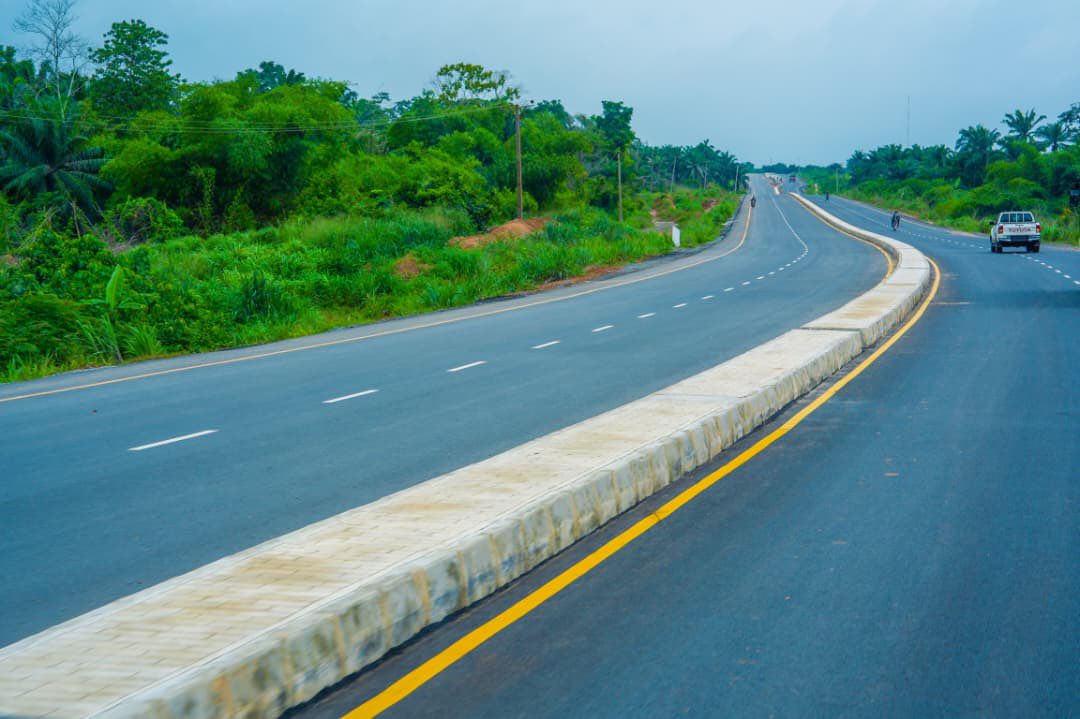
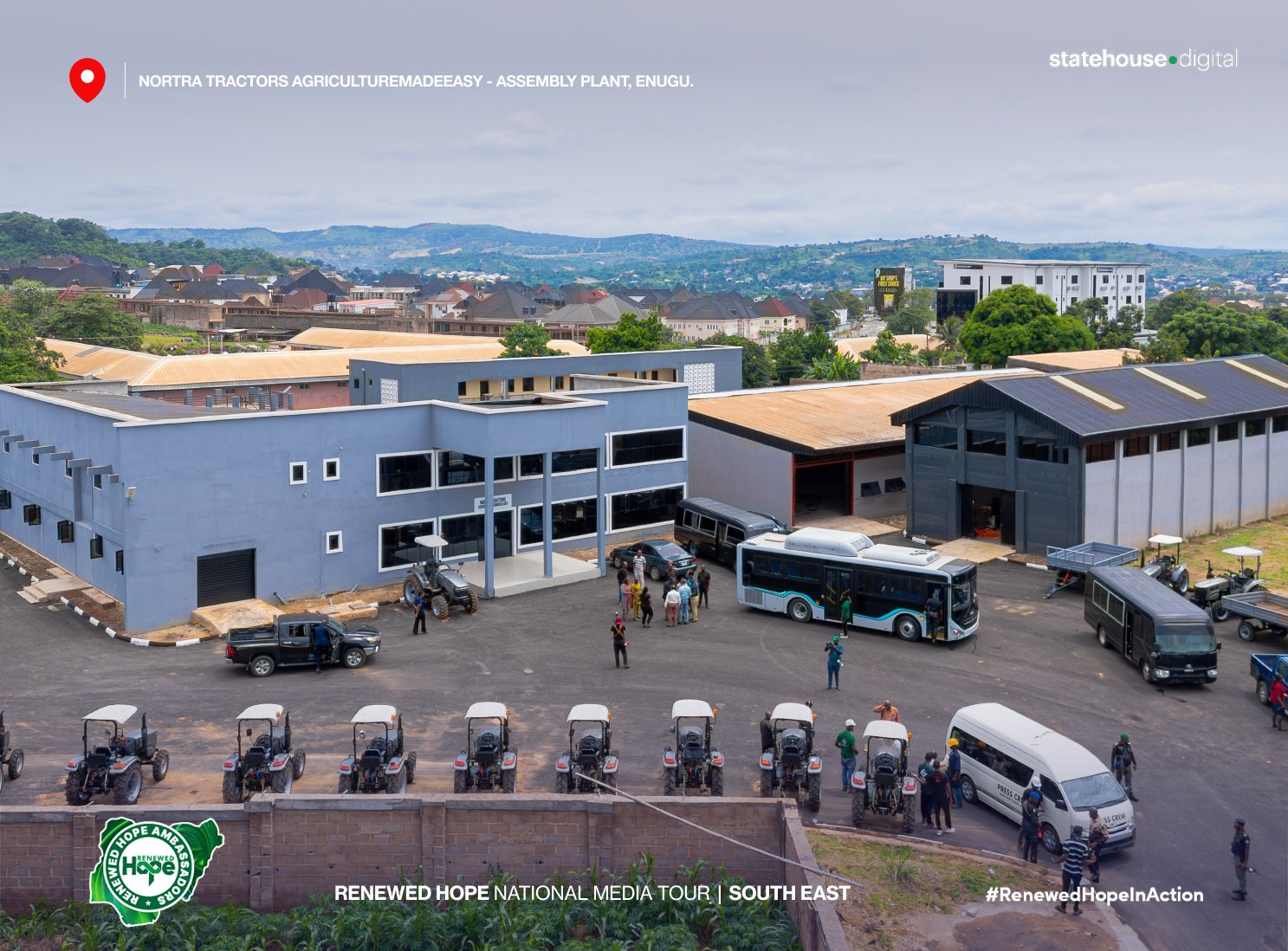
Also at the centre of Mbah’s administration $30 billion economic growth target is the newly constructed 40 – Kilometre Owo-Ubahu-Amankanu-Umualor-Neke-Ikem dual carriageway. The road which was constructed brand new by the Mbah’s administration provides alternate route to North Central Nigeria, Onitsha and other parts of Nigeria from Enugu. “What you’re noticing here is a road that can help with our logistic corridor. This opens a whole new corridor for moving goods and services into Enugu State, and also goods that pass-through Enugu State, to reduce the burden on the roads, the traditional road. This area is also where we are going to start the development of our special agro-processing zone, which is a partnership between Enugu State Government, the Federal Government of Nigeria, and the African Development Bank and to also create that agricultural ecosystem around here in Nkanu East,” the Secretary to the Enugu State Government said of the significance of the road. We also have smart farms coming up in this corridor. We have a vehicle processing, a vehicle assembly plant on the left as we are going that will also be in this corridor, opening up the economic cluster that we were talking about earlier. So, it’s not just the infrastructure, but infrastructure planning is aligned with the strategic economic growth outlook of the state governments to build our GDP towards our target, which is from 4.4 billion U.S. dollars to 30 billion U.S. dollars by 2031. That’s the thinking behind this corridor,” he said.
In the same vein, Governor Mbah said his administration is treating not just as a means of guaranteeing food security, but as a major business with capacity to contribute to the $30 billion GDP growth plan. To actualize this, he said his administration has adopted an initiative which involved the construction of farming estates. “We’re doing 260 farm estates. The idea of a farm estate is to have a location that is ring-fenced and the size of a typical farm estate is 200 hectares. Then you bring in your smallholder farmers there, people who ordinarily did subsistence farming. You introduce them to mechanized farming. You also have an agronomist who helps them with extension services, training and all that.
“And then you also have a storage and then you have an aggregation center. The total number of wards in Enugu is 260, so when we talk about 260 in education, 260 in healthcare, we’re referring to the electoral wards because our model of development is all inclusive, so making sure that no part of the state is left behind. So the farm estates, we’re doing the same thing. We have the database of our farmers. We have about 80,000 smallholder farmers in Enugu. What we do is to make sure we put them in those farm estates and providing them with the machineries, the tractors and the implements as well to be able to practice mechanized farming. What that does essentially is to scale up our production. And because we are now producing at scale, we’re also now building processing plants beyond the aggregation centers. We also have the ATC, the agro-transformational centers. We also have the SAPZ coming on, which is something we’re doing in conjunction with the federal government through the funding from AFDB. So, we have the special agro-processing zone that is coming. That is a much larger scale processing zone. That also connects with the airport because it helps us with exports and all that.”
He was empathic that the initiatives and projects being implemented by his administration to achieve the $30 billion GDP would not have been possible with the support and reforms of President Tinubu. He also said the President has been intentional in empowering the subnational governments to be part of efforts to achieve the $1 trillion GDP growth for the nation.
“I think it would have been impossible; to say the least for us to have done things at the scale we are doing without some of the bold and courageous policies of Mr. President. First of all, what the policies of Mr. President did for subnational is largely to free up resources. I think Mr. President has been very intentional in terms of how this $1 trillion economy is to be achieved. He believes strongly that this is not going to come from the top bottom, it’s going to come from the periphery. And in order to achieve that, you have to strengthen the periphery, both in terms of responsibility and also in terms of financing. And what we’re seeing in Enugu today and the scale these things are happening is only possible because we now have more funds coming from the federation and quite a lot of support from the center to the subnational. And for us, it’s to make good use of that opportunity.
“And that’s essentially what we’re doing. So whether you want to look at things from the removal of the subsidies, the unification of the exchange, the foreign exchange, if you look at the reform in the tax sector, and quite a whole lot of great initiatives. If you look at the NELFUND policy, this is something that we’re excited about because typically the list of scholarships you get, the application, the applicants you get every year, it’s almost unimaginable. But today, we encourage them to access NELFUND and that again frees up funds for us to do other things. So, the impact is invaluable,” he said.
Enugu and indeed, the entire of the Southeast are also benefitting from the President’s investments in infrastructure with multiple transport and logistics corridors simultaneously under construction, rehabilitation or redesign across the country. The Senator representing Enugu West Senatorial District, Sen. Osita Ngwu who is also a member of the Senate Committee on Works told the Renewed Hope media team that the region is currently witnessing numerous infrastructure projects while dismissing claims that the South-East has been neglected under the present administration.
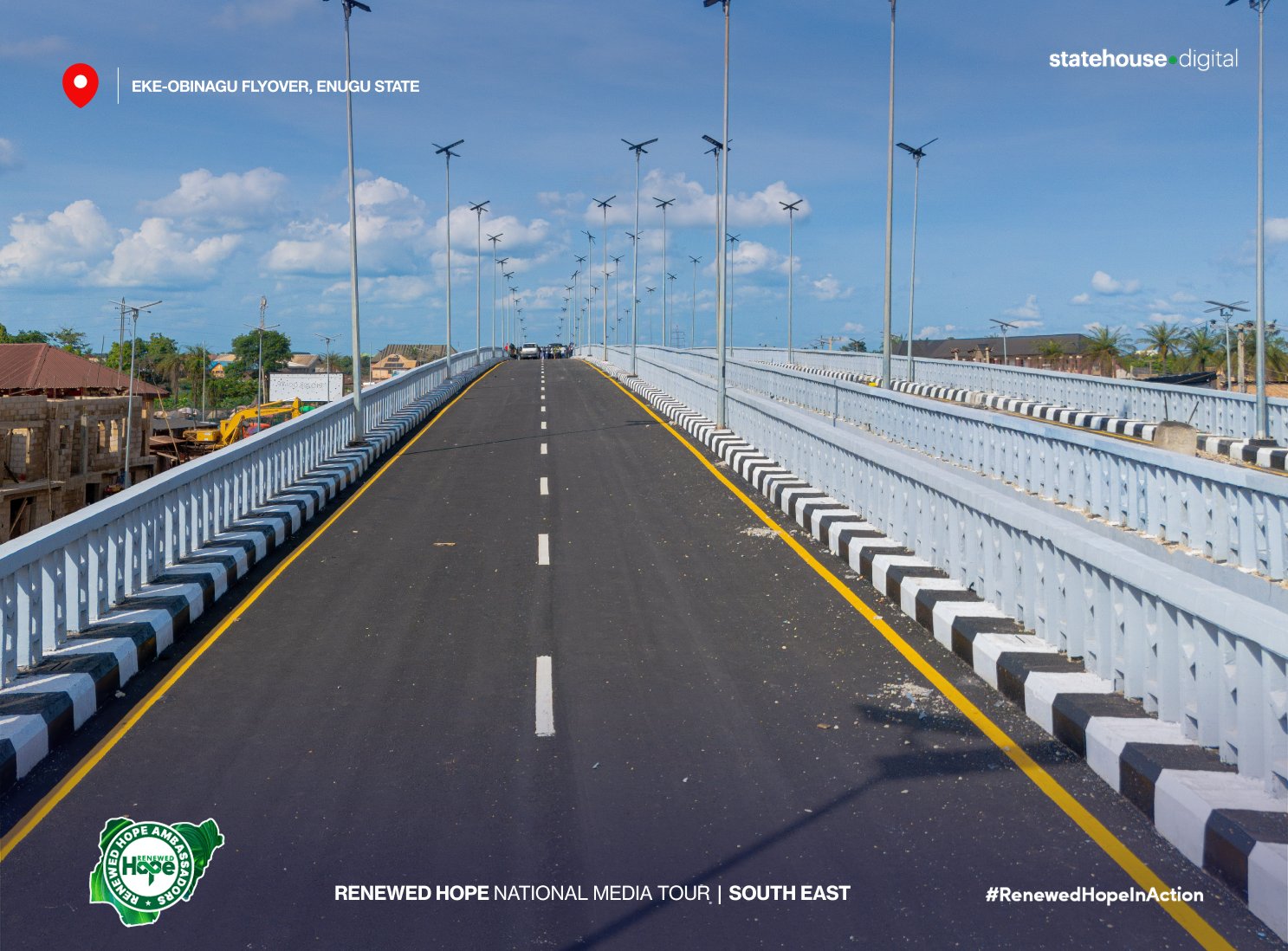
He listed some of the key interventions of President Tinubu in the state to include the Eke Obinagu Flyover linking Enugu and Ebonyi states, sections of the Enugu-Port Harcourt Expressway, the Enugu-Onitsha Expressway, and the ongoing Abakpa Junction Bridge project.
“Being honest, I was among those who once said that the South-East was abandoned in the past. But that is no longer the case. Since the coming of the Tinubu administration, Enugu has not been abandoned. We have been carried along and several federal road projects are ongoing in the state as we are part of the centre,” Senator Ngwu told journalists on top of Eke Obinagu Flyover which he described the bridge as a major intervention that had eased traffic congestion along the busy route connecting Ebonyi and Enugu states.
“Before now, this place was a nightmare for commuters because it serves as the gateway from Ebonyi State into Enugu State. The congestion here was enormous. We appreciate the Tinubu administration for constructing this bridge and completing it within a remarkable timeframe. Work never stopped from commencement to completion,” he added.
The Senator also highlighted how the rehabilitation of the Enugu-Port Harcourt Expressway by the Tinubu’s administration has benefitted the people: “There was a time it took between five and six hours to travel from Enugu to Port Harcourt because motorists had to use alternative routes through villages. “Today, it takes just a little over two hours. That is the impact of the infrastructure projects under the Renewed Hope Agenda,” he said. He also noted that the reconstruction of the Enugu-Onitsha Expressway had significantly reduced accidents, particularly around Ugwuonyeama axis, previously regarded as a death trap. The other ongoing federal projects in Enugu include the reconstruction of the Enugu-Onitsha Expressway, the dualisation of the Enugu-9th Mile-Makurdi Expressway, the Abakpa Junction interchange, and emergency interventions on damaged sections of the Oji-Achi-Mmaku road.
Analysts said the investments of the Federal Government in roads and other infrastructure will contribute to the efforts of Governor Mbah to grow Enugu’s economy to $30 billion by 2030.
No doubt, Mbah and Tinubu are aligned in the bid for $1 trillion economy.
Comments