



‘The worst disaster in 123 years’: Venezuela reels as quake death toll hits 1,430

 Quick Read
Despite fading hopes of finding more survivors, rescue operations continue around the clock, with emergency workers refusing to abandon the search.
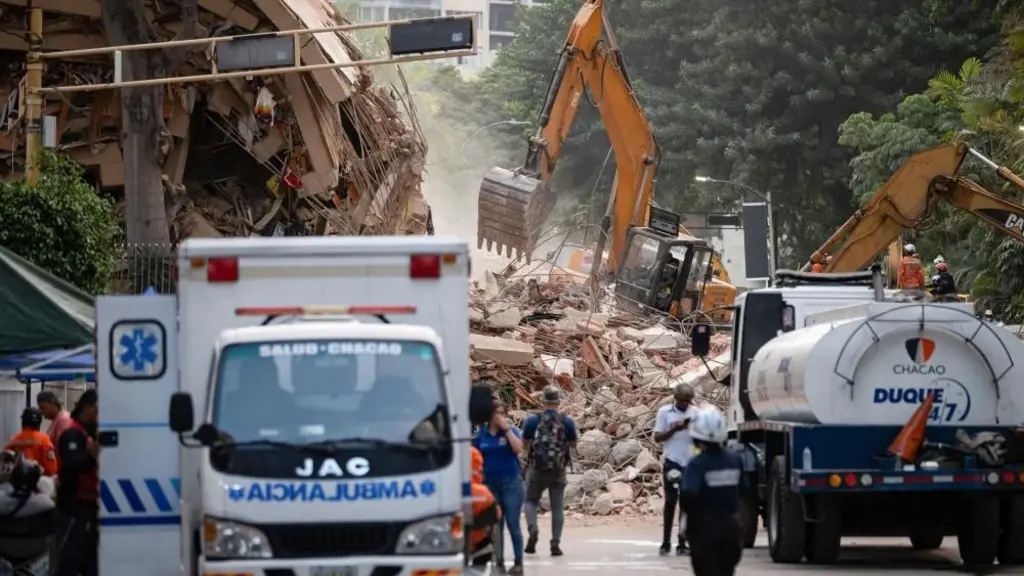
The death toll from the devastating twin earthquakes that struck Venezuela has risen to 1,430, with more than 3,200 people injured, as rescue teams from around the world race against time to find survivors trapped beneath collapsed buildings.
Authorities said Saturday that the search had entered its most critical phase, with the widely recognised 72-hour survival window nearing its end.
Speaking on state television, senior lawmaker Jorge Rodríguez described the disaster as “the most disastrous event this republic has suffered in the last 123 years,” revealing that 3,238 people had been injured while more than 3,100 families had been displaced into emergency shelters.
The powerful earthquakes, measuring magnitudes 7.2 and 7.5, struck less than a minute apart during Wednesday’s national holiday, catching many residents inside homes and high-rise buildings. The coastal state of La Guaira suffered the heaviest destruction, where entire apartment blocks were flattened and critical infrastructure severely damaged.
Authorities also reported more than 430 aftershocks since the initial quakes, prompting renewed warnings for residents to avoid unnecessary travel to the worst-hit areas.
Despite fading hopes of finding more survivors, rescue operations continue around the clock, with emergency workers refusing to abandon the search.
Acting President Delcy Rodríguez said rescuing people trapped beneath the rubble remained the government’s highest priority, expressing hope that more survivors would still be found.
“Our priority is to rescue those who are still alive,” she said, while confirming that electricity had been restored to about 60 per cent of La Guaira and that more heavy equipment had been deployed to the disaster zone.
She added that approximately 14,000 military and police personnel had been deployed to maintain security and support relief operations.
International support has continued to pour into Venezuela, with at least 20 specialised urban search-and-rescue teams already operating in the country and dozens more mobilising from Europe, North America and Latin America.
Rescuers from countries including the United States, the United Kingdom, France, Germany, Italy, Spain, Turkey, Mexico, Colombia, Chile, Ecuador and the Netherlands have joined local emergency responders, bringing rescue dogs, heavy equipment and specialist medical personnel.
Experts warn that every passing hour reduces the chances of locating survivors alive.
Josh Macabuag, an engineer with UK-based Search and Rescue Assistance in Disasters (SARAID), said survival rates decline steadily after major earthquakes, although rare rescues have occurred more than 100 hours after previous disasters.
“Time is of the essence,” he said, adding that while there is no fixed cut-off, the probability of survival decreases with every passing hour.
Across La Guaira, desperate families have refused to give up hope.
Among them is the family of 31-year-old Carlos Eduardo, who remains trapped beneath the rubble of a collapsed building. Relatives said they recently heard him groan from underneath the debris before rescue teams temporarily suspended excavation after failing to detect further signs of life.
“We still believe he can come out alive,” a family member said.
Elsewhere, heartbreaking stories have emerged from rescue sites, including that of a woman whose body was recovered while still clutching her dog, which miraculously survived.
Satellite imagery has also revealed the scale of the devastation, showing entire residential blocks reduced to rubble and visible damage to Simón Bolívar International Airport, where cracks appeared on the runway and sections of the terminal building partially collapsed.
Although the airport remains open for chartered humanitarian flights, commercial operations have been severely disrupted.
The United States Geological Survey (USGS) warned that the final death toll could rise significantly as rescue and recovery efforts continue.
Using its earthquake impact assessment model, the agency estimated that fatalities could eventually range between 10,000 and 100,000, although it stressed that the projection is not a confirmed casualty figure but an assessment intended to guide emergency planning and resource deployment.
Comments