



Tinubu swears in eight Federal Commissioners for RMAFC, NPC

 Quick Read
Among the new NPC commissioners, Nasiru Mu'azu Magarya, from Zurmi Local Government Area of Zamfara State, previously worked as a volunteer Public Health Assistant at General Hospital Moriki and Primary Health Centre Magarya. He also chaired the Zamfara State COVID-19 Task Force and served as Speaker of the Zamfara State House of Assembly from 2019 to 2023, where he championed reforms that strengthened legislative-executive relations.
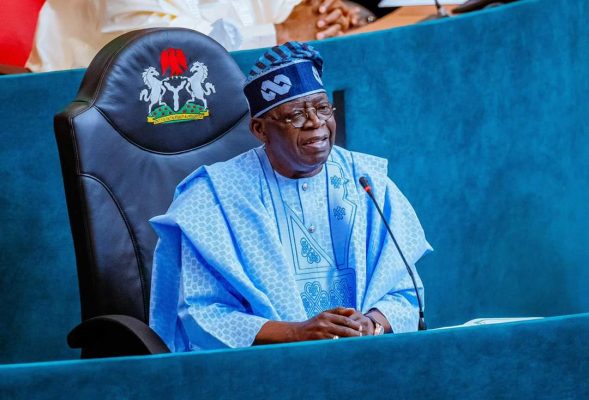
President Bola Ahmed Tinubu on Monday administered the Oath of Office to eight Federal Commissioners appointed to the Revenue Mobilisation, Allocation and Fiscal Commission (RMAFC) and the National Population Commission (NPC), reaffirming his administration’s commitment to strengthening key national institutions.
The newly inaugurated officials comprise two commissioners for the RMAFC and six members of the National Population Commission.
The two commissioners appointed into the Revenue Mobilisation, Allocation and Fiscal Commission are Hajiya Amina Ibrahim Gamawa and Abdullahi Mukhtar Muhammad.
The six members sworn into the National Population Commission are Nasiru Mu’azu Magarya, Kolawole Oladipupo Alabi, Prof. Sadiq Isah Radda, Suleiman Umar, Dr Isiaka Alada Yahaya, and Chiso Abdullahi Dattijo.
Hajiya Amina Ibrahim Gamawa, from Gamawa Local Government Area of Bauchi State, holds a Bachelor of Laws (LL.B) from the University of Jos and a Postgraduate Diploma in General and Investigative Journalism from the London School of Journalism.
She previously served at the National Assembly, the Corporate Affairs Commission, the Nigeria Social Insurance Trust Fund, and the National Youth Service Corps. She also played a key role in establishing the National Blood Transfusion Service in Nigeria.
Abdullahi Mukhtar Muhammad, from Kubau Local Government Area of Kaduna State, holds a Bachelor’s Degree in Law, a Postgraduate Diploma in International Law and Diplomacy, and a Master’s Degree in International Affairs and Diplomacy, all from Ahmadu Bello University, Zaria. He also earned a Master of Arts in Peace and Security Studies from the National Institute for Security Studies/University of Ilorin.
He served as Director of Operations at the Kaduna State Muslim Pilgrims Welfare Board from 1994 to 1997, became Executive Secretary of the Board from 2003 to 2011, was appointed Federal Commissioner in charge of Operations at the National Hajj Commission of Nigeria between 2011 and 2015, and later served as Chairman/CEO of the Commission from 2015 to 2020.
Among the new NPC commissioners, Nasiru Mu’azu Magarya, from Zurmi Local Government Area of Zamfara State, previously worked as a volunteer Public Health Assistant at General Hospital Moriki and Primary Health Centre Magarya. He also chaired the Zamfara State COVID-19 Task Force and served as Speaker of the Zamfara State House of Assembly from 2019 to 2023, where he championed reforms that strengthened legislative-executive relations.
Kolawole Oladipupo Alabi, from Ikere-Ekiti, Ekiti State, is an information technology professional with over 25 years of experience in Systems Application Products (SAP) Supply Chain Management consulting. He holds a degree in Information Systems Management from the University of Maryland and a Master’s in International Affairs and Diplomacy from the University of Buckingham. Before his appointment, he served as Executive Commissioner, Corporate Services at the Federal Competition & Consumer Protection Commission (FCCPC).
Prof. Sadiq Isah Radda, from Katsina State, is a Professor of Sociology and Criminology at Bayero University, Kano. He has served as Deputy Vice Chancellor (Administration) at the university, Executive Secretary, and a member of the Presidential Committee Against Corruption (PACAC).
Suleiman Umar, from Hadejia, Jigawa State, holds a Bachelor of Arts Degree in Education from Ahmadu Bello University and a Master’s in Applied Psychology from Bayero University, Kano. He began his career as a Graduate Assistant and lecturer before joining the Nigeria Immigration Service in 1989, where he rose to become Deputy Comptroller General of Immigration in charge of Intelligence, Investigation, Enforcement, Works and Procurement before retiring in 2013.
Dr Isiaka Alada Yahaya, from Kwara State, obtained a Bachelor of Science Degree in International Studies from Ahmadu Bello University in 1986, and later earned both a Master’s Degree and PhD in Political Science from the University of Ibadan. He joined the National Population Commission in 1991 as Public Affairs Officer I and rose through the ranks to become Director of Public Affairs between 2021 and 2023.
Chiso Abdullahi Dattijo, from Sokoto State, holds a Bachelor of Science Degree in Urban and Regional Studies, with a minor in Geography, from Indiana State University, and a Master of City and Regional Planning (MCRP) from Rutgers University, both in the United States.
He began his career as a Town Planning Officer in the Sokoto State Civil Service before joining the National Population Commission as Chief Cartographer, rising to the rank of Deputy Director in 1996. He later returned to Sokoto State, where he served as Director-General, Permanent Secretary in the Ministry of Lands and Housing, and Commissioner overseeing several ministries, including Works, Housing and Transport; Water Resources; Health; Agriculture and Natural Resources; as well as the oversight of the Ministries of Education, Commerce, Industry and Tourism.
Dattijo also served as Deputy Governor of Sokoto State between 2006 and 2007. President Tinubu has now reappointed him as Federal Commissioner for a second term.
The appointments are expected to strengthen the operations of both the Revenue Mobilisation, Allocation and Fiscal Commission and the National Population Commission as they continue to play critical roles in fiscal governance, revenue allocation and demographic planning.
Comments