



Senate moves to stop govs from turning state police into political weapon

 Quick Read
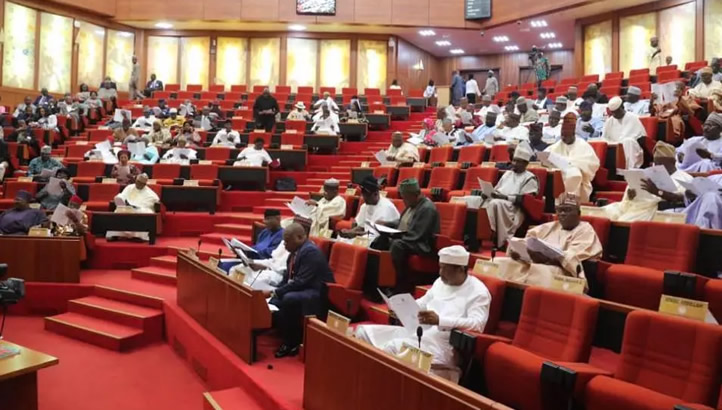
The National Assembly is working on legal safeguards to stop governors from turning state police into instruments of political intimidation, Senate Leader Opeyemi Bamidele said on Wednesday.
The National Assembly is working on legal safeguards to stop governors from turning state police into instruments of political intimidation, Senate Leader Opeyemi Bamidele said on Wednesday.
Bamidele spoke at the Presidential Villa, Abuja, after a meeting with President Bola Tinubu, where he described state police as a “child of necessity” but admitted that fears over abuse by governors remain legitimate.
The debate over state police has intensified as Nigeria battles worsening insecurity across many states and growing pressure for governors to have direct control over security structures within their territories.
But the biggest fear has always been clear: once governors control their own police forces, what stops them from using them against opponents, critics, protesters, journalists or rival political actors?
Bamidele said the National Assembly is not ignoring that danger.
“There will always be fears and concerns, but whether the concerns are well-founded is another issue altogether, and we are not unmindful of them,” he said.
“They are legitimate concerns, but let me put it this way: even with the federal police, a governor who is the chief security officer in the state can still use the police in a way he deems possible, depending on how much the system allows manipulation.
“Most importantly, we are putting mechanisms in the law as we amend the constitution that would prevent or minimize instances of abuse by state governors.”
The Senate Leader said some of the details would be handled through a later amendment to the Police Act, because not every operational safeguard can be inserted into the constitution.
“In the amendment to the Police Act that will follow, we will spell out more details — details that cannot possibly go into the constitution of the Federal Republic of Nigeria,” he said.
Bamidele insisted that the push for state police has gone beyond partisan politics, saying most governors are now aligned with the National Assembly on the need for the reform.
According to him, that support will become obvious when the constitutional amendment bill is transmitted to state houses of assembly for concurrence.
“All the governors, or most of them, are on the same page with us,” he said.
“That will be demonstrated by the speed with which the bill will receive concurrence in their state houses of assembly when we eventually transmit it. We all must know state police is a child of necessity.”
Ekiti State Governor, Abiodun Oyebanji, also backed the proposal, saying governors are ready to approve state police once the constitutional process reaches the states.
He said the National Economic Council, which includes the 36 state governors, had already discussed the matter and that most governors had submitted their positions.
“We are ready for state police, and we are grateful to the National Assembly for the constitutional amendments,” Oyebanji said.
“We are waiting for them to be transmitted to the state houses of assembly. The governors have made up their minds that they will give it speedy approval so we can start implementing.”
Oyebanji also used the Villa visit to speak about his recent re-election in Ekiti, attributing his victory to the grace of God and the support of President Tinubu.
He said the election was over and that he had begun reaching out to opposition candidates in the state.
“The election ended when the winner was declared,” he said.
“I phoned the two other candidates and, with the chairman of the campaign council, we visited one of them and reached an understanding.
“Once I get back to Ekiti, I will visit the other one, and they’ve assured me of their cooperation, because the election and politics have ended and we must return to governance.”
The governor said his second term would remain tied to Ekiti’s 30-year development plan, which he described as the foundation of the state’s budget and manifesto.
But his most political comment came when he was asked about President Tinubu’s chances in Ekiti in the 2027 election.
Oyebanji said the President’s chances were “very bright,” arguing that the ruling party’s vote numbers in Ekiti had continued to rise.
He said the party won 187,000 votes in the 2022 governorship election, increased the figure to 210,000 during Tinubu’s presidential election, and then posted 318,000 votes in the 2026 governorship election.
“From that, you can extrapolate and see that in 2027 a target of 600,000–700,000 is doable,” he said.
Comments