



CSOs outline strategies to protect 2027 elections

 Quick Read
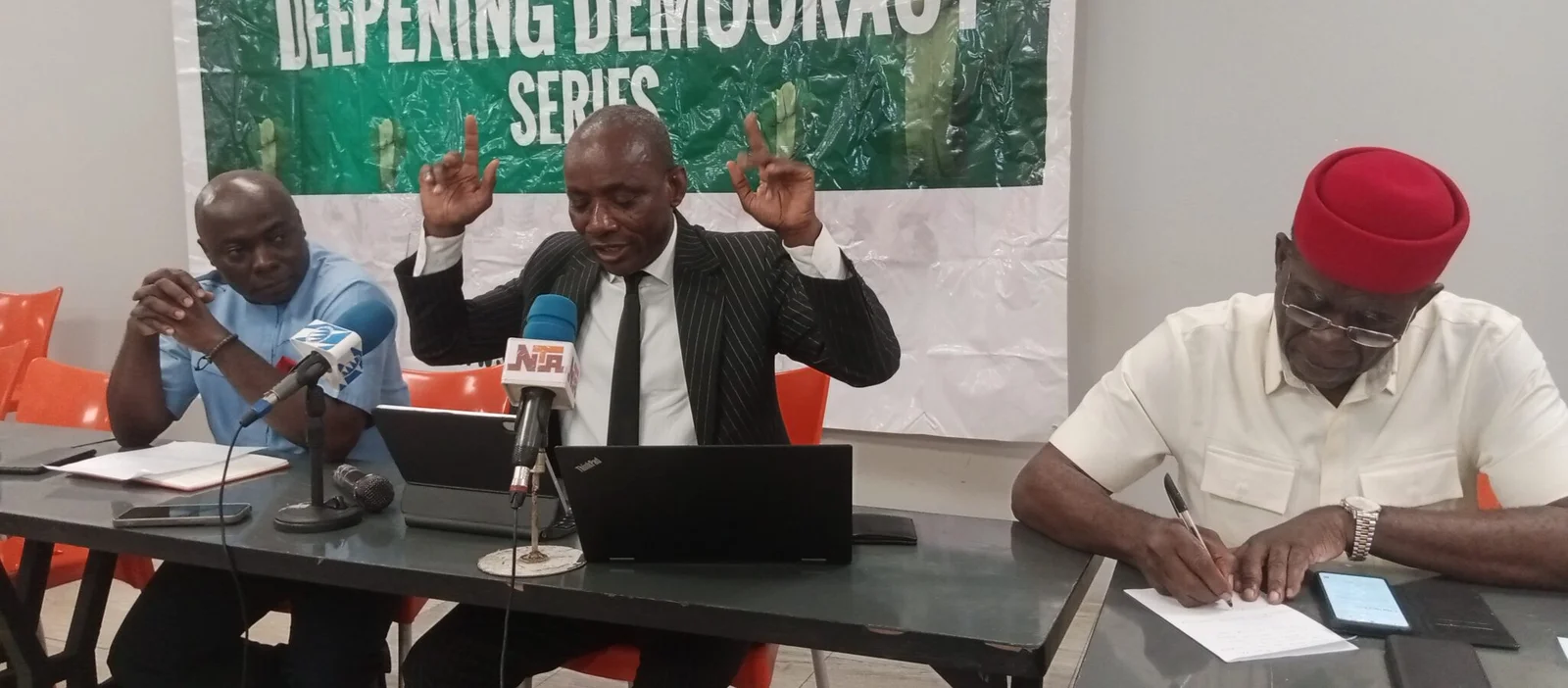
The stakeholders spoke on Tuesday in Abuja at a policy dialogue convened by the Abuja School of Social and Political Thought (ASSPT).
By Emmanuel Oloniruha
Civil Society Organisations (CSOs) and election experts have identified weak political parties, non-credible polling agents and poor technology management as threats to Nigeria’s 2027 elections.
The stakeholders spoke on Tuesday in Abuja at a policy dialogue convened by the Abuja School of Social and Political Thought (ASSPT).
The dialogue reviewed and strengthened a draft document titled, ‘Nigeria 2027 Election Integrity, Citizen Participation, and Democratic Resilience Strategy’.
Presenting the document, ASSPT Director, Dr Sam Amadi, said Nigeria’s democratic integrity required a practical, non-partisan framework holding electoral institutions and political parties accountable.
Amadi said Nigeria had recorded administrative and technological progress, but significant gaps remained in political parties’ capacity to protect the electoral process.
“Our interest is the integrity of the election. It is more important than who wins; it is about the process,” he said.
He said competitive elections required opposition parties capable of demanding fair regulation from electoral institutions without compromising civil society’s independence.
Amadi said electoral integrity could not be sustained by one institution, urging coordinated action among citizens, CSOs, political parties, media, security agencies and election management bodies.
He described the strategy as a unified framework designed to shift civil society engagement from election-day monitoring to pre-emptive, full-cycle interventions.
According to him, past civil society efforts often involved monitoring elections and issuing statements after electoral malpractices had already occurred.
He said the framework was built around protecting the integrity of the vote and improving the democratic environment.
This, he said, included ensuring votes were freely cast, accurately counted, transparently transmitted, lawfully collated and faithfully declared.
Amadi said the Civil Society Situation Room would serve as the central platform for independent citizen engagement.
He added that plans were underway to establish or strengthen State Situation Rooms across the 36 states and the Federal Capital Territory.
“To hold election administrators accountable, civil society will maintain a public tracker monitoring the Independent National Electoral Commission’s commitments,” he said.
He said priority areas would include election funding, voter registration, Permanent Voter Cards, logistics and technology protocols.
On concerns surrounding the Bimodal Voter Accreditation System and INEC Result Viewing Portal, Amadi called for clear protocols on result transmission and backend reviews.
He also urged clarification of the legal precedence between hard-copy EC8A result forms and electronic records.
Amadi said implementation would include a Citizen Townhall on the 2023 elections, enabling grassroots participants and lower-level officials to provide evidence of operational failures.
He said the evidence would inform advocacy for electoral reforms.
The strategy, he added, contained non-partisan support modules to strengthen internal party democracy, transparent primaries, campaign finance compliance and polling-agent training.
Amadi said the strategy was structured into four phases: institutional preparation, campaign monitoring, election-day and collation operations, and post-election learning and reform.
Prof. Vivian Madu, a visiting professor from the National Human Rights Commission, stressed grassroots accountability and credible party-agent recruitment.
Madu identified the failure of political parties to field credible agents as a major weakness in previous elections, including the 2023 general elections.
“If you do not have credible agents on the field—agents who cannot be compromised—then you have lost the election before it ends,” she said.
Country Director of Accountability Lab Nigeria, Mr Odeh Friday, urged citizens to properly document electoral irregularities.
“In many elections, citizens report incidents, but it feels like nothing happens because those incidents were not properly documented,” Friday said.
Prof. Theophilus Ndubuaku of the Nigeria Labour Congress Political Commission called for aggressive voter education to encourage citizens to vote according to their conscience.
He said addressing hunger and poverty before the 2027 elections was essential to preventing voter inducement.
The Chief Executive Officer of KORA 360, Onyinyechi Etusi, stressed the need for post-election accountability by the electoral commission.
Etusi urged INEC to consistently account for its performance and operational challenges.
Kosi Umeh, Programme Officer at the Policy and Legal Advocacy Centre, said the centre planned to deploy a citizen-led electoral accountability tracker.
She said the tracker would empower citizens to report incidents and monitor electoral activities in real time.
(NAN)
Comments