



How Sanwo-Olu deconstructed power by being a photographer

 Quick Read
on the evening of July 20, 2026, at the grand ballroom of Eko Hotel and Suites, Lagos State Governor Babajide Sanwo-Olu quietly reversed that script. He became a photographer.
By Nehru Odeh
Lagos State Governor Babajide Sanwo-Olu never fails to deconstruct power by exposing its banality. He never fails to show the ordinariness of power through his actions, whether on the streets or in the way he relates to his subordinates.
Indeed, he has done that many times in the course of his public service through actions that belittle power, that stubborn, headstrong taskmaster who prefers to be served rather serve, that egocentric overlord, that over-bloated, power-drunk “oga-at-the-top (to use Nigerian pidgin parlance) who prefers to be worshipped rather than serve.
Power, of course, often announces itself with distance. It prefers the high table to the crowded floor, the spotlight to the shared moment. It is more accustomed to being photographed than to holding the camera.
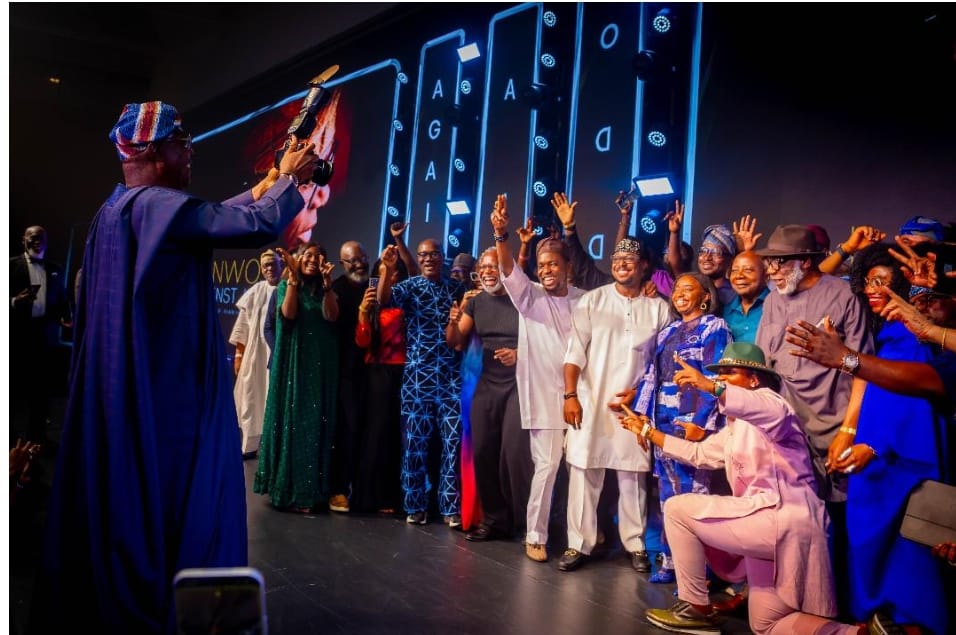
But on the evening of July 20, 2026, at the grand ballroom of Eko Hotel and Suites, Lagos State Governor Babajide Sanwo-Olu quietly reversed that script. He became a photographer.
It lasted only a few moments. Yet the governor unknowingly captured more than smiling faces gathered on a stage. He captured a philosophy of leadership: service -especially the one espoused by John C. Maxwell when he said: “The measure of a leader is not the number of people who serve him, but the number of people he serves.”
Standing before a crowd of photographers, artists, public officials, family members and friends during the public presentation of Sanwo-Olu Against the Odds: A Photo Story of Resilience in the Face of Adversity, a coffee-table book by renowned photographer Ademola Olaniran, Sanwo-Olu accepted a professional camera, raised it with surprising ease, focused on Olaniran and his colleagues who had assembled on stage, and pressed the shutter.
The photographers became the photographed.The governor became the image-maker. The symbolism was impossible to miss.
Some people might dismiss it as just a show, as the governor playing to the gallery and paying back his photographer in his own coin for all his years of service and obeisance.. Some might dismiss that singular gesture as the governor cashing in on the opportunity to not just steal the moment but the show and also to “cash out” by gaining social capital from it.
But it is more than that. Power doesn’t genuflect. It hardly concedes defeat. It hardly pretends to be what it is not. For a man whose public life has been documented through countless lenses, there was something deeply human about his willingness to step behind the camera and celebrate those who usually remain behind it.
It was a simple gesture, almost playful, but it reflected the traits many Lagosians have come to associate with him: humility, accessibility and an instinctive appreciation for the contributions of others.
Leadership, after all, is not always measured by grand speeches or monumental projects. Sometimes, it reveals itself in the smallest acts. That photograph was one such act.
It was an acknowledgment that history is not written by leaders alone. It is also preserved by those who patiently document every handshake, every inauguration, every crisis, every triumph and every ordinary day that eventually becomes extraordinary.
For one brief moment, Sanwo-Olu crossed that invisible line separating the subject from the storyteller. It was a role reversal filled with quiet grace. Those who have followed his political journey would hardly find the gesture surprising. Humility has remained one of the defining features of Sanwo-Olu’s public persona.
Since assuming office as governor in 2019, he has cultivated the image of a leader more comfortable among people than above them. Whether walking through flooded neighbourhoods after heavy rains, visiting markets without excessive ceremony, riding public transportation to inspect ongoing reforms, or engaging directly with victims of disasters, he has consistently projected the image of a governor who prefers proximity to aloofness.
During the COVID-19 pandemic, when Lagos became Nigeria’s epicentre of the crisis, Sanwo-Olu’s daily briefings became less about officialdom than reassurance. Rather than govern from behind closed doors, he spoke directly to residents, explaining difficult decisions, calming anxieties and sharing the burdens of uncertainty.
He understood that leadership, especially in moments of crisis, is not merely about issuing directives. It is also about being visibly present.
That same disposition has often manifested in quieter moments. Staff members and political associates frequently recount a governor who remembers names, acknowledges junior officers and treats protocol as a necessity rather than a barrier. Such stories rarely make newspaper headlines, yet they often shape public perception more profoundly than political rhetoric.
His decision to launch Olaniran’s book was itself an affirmation of creative labour. Photography has long occupied a paradoxical space in public life. Every great political moment is remembered through photographs, yet photographers themselves often remain anonymous, hidden behind the cameras that immortalise everyone else.
On that evening, Sanwo-Olu turned the spotlight around. He celebrated the storytellers. He recognised that history belongs not only to those who make it but also to those who preserve it.
Perhaps that explains why laughter filled the hall as he carefully aimed the camera at Olaniran and his colleagues. The governor appeared genuinely delighted by the experience, while the photographers responded with raised hands, broad smiles and playful poses.
It was less a ceremonial exercise than a shared human moment. The irony was delicious. The man whose resilience had inspired an entire photo book suddenly found himself learning, however briefly, the craft of the man who had chronicled his journey through years of political storms, public scrutiny and personal resolve.
For a fleeting instant, the governor stepped into the shoes of the artist.
And perhaps he came away with a deeper appreciation of the patience behind every memorable photograph.
Photography demands timing, perspective and empathy. So does leadership. Both require seeing what others overlook. Both depend on understanding that every face has a story.
As guests applauded and cameras flashed across the ballroom, Sanwo-Olu’s impromptu lesson in photography became more than a delightful interlude in an otherwise formal event. It became a metaphor.
A reminder that leadership is strongest when it remains grounded enough to exchange roles, honour others and celebrate those whose work often unfolds outside public applause.
The photograph he took may never win an international photography award. That was never the point. Its greatest value lies in what it represented: a governor willing to step down from the pedestal, stand behind the lens and allow others to occupy centre stage.
In an age when power too often seeks to be seen, Sanwo-Olu chose, if only for a few minutes, to see. Sometimes, that is the finest picture a leader can take.
Comments