



‘I deceived nobody,’ Obasanjo fires back at Osoba over 2003 political row

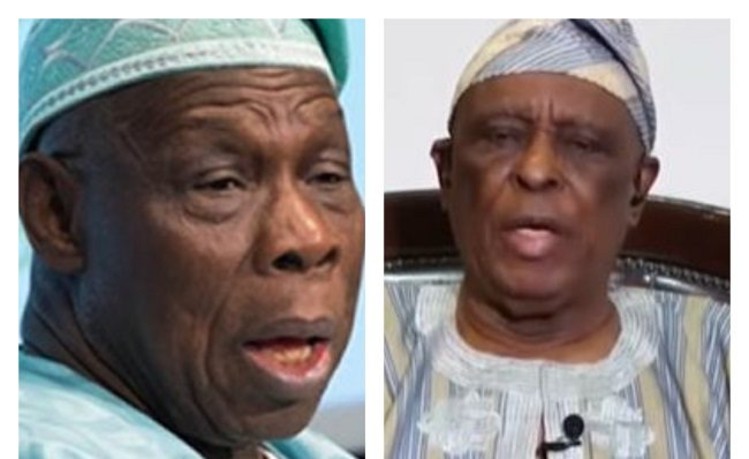
 Quick Read
Obasanjo said Osoba was not privy to several political consultations that preceded his decision to contest the presidency after his release from prison.
By Adejoke Adeleye
Former President Olusegun Obasanjo has strongly refuted allegations by former Ogun State Governor Olusegun Osoba that he deceived leaders of the Alliance for Democracy (AD) ahead of the 2003 general elections, insisting he neither misled anyone nor acted in bad faith during his presidency.
In a detailed letter dated July 23, 2026, addressed to Osoba, Obasanjo described the former governor’s account, published in The Legal Observer under the title “How Obasanjo Deceived Us in 2003,” as inaccurate and lacking important historical context.
“There are many things you got wrong and many things you omitted advertently or inadvertently in your write-up,” Obasanjo wrote. “Your presentation was farfetched to put it mildly.”
The former president took particular exception to being labelled deceptive.
“I take strong and serious objection to your calling me a deceiver because I deceived nobody. I always presented my case and all issues as I had them and as I understood them.”
Obasanjo said Osoba was not privy to several political consultations that preceded his decision to contest the presidency after his release from prison.
According to him, different groups, including those led by Lawan Katsina, the late Chief S.M. Afolabi and Martins Kuye, approached him to seek elective office before he embarked on nationwide consultations with political leaders across the South-West, North and South-East.
He maintained that his political philosophy has always been anchored on inclusion rather than bitterness.
“Politics is for welfare and well-being of people and there should be no personal bitterness or acrimony in it.”
Obasanjo also rejected suggestions that his post-1999 collaboration with the AD stemmed from political weakness, insisting that his decision to build what he described as a “sort of national government” was motivated by national unity.
“Bringing PDP and AD to join me was not out of weakness rather, it was out of strength and the unity and progress of the country.”
The former president further disclosed that after the 1999 elections, he directed defeated Peoples Democratic Party (PDP) governorship candidates in the South-West to begin rebuilding support in the region and encouraged dialogue with prominent AD figures to bring the Yoruba into what he called Nigeria’s political mainstream.
Responding to Osoba’s comments on the political crisis involving former Speaker of the House of Representatives, Ghali Na’Abba, Obasanjo alleged that the impeachment plot against him was initiated by his then Vice President, whom he accused of secretly plotting to succeed him after only one presidential term.
“He gave him N5 million to begin his impeachment work. I treated it with contempt as I had committed no impeachable offence.”
Obasanjo also dismissed claims that six AD governors could have dictated the direction of his administration, describing such a suggestion as unrealistic.
“Six to dictate to thirty is ridiculous. I had an Executive Council, a National Assembly, a virile political party, 21 governors and nine other governors from another party.”
On the 2003 elections, the former president insisted that the defeat of most AD governors reflected the electorate’s choice rather than political manipulation.
He argued that, except for Lagos State, where he referenced allegations surrounding the alteration of election figures, the outcomes in the South-West were genuine.
Obasanjo reiterated his opposition to ethnic politics, saying he consistently rejected attempts to reduce his presidency to a regional project.
“I screamed and said Nigerian President must not be trivialised by tribalising it.”
Despite the sharp rebuttal, Obasanjo ended the letter on a conciliatory note, thanking Osoba for allocating the land on which the Olusegun Obasanjo Presidential Library (OOPL) was built in Abeokuta.
“The greatest service you rendered for me and for Abeokuta is the land allocated for Olusegun Obasanjo Presidential Library. It has become the most significant landmark in Abeokuta.”
The letter is Obasanjo’s first formal response to Osoba’s public account of the political events leading to the 2003 elections and offers his version of the relationships, negotiations and decisions that shaped one of Nigeria’s most consequential political periods.
Comments