



Doyin Aguoru: The scholar who breaks barriers and collapses boundaries


 Quick Read
Some of Africa's finest minds - academics, writers, literary critics, students, theatre practitioners and cultural enthusiasts - converged on the Senator Abiola Ajimobi Resource Centre, University of Ibadan, for the public presentation of Falola’s book, “Feminism, Africanism and Globalism: Doyin Aguoru's Voices through Drama”
By Nehru Odeh
Professor Doyin Aguoru is a scholar and writer whose works break barriers, collapse borders and extend the frontiers of imagination. She belongs to that rare company of scholars whose influence cannot be measured merely by the books they have written, the lectures they have delivered, or the academic titles they bear but by the way they live and give expression to their ideas.
Still, while some intellectuals produce knowledge and others become knowledge’s faithful custodians, she has done something even more enduring. She has transformed scholarship into a moral vocation, drama into a language of resistance, and feminism into an African conversation rooted not in borrowed theories but in lived realities.
And for decades, she has stood at the crossroads where literature meets history, where performance encounters politics, where culture wrestles with conscience. In her hands, the stage ceases to be a place of entertainment. It becomes a courtroom where injustice is arraigned, a shrine where forgotten memories are resurrected, and a marketplace where ideas negotiate with tradition.
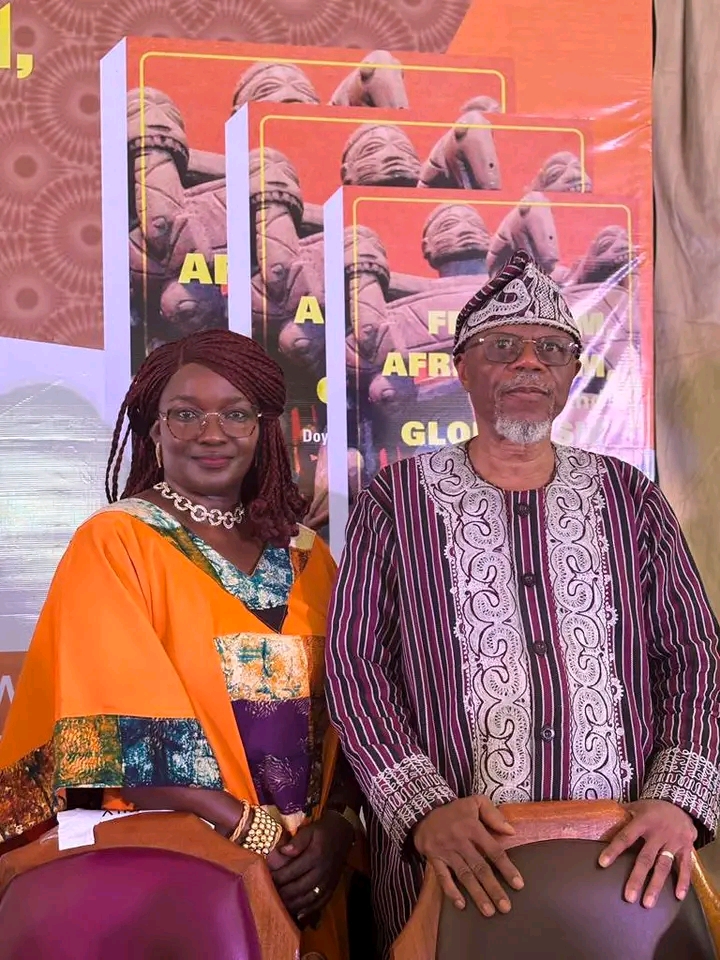
This is indeed why Professor Toyin Falola, one of Africa’s most celebrated intellectuals and the Jacob and Frances Sanger Mossiker Chair in the Humanities at the University of Texas at Austin, found himself irresistibly drawn to her scholarship.
It was on account of these and other reasons that some of Africa’s finest minds – academics, writers, literary critics, students, theatre practitioners and cultural enthusiasts – converged on the Senator Abiola Ajimobi Resource Centre, University of Ibadan, for the public presentation of Falola’s book, “Feminism, Africanism and Globalism: Doyin Aguoru’s Voices through Drama” on Wednesday, 15 July 2026
Published by Carolina Academic Press, the 346-page volume is much more than an appreciation of Aguoru’s academic accomplishments. It is a rigorous intellectual engagement with her ideas, her plays and her enduring contribution to African literary scholarship.
It was an afternoon of tributes, of music, of drama and indeed of scholarship. It was an afternoon of memories and of stories steeped in what Professor Abiola Irele refers to as the African imagination. It was also a day when scholarship met creativity, and both were joined in an intellectual union.

Hosted by the then Vice-Chancellor of the University of Ibadan, Professor Kayode Adebowale, represented by the Deputy Vice-Chancellor (Academics), Professor Juwon Tunde Arotiba and moderated by Dr. Samson Ijaola, the programme combined scholarship with culture, creativity and literary criticism in a manner that reflected Aguoru’s own intellectual philosophy.
Goodwill messages were followed by a soulful, musical performance by the University’s Department of Music, while dramatic presentations of “Stolen Seeds” by Dr. Oreofe Williams and City of Talents brought to life the very ideas that Falola’s book seeks to examine.
In his welcome address, Prof Juwon Tunde Arotiba, Deputy Vice-Chancellor (Academics), University of Ibadan, was full of praise for Aguoru, who he described as an asset to the university and an indefatigable woman who puts all her efforts and passion into whatever she wants to do.
Dr Tokunboh Dosunmu, who was unavoidably absent, spoke virtually. She noted that the event was more than the presentation of a book. According to her, it was a moment of deep, personal reflection, as she had the privilege of knowing Aguoru in the last three years, of watching her journey and of seeing her grow in scholarship and confidence. “There is a special joy that comes in watching someone you know remain faithful to their deeds,” she said.
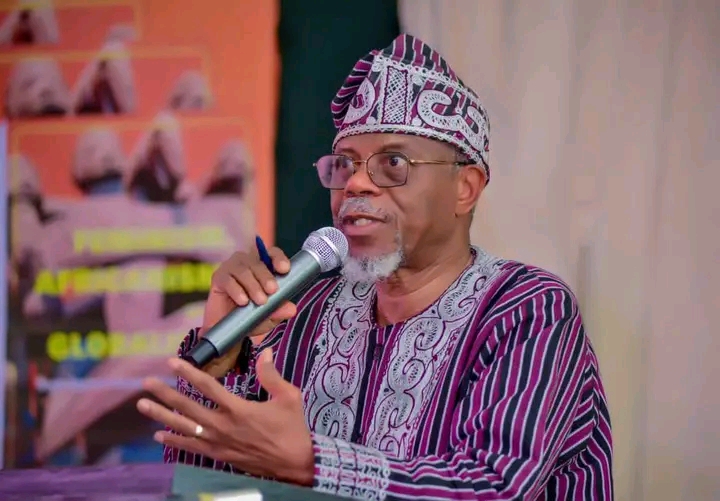
“Aguoru has evidently always understood that her voice was not given merely to be heard. It must be used. It must question, challenge, illuminate, and where necessary, disturb our comfort. Through her drama, she has used that voice to engage some of the most important questions confronting our society.
“And now, that voice has become the subject of a substantial work of scholarship. There is something deeply gratifying about that. It means that the stories have travelled, the ideas have taken root, the questions have remained alive, and other scholars have found the work important enough to examine, debate, and preserve for future generations.
“I am very proud of how far you have come, proud of the seriousness with which you have pursued your calling, proud that you have continued to speak in your own words, and proud that your work is helping to enlarge the space for African women to speak, create, question, and shape the societies in which they live,” Dosunmu noted.
Prof Toyin Falola, author of the book, said he knew Aguoru through Professor Ademola DaSilva. “We were planning a conference, and I was looking for someone to plan it. Professor DaSylva said, ‘I have this dedicated student who can do it?’ And she did a good job. At one time, when the university gave me an honorary doctorate, the Vice-Chancellor asked her to organize a conference in my honor. And she did a good job. When Professor Aina was appointed Vice-Chancellor of Caleb University, he also approached her to organize a conference. And she did a good job. And it’s from doing those good jobs that one thing led to the other,” Falola enthused.
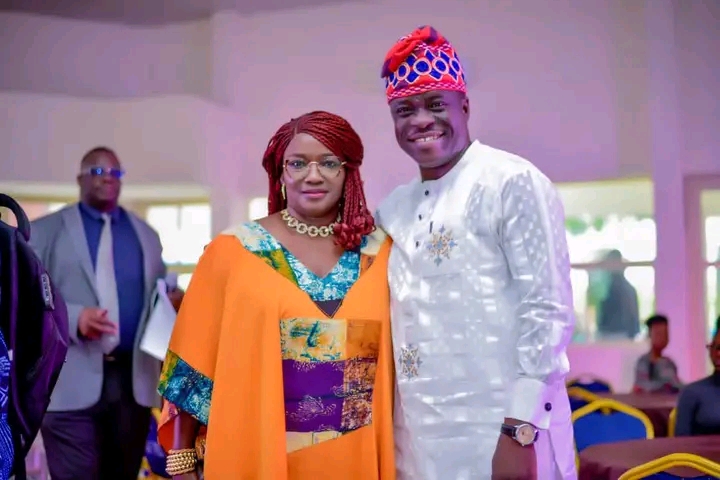
Falola also stressed that more attention should be paid to young writers instead of focusing on works of older and established writers. The distinguished scholar said that was the only way to the future and how the works of the older writers can be sustained.
“No matter what we do. If we don’t encourage younger people in all that we do, we fail in the final analysis. There can be no success without successors. And, we must always remember that If you produce a poet in Niyi Osundare, my friend, If younger people don’t follow in that tradition, both Niyi Osundare and the generation in the distant future will be forgotten. And that is one of the crises that we have now as a nation,” Falola averred.
Falola then used the opportunity to reveal the major achievements of the book. “First, the book is a counter-narrative in the sense that while many texts are male-centric interpretations of African drama, this book centers on the female voice. Second, the book distinguishes itself by moving beyond Western feminist theories. So, it’s a post-colonial project. Third, I balance African studies with gender and women, with political science and sociology.
“The book was also driven by a politics of recognition. African women writers and intellectuals have frequently been insufficiently studied, celebrated, and incorporated into intellectual history. Without serious analysis, citation, teaching, and publication, even important scholars may gradually disappear from academic memory. Writing about Aguoru was therefore a deliberate intervention against the exclusion of female intellectuals from the dominant narratives of African scholarship,” he said
Dr Oreofe Williams, author, dramatist and presenter, also extolled Aguoru’s virtues and achievements effusively. He described her not just as a university teacher but also the mother of all and a woman of genius. “I’m talking about a woman who has raised a number of us. A woman of uncommon intelligence. A woman of distinction. A woman of integrity, whose character inspires confidence. A woman of wisdom, whose counsel shapes love. A woman of excellence who upholds the highest standards.
“A woman of genius, whose commitment to scholarship is unwavering. A woman of courage, who embraces challenges with grace. A woman of compassion, who mentors with patience and sincerity. A woman of discipline, who inculcates love, respect, consistency, and purpose. A woman of influence, whose impact is felt beyond the university. A woman of knowledge and of learning. A woman of leadership, who leads by example and service.
“A woman of innovation, who encourages creativity and critical thinking. A woman of humility, whose achievements are marked by grace and humility. A woman of inspiration, whose journey motivates generations of scholars. A woman of service dedicated to humanity and national development. A woman of honour, whose contributions continue to earn admiration and respect. A woman of purpose, whose legacy is purity, whose life transforms our world,” Williams enthused.
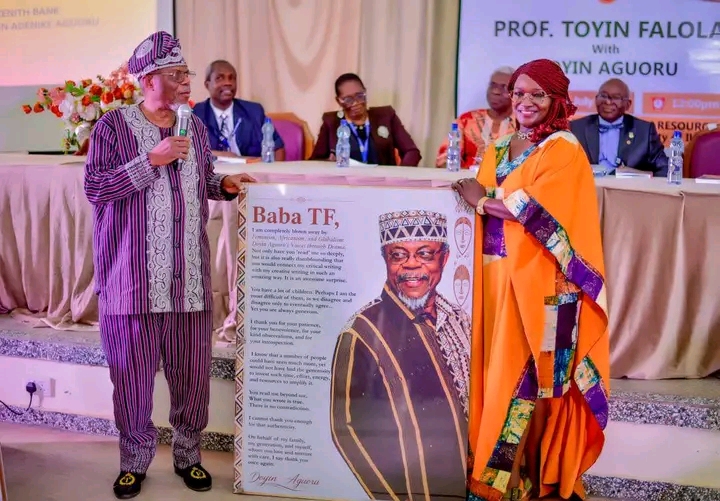
Aguoru, who was palpably appreciative of what Falola had done, for interrogating her plays, devoting so much time and effort to her scholarship and publishing a critical work on them, presents a giant-sized portrait of the distinguished scholar to him.
“I have the most unusual relationship with Professor Toyin Falola. Baba TF,” she said. “I’m completely blown away by the book, ‘Feminism, Africanism, and Globalism: Aguoru’s Voices Through Drama.’ Not only have you read me so deeply, but it’s also really dumbfounding that you connect my critical writing with my creative writing in such an amazing way.
“It’s an awesome surprise. You have a lot of children, but I know that I’m the most difficult of them. We disagree and disagree only to agree eventually, yet you are always very generous. I want to thank you for your patience, for your benevolence, for your kind observations, and for your introspection,” she remarked.
In a chat with newsmen, Aguoru also said: “I receive this recognition with profound humility and gratitude. Professor Toyin Falola has demonstrated that scholarship achieves its highest purpose when it generates dialogue across generations, disciplines, and cultures. I am deeply honoured that my work has become the subject of such thoughtful critical engagement.
“This book is not simply a celebration of my work; it is an invitation to continue asking difficult questions about Africa, gender, culture and justice. I dedicate this honour to my students, colleagues and the many African women scholars whose research continues to reshape our understanding of the continent. I hope it inspires younger academics to pursue scholarship that speaks confidently to both Africa and the wider world.”
Professor Niyi Osundare, poet, scholar, essayist and Emeritus Distinguished Professor at the University of New Orleans also praised Falola and Aguoru, describing them as two lucky protagonists, for their energy, enthusiasm and tenacity. He also wondered how Aguoru was able to create this kind of work that tells stories about other African countries in Nigeria.
“There are two lucky people in our celebration today. Two lucky protagonists. The first is the writer, Professor Doyin Aguoru, who produced the primary works, on which Professor Falola has done this book. Without one, there cannot be the other.
“I knew Professor Aguoru before she became a doctor, and before she became a professor, and after she became my colleague in the English department, I often wonder, and I tell her, again, the question I ask Professor Falola, ‘Do you have any time for rest at all?’ To talk about the energy, the enthusiasm, the tenacity that this lady brings to the work we do.
“And the way she takes this academic work, which doesn’t pay us much in material terms, and which is not recognized very much by some people in positions of power in Nigeria, the way she loves this profession, in spite of all that. Now, if you come, if you run into somebody, you meet somebody who works hard at all these things, it is important for you to recognize her energy and to pay her back. It is important. Without responses like this, art dies.
“Some people would say that what Aguoru has done belongs to the primary sphere of creativity. She was the one who created the stories, whose appreciation we have there. Other people would say, without the secondary hemisphere, there wouldn’t be something like this. So it takes two to tango in this kind of work. And this is what we have been celebrating all day.
“One or two words about the title. Feminism, Africanism, Globalism. Feminism. This book is written by a woman. The book and the scholarly works were produced by a woman. Then Africanism. You know, without any doubt, after reading the first few pages that this must have been written by an African. The sense of indigeneity, the pride in our not local, but indigenous culture that we find here. Then Globalism. I’m looking at the settings of Professor Aguoru’s works.
“When I encountered the refugees of the Great Lake for the first time, I think I asked her, ‘How many years did you spend in Rwanda?’ What about East Africa? I don’t think she was there for that purpose at all. How have you been able to create this kind of work in Nigeria? And this is about Rwanda, and the languages, East African, and so on. This takes us to what we call two kinds of imagination: the primary imagination and the traveling imagination,” Osundare submitted.
Reviewers hailed the book as a landmark contribution to African literary criticism, praising its rigorous, interdisciplinary engagement with Aguoru’s dramatic oeuvre and its nuanced exploration of the intersections of feminism, African identity, globalization, performance studies, and literary theory.
They noted that the book not only situates Aguoru’s scholarship within contemporary global intellectual debates but also demonstrates the enduring power of African drama to illuminate pressing questions of justice, gender, cultural memory, identity and human development, affirming Falola’s reputation as a scholar whose work bridges history, literature and cultural criticism while expanding the frontiers of African humanities scholarship.
And as the event wound down to a close, all the guests present agreed that Aguoru’s scholarship is a melting pot in which not only barriers are broken, boundaries collapsed, but also one in which creativity and literary criticism join hands in an intellectual union.
Comments