


 Quick Read
Speaking on the agonising experience of the residents, Aribidesi lamented that for over 10 years, they had been virtually living amidst a refuse dump, saying that the government had practically looked away while their once serene environment was being turned into a "refuse city."
Lagos Communities Where Dumpsites Threaten Potable Water, Human Existence
As waste management continues to pose a serious challenge in Lagos, Muritala Ayinla reports that thousands of residents of Lanre community and other areas on LASU-Igando Road are at risk of an outbreak of an epidemic and sudden death due to the increasing dumpsites overrunning the habitats and polluting their water.
As the weather changed with powerful winds threatening to remove the roofs of houses in the neighbourhood of Unity community, a burgeoning settlement in Igando overrun by heaps of refuse, Mrs Bunmi Aribedesi, 54, a food vendor, was also busy cooking with her charcoal stove. She joined other residents and property owners in silent prayers against the downpour that could flood the dumpsite and consequently spill into and submerge their community.
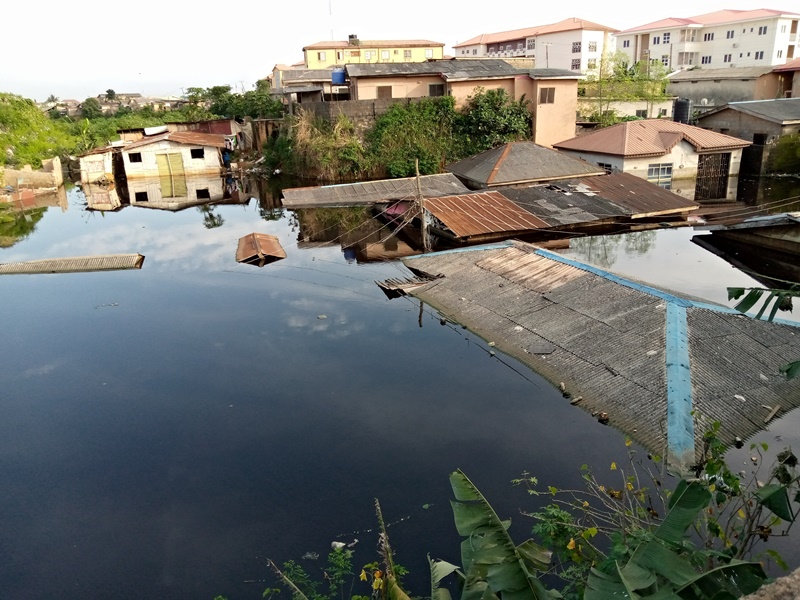
But it appeared the rain was more than prepared to descend heavily. As the atmosphere became cloudy with intense lightning, which heralded an impending rain, flames from her charcoal stove went off with powerful winds, which almost upturned the pot and its contents. She hurried to fetch a wooden plank to cover the violent breeze. But in one fell swoop, the rain began in torrents, and in the twinkle of an eye, the flood enveloped the community. The flood, carrying heaps of refuse from the dumps, took over the community and rendered the environment impassable.
For nearly two hours, it rained heavily, and throughout the day, Aribidesi, the Oyo State-born trader, could neither display her food items nor sell as the floodwater from the dumpsites surrounding her house had submerged her environment, forcing some residents to remain indoors for days while some pupils couldn’t go to school until the flood subsided.
Her sad tale is one of the frequent experiences of residents and business owners at Lanre, Oko Filling, Ile-Epo, Unity, and other suburbs where dumpsites are situated on the Lagos State University–Iba Road near the ever-busy Igando town in Alimosho Local Government Area of Lagos.
Residents of these communities in the heart of Lagos, Nigeria’s commercial hub, literally live and procreate in the midst of mountainous refuse sites, which occupy a large expanse of land in the community. The dumpsites are among the major recognised landfills by the Lagos State Waste Management Authority (LAWMA), the agency saddled with the responsibility of managing waste in the state.
They are officially referred to as Solous Sites and classified into three, namely: Solous I, Solous II, and Solous III.
The Solous (Landfills)
The landfills, otherwise referred to as Solous, are located at the extreme east-west area of metropolitan Lagos in Alimosho Local Government. Like other landfills, they receive waste of different kinds, ranging from domestic to commercial and industrial sources, from major parts of the state metropolis.
The sites were originally pits for lateritic soil, bordered by residential housing. The wastes brought by trucks are dumped haphazardly without the use of daily soil cover and are sorted by the on-site waste pickers. Solous I Landfill encompasses an area of 7.5 hectares and is located at N060 34. 307’, E0030 15.
It is the oldest of the sites. It began operation in 1993 and closed in 2006 without the use of a final cap or cover. It was reopened in 2011 and has since been in use.
Solous II, which occupies N060 34. 286’, E0030 15. 146’, spreads over an area of 7.8 hectares. It started operation in 2008, and on average, about 2,250m³/day of waste is dumped at the site.
Solous III, located at N060 33. 897’, E0030 15. 082’, started operation in 2008 and is estimated to receive about 2,250m³ of waste daily. It is divided into cells with access roads. It is the largest of the three sites, spreading over an area of 12 hectares. It is flanked by Alimosho General Hospital, Igando.
With the growing refuse dumpsites that are fast degrading the environment, life is gradually departing these communities as residents only exist but are losing everything that makes the world worth living. They exist without the freedom to breathe fresh air and without an ambient environment to live in. They are limited to their rooms or apartments, while many hardly open their windows for fresh air as their atmosphere is constantly polluted.
In these neighbourhoods leading to the state university and playing host to the general hospital of Lagos’ most populous settlement, Alimosho, every passer-by, whether in vehicles or walking through the area, is usually welcomed by the disgusting stench from the compactors conveying refuse, usually parked haphazardly on LASU-Igando Road. The air pollution in this part of Lagos is intense.
Speaking on the agonising experience of the residents, Aribidesi lamented that for over 10 years, they had been virtually living amidst a refuse dump, saying that the government had practically looked away while their once serene environment was being turned into a “refuse city.”
“This is no longer a community where you can sit comfortably outside your house to relax and get fresh air; our air has been polluted. What we breathe in is polluted air and toxic air coming from the burning dumpsites surrounding us. When you open a bottle of drink, hundreds of flies besiege your drink,” she said.
According to her, beyond the fact that the existence of the residents is constantly being threatened by the refuse and the reek oozing out from the area, businesses and other economic activities are collapsing rapidly, while shops and businesses are closing down due to the stench that has enveloped the community.
“No matter how I make my shop environment tidy and attractive despite the filth in our community, customers have stopped eating in my shop since I can’t control the polluted air that comes from the dumpsites. Now, it is difficult to sell four cups of rice daily. The only people left as my customers are the scavengers and cart pushers from the dumpsite. We only hope that someday, a governor with a heart of gold will pay attention to our environment.”
If Mrs Aribidesi is still hopeful about the possibility of government intervention in the area, Funsho Olalude, 57, who owns and operates a relaxation centre in the area, seems to have given up hope of the likelihood of government coming to his rescue.
The businessman said that the proximity of the dumpsite has hampered his multi-million-naira investment from growing, saying so much has been lost and is still being lost with the presence of refuse dumps.
He said: “It is ironic that successive administrations in Lagos, which boasted of growing the state’s economy, have also killed so many businesses in this environment through the siting of dumpsites on this axis.”
Olalude, who owns a big restaurant and relaxation centre in the area, added, “Our kind of business requires a serene environment where people can relax in a good ambience. But we no longer get patronage like in the past because of the terrible smell emissions from the dumpsite. Foul odour from decomposing garbage has dominated the air. We perceive the stench as oxygen, while the whole environment is a ‘no-go area’ whenever it rains; it is terribly flooded. We are living in a world of pollution—our air, our environment, and most sadly, our water.”
Polluted Water as a Major Burden
Besides the pain of having to live in the perpetually putrid stench hanging thickly in the air, threatening their existence, the underground water in these communities has also been badly polluted by the presence of the landfills in their vicinity.
Experts described this as a clear indication of failure on the part of the government to carry out environmental impact assessment tests before siting the landfills in the area.
From Lanre Street to Alhaji Sekoni Way, come the lamentations over contaminated underground water. From Raimi Ajibowo to Somoye Ogundairo and other areas in the vicinity, nobody can boast of fresh and clean water.
Other Hazards of Living Close to Landfills
Other health and environmental experts, including the Lagos State Commissioner for Health, Prof. Akin Abayomi, confirmed that poorly managed and wrongly sited waste dumping sites are pathogen and epidemiology centres where germs breed and diseases spread among residents and passers-by. According to them, viruses, bacteria, and fungi, which breed regularly in waste dumps, landfills, waste tanks, and waste bins, can produce infectious diseases, toxic gases, and radioactive elements. They added that waste dumps and landfills may emit toxic compounds or harbour radioactive materials that are dangerous to human health and well-being.
Corroborating their submission, Dr. Ibrahim Hassan of the University of Maiduguri Teaching Hospital said that emerging research has shown that exposure to dumpsites also has grave consequences for pregnant women.
“There is an anatomical problem of deformity in the physical structure of the animals living in the vicinity of waste dumps due to the availability of teratogenic substances (teratogens). Carbon monoxide poisoning in pregnancy is the most fatal cause of birth defects and fetal death.
Carbon tax and pollution tax are introduced to curtail excessive carbon emissions by vehicles and industries,” he said.
Hassan listed other health risks of living close to a dumpsite to include: skin disorders resulting from fungal infections, allergic dermatitis, pruritus, and skin cancer; respiratory abnormalities arising from bacterial upper respiratory tract infections (pharyngitis, laryngitis, and rhinitis), chronic bronchitis, and asthma. He added that inhabitants of the landfill areas are also at risk of abdominal and intestinal problems such as bacterial enteritis, helminthiasis, amoebiasis, liver cancer, and renal failure.
“They can also be suffering silently from dental disorders, ear infections – otitis media and bacterial infections, skeletal muscular system issues also known as back pain, central nervous system impairment, neurological development disorders, peripheral nerve damage, and headaches; eye infections – allergic conjunctivitis and bacterial eye infections. They can also have problems with blood disorders resulting from iron deficiency anaemia, and other health risks include malaria, chickenpox, septic wounds, congenital abnormalities, cardiovascular diseases, and lung cancer.”
A Call for Action from the Lagos Government
While the Lagos State Health Commissioner, Abayomi, concurred with other health experts that a polluted environment cannot have a healthy population, he expressed fear that as long as waste is dumped and burnt openly, there would be continued pollution, which will further threaten the lives of residents.
Hence, he advised the residents to abstain from such water. He said: “For now, they can’t take the underground water anymore; the water is already damaged. The state government, through its environmental protection agency, Ministries of Environment and Water Resources, Health, and Agriculture, is developing a policy on how to address this situation, especially on landfills.
“We are moving landfills all the way to Ogun State. At least that needs to be done properly because there is no space in Lagos. The water level is very high, and Lagos, being a coastal city, is faced with the challenge of space.”
Even though the waste is still being dumped in the community, the Managing Director of LAWMA, Dr. Muyiwa Gbadegesin, insisted that the agency had concluded plans to decommission the Igando landfill and the one at Olusosun near Ojota due to “urban encroachment and increased human activities around the areas.” He said that the process of winding down activities at those landfill sites had commenced, explaining that there was not much human activity close to the sites at inception, but fast-paced development in the state has seen houses built around them.
For a sustainable environment and a dumpsite-free community, the Lagos State Environmental Protection Agency (LASEPA) General Manager, Dr. Dolapo Fasawe, pointed out that the state government has begun moves to tackle the issues of environmental pollution with the recently launched Blue Box Programme aimed at encouraging the separation of recyclable materials.
The state Health Commissioner, Abayomi, hinted that the government, through LASEPA, in conjunction with the World Bank, was currently working on a permanent solution to the air pollution in the area.
“We are going to put things in place to reduce air pollution, and we are going to measure the impact on health and correlate it with improvement in air quality and life,” the commissioner said.
Last Line
It is crystal clear that with the presence of landfills and the continued flocking of waste compactors around Lanre, Oko Filling, and its environs for refuse dumping, Lagos is sitting on a time bomb with more possible outbreaks of deadly diseases that may affect countless residents, just as it recently raised the alarm over 400 cases of gastroenteritis, also known as vomiting and diarrhoea, which claimed 11 lives.
Comments