


Welcome to Tan’lese, Where Privacy is a Luxury

 Quick Read
But as unpleasant as life may appear to be in Tan’lese, tenants of these chalets live a better lifestyle when compared with other categories of Lagosians who sleep on the highways and under the bridges.
Millions of houses are built across the globe, yet more millions are homeless or living as slaves. Muritala Ayinla, who spent three days in one of the overcrowded rooms in Lagos, writes on the life of Lagosians living in Tan’lese Chalets, where comfort is a luxury.
He was one of the three underaged boys rescued on the streets of Lagos by officials of the Lagos State Ministry of Youth and Social Development on October 25, 2016, while washing vehicle windscreens during school hours. He was rescued alongside 30 other children used by beggars to solicit alms in the state.
At age 12, fate had entrusted Wasiu Issa with the responsibility of an adult, such that he not only struggled to survive but was also saddled with the responsibility of assisting his mother in paying house rent and taking care of his younger ones in Ibadan, the Oyo State capital. He lives in ‘Tan’lese’ (an overcrowded) room in Mushin with 15 other boys, where his cost of accommodation daily is N300—a decision he took when he had no relative in Lagos who could accommodate him.
To secure space in the Tan’lese chalet and a mat to lay his head at night, he pays N200 daily, while he rents a cover cloth for N100 daily. If he must take a bath, he has to pay an extra N50. “The first time I came to Lagos, I was sleeping under the bridge, but when I was mistakenly arrested by officials of the Lagos State Task Force on Environment Special Offences Unit as one of the underaged pickpockets in Oshodi—a crime I knew nothing about—that was when I began to manage in Tan’lese homes despite the cost of living there,” he explained.
In the Tan’lese chalet built on a drainage channel, Issa also pays for the use of body cream, though, like many of his colleagues, “I don’t bathe daily because of the extra fee,” he told this reporter before he was taken to the rehabilitation centre with other rescued kids by officials of the ministry.
Issa is one of thousands of Lagosians who find themselves in Lagos searching for greener pastures. They have nowhere to stay, yet they want to remain in the state of aquatic splendour so long as they can get a place to lay their heads at night. Hence, the choice of Tan’lese—extremely overcrowded rooms located in the state metropolis—is their only option for accommodation in the nation’s commercial nerve centre.
Tan’lese homes abound everywhere in Lagos metropolis. They are located in markets and some houses in the heart of Lagos. From Ketu to Mile 12, Mushin to Oyingbo, Alaba Rago to Ajangbadi, and other parts of the state, especially on Lagos Island, there is hardly any commercial centre in the metropolis without some overcrowded lodges where human beings sleep like animals and jettison any known comfort.
In the heart of Lagos Island are Pelewura, Bombata, Gorodomu, and Dumping Markets—popular markets that house Tan’lese chalets and serve as homes to an estimated 8,000 tenants living in shops-turned-living-rooms. These overcrowded rooms, popularly known as Tan’lese, are home to most Lagos hawkers, street traders, artisans, bus conductors, factory workers, shop attendants, security guards, herb sellers, and porters known as “Alabaru” or “Alabo,” as they prefer to be called. It is also a place of abode for most Lagos street sweepers, shop owners, and food vendors commonly seen in Lagos motor parks and building construction sites. To some of the tenants, Tan’lese is their own “Eko Atlantic City” in the Centre of Excellence, where they can work and live.
Residents of Tan’lese are mostly responsible people who go about their normal businesses or means of livelihood peacefully. They form the vast majority of the estimated 6,000 Nigerians who come into Lagos daily in search of greener pastures without any plans to return to their hometowns immediately. They all came to Lagos with the notion of migrating to a land of abundant opportunities and high hopes of making it. They had lofty dreams while leaving their towns and villages, aiming to return with fortunes. They are at peace with the hustle and bustle of Lagos life, such that, despite the obvious challenges of jobs, accommodation, and security, they want to remain in the city no matter the odds. Like most Lagosians, they say, “Lagos is not easy,” yet the thought of returning to their villages or hometowns is not an option for this category of Lagosians.
To them, where they lay their heads when night falls doesn’t matter, as long as they are seen at work during the day or their scheduled work hours. They hustle from the beginning to the end of the year and most of them briefly return to their country homes during Christmas, New Year, or Eid-el-Kabir festivals.
Visiting Tan’lese
When this reporter visited Pelewura Market, situated on Adeniji Road, a few metres away from the Iga-Iduganran Palace of the Oba of Lagos, it was gathered that the market alone plays host to over 3,000 tenants living in shack rooms, where over 50 percent of the shops have been converted to living quarters. At Tan’lese chalets, whether in Pelewura or other places, comfort is a luxury that nobody cares for. What matters most is where tenants retire at night before daybreak. Hence, K-klamps shops converted into rooms could shelter about seven boys, while those measuring 10×10 per square metre could occupy as many as 13 people, regardless of the health implications.
Inside a Tan’lese Room
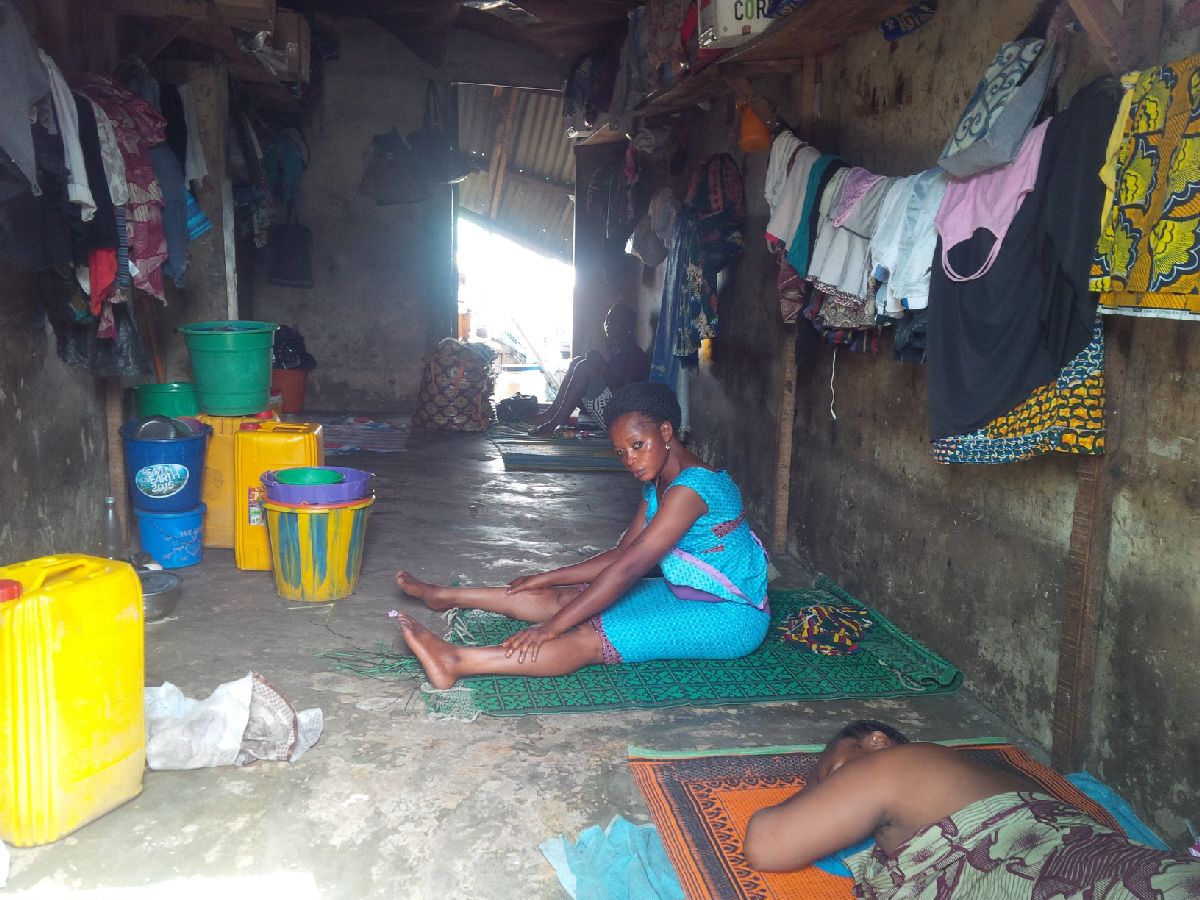
The rooms are usually congested and demarcated, such that turning or changing position during sleep could amount to trespassing. Occupants who do not have a mat spread their clothes on the bare floor to sleep and sit. So too are the spaces where their luggage and other personal belongings are kept.
Rooms in Tan’lese have similar features regardless of the location and the amount paid by the tenants to their landlords. Hung in the rooms are all manners of luggage lumped together on the racks. Clothes are usually hung haphazardly on ropes tied to the ends of the room and sometimes to the walls. The floors of these rooms are always occupied by kegs of water, while the walls look dilapidated with arrays of “Ghana Must Go” bags lying on the racks in their ramshackle sheds.
In Tan’lese Republic, as it is often called, whether it is the male or female quarters, potable water, ventilation, mattresses, ceiling fans, curtains, chairs, and other household items are luxuries. Almost all the occupants have their own hand-fans, as their shop-turned-living-room usually lacks windows and other means of ventilation. Most of these tenants also cook in the same room, thus aggravating the heat in the already stuffy space.
Few of the shops in these ‘Tan’lese markets’ are used for business, while the majority are occupied by tenants who pay as low as N50 per day and N6.60 kobo each for electricity and security.
“They call houses like these ‘Tan’lese,’ which means ‘whose leg is this?’ because of our sleeping arrangement. Each of us pays as much as N1,500 to our landlord, who owns the shop where we sleep. In some places, the more the occupants or tenants, the lesser the amount paid as rent,” a 45-year-old local herb seller, Mrs Ajara Jolaade, told this reporter.
Meeting Jolaade for the first time, she had mistaken this reporter for a customer, saying: “Brother, what do you care for? I have ‘Alomo,’ ‘Opa Eyin,’ ‘Ale,’ ‘Ogindinga,’ ‘Narun,’ ‘Iba,’ ‘Baby Okwu,’ ‘Pakurumo’ (all manner of gins and local herbs for diseases).” But after a brief introduction, the woman explained that life in Tan’lese is truly uncomfortable for most of them, but they all have to brave the odds and overlook the challenges of dwelling in such homes.
Other Homeless Lagosians
But as unpleasant as life may appear to be in Tan’lese, tenants of these chalets live a better lifestyle when compared with other categories of Lagosians who sleep on the highways and under the bridges. A trip through Lagos metropolis at night will reveal hundreds of mentally stable and responsible Lagosians who sleep on the street in front of shops, banks, and filling stations just to pass the night in these places. While some pay security guards manning the places to enable them to do so, others just manage in such available spaces free of charge and wake up as early as 5 a.m. before finding their way to their places of work.
Health Implications/Consequences of Overcrowding
But beyond the inconvenience of lacking privacy and comfort, a Senior Registrar at the University of Ilorin Teaching Hospital (UITH), Dr. Jimoh Saheed, said those who live in Tan’lese homes are prone to diseases that could be life-threatening in the long run. According to him, occupants of overcrowded rooms are susceptible to respiratory diseases and accumulated stress due to long-term discomfort. He said inhabitants of such houses are at risk of lung infections such as tuberculosis, pneumonia, and other upper respiratory tract infections. They could also develop lung cancer in the future.
“Such people can have lung cancer, especially if they live with a smoker. Even when they are not active smokers, since they are passive smokers by virtue of sharing a room with a smoker, they are equally prone to all the health complications of a smoker. Overcrowding could also worsen asthma for those who have the disease. They are also at risk of communicable diseases such as conjunctivitis, catarrh, chickenpox, and other infections. If one of them has it, they will all have it,” he explained.
While Dr. Saheed said the use of public toilets also poses serious health risks for occupants, the immediate past Commissioner for Physical Planning and Urban Development in Lagos State, Mr. Toyin Ayinde, a town planner, said that ideally, a maximum of three persons should be in a room. He noted that dwellers of overcrowded homes will have limited privacy and comfort, which, according to him, will hamper their productivity.
“The moment you have more than four or five people living in a room, no matter how large, the occupants begin to have limited freedom. That is certainly a factor in the overcrowded nature of a city like Lagos and the inability to provide sufficient housing,” Ayinde said.
“This is one of the issues that the 2016 World Habitat Day, themed ‘Housing at the Centre,’ focused on because the kind of house a person lives in determines the kind of person they become. If you live in a place where, when it rains, you have to drain your apartment through the night, or if you are at work and it rains, you will no longer be able to concentrate,” the town planner added.
Rural/Urban Migration-Induced Housing Challenges
Experts agree that housing challenges will continue to surface with more people becoming homeless or living in substandard homes due to the continued migration of people from rural areas to urban centres. It is crystal clear that people will migrate to city centres from rural communities when they cannot be adequately linked with social services such as electricity, water supply, and transportation facilities.
With the continuous influx of people into urban cities like Lagos, there is no doubt that the available infrastructure will be overstretched, leading to a shortage of housing, homelessness, and poor living conditions such as slum dwelling, squatting, and overcrowding, as seen in Tan’lese homes.
Despite the fact that the housing sector’s performance is one of the yardsticks by which the health of a nation is measured, access to affordable housing has largely remained an unfulfilled dream for the vast majority, especially the middle and lower classes of society in Nigeria.
With an estimated population of about 174 million people, Nigeria is currently facing a national housing deficit of about 17 million units, according to a World Bank study. Nigeria has a population growth rate of about 3% and a density of 205 per km² (532 people per mi²). The housing deficit in Nigeria rose from 7 million in 1991 to 12 million in 2007 and 14 million in 2010.
According to experts, Nigeria is also one of the most rapidly urbanising countries in Africa, with over 48% of the population concentrated in urban areas, towns, and cities, which cover less than 10% of the habitable land in the country.
The implications of the ever-increasing population, according to experts, will not only impact the high housing deficit but also force tenants in rented apartments, particularly in cities like Lagos, Port Harcourt, and Abuja, to pay as high as 60% of their average disposable income on housing—far higher than the 20-30% recommended by the United Nations.
Hence, in Lagos, for instance, despite the Lagos Tenancy Law 2011, which forbids landlords from collecting more than one year’s rent from tenants, many landlords in the state demand instant payment of two years’ rent or more, along with other spurious charges such as agreement fees and commission. In most cases, tenants are also forced to pay damages.
Consequently, many who do not have the financial means to secure better accommodation resort to Tan’lese homes or sleep in any available spaces at night at a very meagre cost or no cost at all.
To bridge Nigeria’s massive housing deficit of 17 million units, a World Bank study projects that the country will need N59.5 trillion. The housing and construction sector accounts for only 3.1% of the rebased GDP, while the total current housing production is about 100,000 units per year. It is estimated that Nigeria will need at least 700,000 additional units yearly to reduce the gap.
Although other cities worldwide face housing challenges, Ayinde said Lagos’s housing problem is more acute due to various reasons. He warned that unless pragmatic measures are taken, the issue may persist or even worsen, as migration into the state continues every minute.
Recently, Lagos State’s Commissioner for Housing, Gbolahan Lawal, stated that over 3 million housing units are currently needed in the state. He added that efforts are ongoing to provide about 200,000 housing units yearly.
Housing Schemes: How Affordable?
It is crystal clear that Nigeria has a huge housing deficit, but it is also crucial to recognise that people can only demand what they can afford. The population surge has increased demand for affordable housing, while decreasing disposable income—worsened by rising inflation and economic recession—has significantly reduced the purchasing power of most Nigerians.
Despite the growing housing deficit, successive governments have made efforts to tackle the problem. For instance, the Lagos State government has introduced affordable housing schemes to address the challenge in the state. However, these policies have struggled to meet the housing needs of the majority, who are mostly low-income earners.
For instance, the prices of housing units built by the state government under the Lagos State Home Ownership Scheme (LagosHoms) range from over N4 million to N32 million, depending on the size and location of the housing scheme. The least expensive apartment, a one-bedroom flat in Epe, costs N4,340,000, while the most expensive, located in Gbagada, costs N32,530,000.
When unveiling the prices of the housing units in February 2014, the immediate past Governor of Lagos State, who is also the nation’s Minister for Power, Housing, and Works, Mr. Babatunde Fashola, listed the conditions for prospective applicants. He stated that only those who could pay 30% of the cost of the house immediately—followed by instalments at a 9.5% interest rate over ten years—were eligible.
Low-Cost Housing: A Fluke?
Despite government promises of low-cost housing, Ayinde, the second National Vice-President of the NITP, argued that the idea of low-cost housing is unrealistic.
“Let’s be factual—you can’t get cheap or low-cost housing anywhere in Nigeria or beyond because there are no low-cost building materials. However, affordability can be achieved through financing arrangements,” he said.
Ayinde, like other experts, also blamed housing problems on ineffective housing finance, bureaucracy in land acquisition, and documentation issues as major factors exacerbating the crisis.
More Houses, Less Occupants
In spite of the huge housing deficit in Nigeria, particularly in Lagos, which makes thousands of people live in extremely overcrowded rooms with more sleeping on the roadsides and under bridges, it is, however, paradoxical that multi-million Naira mansions located in some highbrow areas in Lagos are lying fallow with very few or no occupants in them.
Investigations revealed that some of the houses, which are priced in United States Dollars, are either overpriced or acquired and abandoned by owners who, in most cases, are not based in the country. Many of them have a security guard or personnel looking after them, or estate managers managing them on behalf of the owners. It was also learnt that many of these houses are owned by high-income individuals who could be based in the country or abroad.
Giving the reason for the rising number of unoccupied mansions in the state, a senior government official, who pleaded anonymity, said some of the structures were acquired by top serving and former government officials as a way to tie down illegally acquired wealth, saying they might not be eager to rent them out. Hence, there are more vacant houses owned by the government and private sector being taken over by reptiles and other animals, while thousands remain homeless—a development many experts described as an indication of a country suffering amidst plenty.
Tackling the Problem Headlong
Although it is almost unlikely to eradicate housing problems in any city, what appears to be an effective step towards addressing the housing challenge is for the government and the private sector, which, Ayinde said, is responsible for the provision of 80 percent of housing in the country, to collaborate in tackling the problem pragmatically and sincerely. To this end, he advocated a review of the nation’s financial system and arrangements to enable citizens to access housing, calling on the government at both the federal and state levels to assist residents by making policies that will truly guarantee accessibility.
The town planner said that the federal government must not leave Lagos alone to solve its housing problem since the state is like a second home to most Nigerians, saying special votes must be set aside for Lagos to address the housing problem, as any problem solved in the state is not just for Lagos but for the entire nation.
“A major factor in solving the problem is knowing the actual population of residents. So, population plays a major role. As the state government is trying to provide houses, the question remains: What is the exact population of residents? Can Lagos cope with solving its own problems? Because as we speak, when you realise that it’s a centre for all Nigerians, some are just coming into Lagos today, and many will come tomorrow. How many people go to other states searching for opportunities? This makes Lagos’ housing problem an acute one,” Ayinde added.
Lending his voice to ways out of the nation’s housing challenges, especially in Lagos State, World Bank’s Financial Sector Specialist, Sinon Walley, said that the state’s population was growing faster than the state could develop houses.
Walley, who led other World Bank specialists to Lagos State Government in addressing housing challenges in the state, said: “What Lagos needs is to develop houses in the long term to encourage the private sector to move away from luxury houses and concentrate on middle-income houses that are as low as N3 million.
“Pension funds have long liability because this fund is meant for people in their old age. Housing is a perfect match for that because it is a long-term investment. It also contributes to other sectors of the economy. Linking pension funds to housing is critical in any economy. It has not been happening today in Nigeria, having existed over the years.”
For Lawal, the state government under the administration of Governor Akinwunmi Ambode has not only reduced its housing scheme prices by about 50 percent but also unveiled the Rent-to-Own policy and House Rental policy to enable more residents to access the housing scheme. He said all the 4,355 housing units in 12 estates spread over the three senatorial districts in the state have been dedicated to the implementation of the policies, explaining that 20 percent of the housing units are set aside for outright sale, while 80 percent of them are for the Rent-to-Own policy—where subscribers are expected to pay over a period of ten years.
“The policies are particularly targeted at low-income earners in both the formal and informal sectors. With the Rent-to-Own arrangement, individuals are required to pay 5% of the value of the housing as a commitment fee, and the balance is spread over a period of 10 years. The programme allows the tenant to live on the property while paying towards ownership at a fixed rent within the period of ten years,” he explained.
Comments