


Tinubu unveils Lagos-Calabar Coastal Highway, vows no mercy for rogue developers

 Quick Read
He declared that no compensation would be forthcoming for developers who neglect mandatory building setbacks or fail to obtain requisite approvals, emphasizing that these measures are crucial for national interest and sustainable urban development.
By Kazeem Ugbodaga
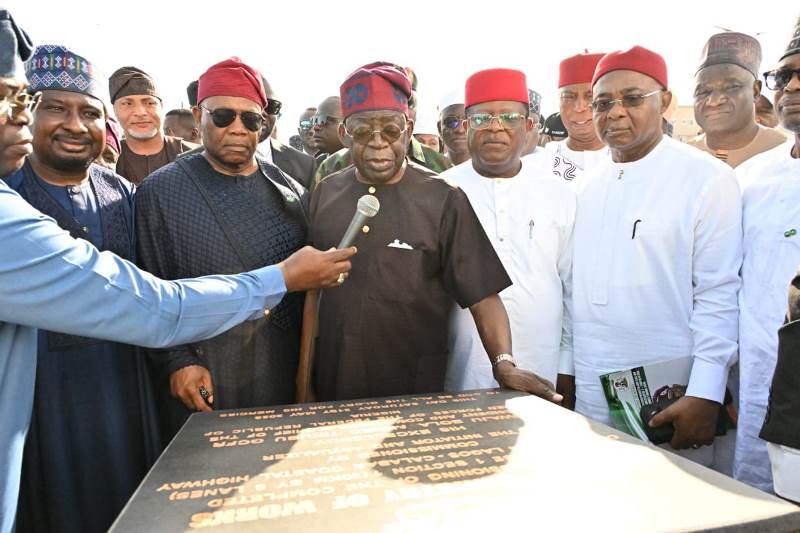
President Bola Tinubu has underscored the Federal Government’s unwavering commitment to promoting local content, technology transfer, and Nigerian empowerment as he officially commissioned the first phase of the Lagos-Calabar Coastal Highway alongside several critical road infrastructure projects nationwide.
At the commissioning ceremony in Lagos on Saturday, President Tinubu charged the Minister of Works, Sen. Engr. Dr. David Umahi, and relevant government officials to rigorously enforce local content laws, ensure comprehensive training of Nigerian professionals, and facilitate effective technology transfer across all ongoing projects.
Reiterating the government’s firm stance on urban planning and regulatory compliance, the President issued a stern warning to contractors and estate developers.
He declared that no compensation would be forthcoming for developers who neglect mandatory building setbacks or fail to obtain requisite approvals, emphasizing that these measures are crucial for national interest and sustainable urban development.
“Developers must comply with the gazetted setbacks. The Federal Government will enforce these regulations strictly, with no exceptions,” President Tinubu stated emphatically.
Paying tribute to Engineer Ronald Chagoury, whose pioneering efforts prevented catastrophic coastal erosion in Victoria Island and Ikoyi, the President highlighted the importance of visionary leadership in safeguarding Nigeria’s infrastructure.
“We have averted a disaster greater than a tsunami,” he affirmed, urging continued innovation and support for infrastructure development.
The President appealed for patience from Nigerians, citing positive economic indicators such as foreign exchange stability and declining food prices as signs of a recovering economy.
He thanked the Minister of Works, contractors, and citizens—particularly Lagos residents—for their unwavering support and called on them to safeguard these new infrastructural assets for future generations.
The commissioned Phase One section of the Lagos-Calabar Coastal Highway runs from Ahmadu Bello Way to Eleko Village in the Lekki Peninsula, representing a significant segment of the 700-kilometre project that will traverse Ogun, Ondo, Delta, Edo, Bayelsa, Rivers, Akwa Ibom, and Cross River States.
President Tinubu lauded Nigerian firm Hitech Construction Company Limited for delivering world-class standards, praising their use of Continuously Reinforced Concrete Pavement to ensure durability over flexible pavement alternatives.
Additional projects commissioned include major road rehabilitations and expansions in the South-South region—such as the Calabar-Ugep-Katsina-Ala Road Section II and the dualisation of the East-West Road in Rivers State—as well as vital infrastructure upgrades in the South East, South West, North Central, North East, and North West zones.
New projects flagged off encompass extensive roadworks spanning Ibadan to Benin, Nembe-Brass Road, Enugu-Onitsha Carriageway, and the dualisation of Kano-Maiduguri Road, among others—demonstrating a nationwide drive to enhance connectivity and foster economic growth.
Senate President Godswill Akpabio pledged strong legislative backing for the government’s developmental agenda, while Minister of Works Umahi disclosed that the government has spent N18 billion in compensations related to the Lagos-Calabar Highway construction, underscoring a commitment to responsible project management.
The commissioning event attracted an impressive assembly of dignitaries, including governors from various states, Nobel Laureate Prof. Wole Soyinka, National Security Adviser Nuhu Ribadu, prominent business magnates such as Aliko Dangote, Abdulsamad Rabiu, and Tony Elumelu, as well as key stakeholders in Nigeria’s infrastructure sector.
Comments