


Our Lagos, their Lagos: When filth becomes politicised

 Quick Read
It was James. A Garfield who said that "the truth will set you free, but first it will make you miserable", and often times, hard-hitting truth creates misery. The truth hit hardest when it came from a young corps member armed with nothing but honesty and a smartphone.
By Oreka Titi Akerejola
It was James. A Garfield who said that “the truth will set you free, but first it will make you miserable”, and often times, hard-hitting truth creates misery. The truth hit hardest when it came from a young corps member armed with nothing but honesty and a smartphone.
In March 2025, Ushie Uguamaye made a simple observation on TikTok: Lagos stinks. What followed was an avalanche of heated opinions showing how Nigeria turns her environmental crises into political theatre.
Government sympathisers descended on Ushie with fury. The NYSC State Coordinator ordered her arrest. And predictably, she retracted her statement. Another voice silenced, thereby squandering an opportunity for positive change.
But here’s what they couldn’t silence: the stench that greets millions of Lagosians every single day.
The Great Denial
When the Lagos state Commissioner for Environment and Water Resources, Tokunbo Wahab dismissed complaints about Lagos’s odour as “politically motivated,” he revealed something that I found quite troubling about the relationship of our leadership with reality. Concerned citizens who report environmental hazards aren’t launching political attacks, they’re gasping for clean air.
This reflexive and unnecessary defensiveness transforms legitimate environmental concerns into partisan battles, while the real enemy is the mountains of rotting waste, the open sewers, the toxic air that continues its relentless assault on public health.
A Tale of Two Cities
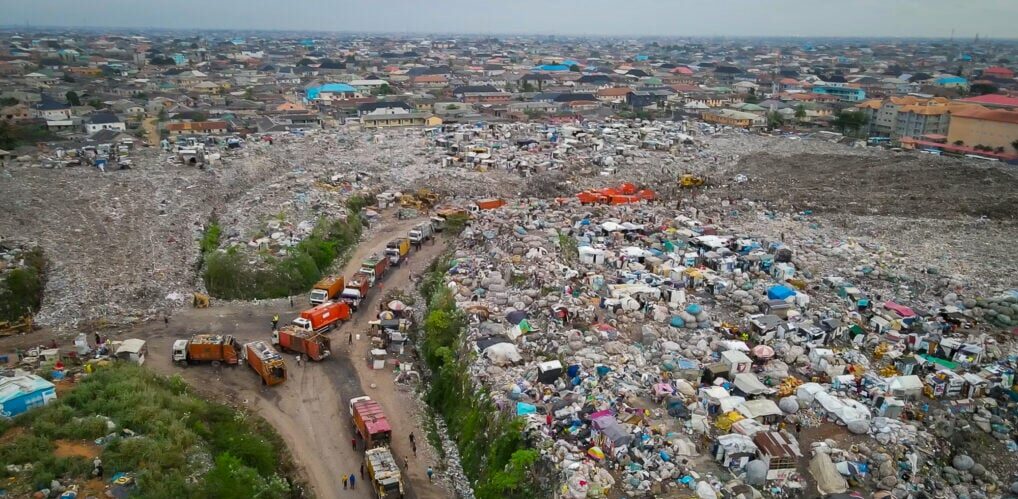
Drive from GRA Ikeja through Ikoyi to Lekki, and you’ll see “our Lagos”. The Nigeria that slithers through our Instagram feeds; Gleaming towers, bright lights at night, manicured lawns, arrays of exotic cars gliding along the roads, and a promise of unlimited luxury. But take a trip to Ojo, Okokomaiko, Amuwo, Alaba, or Badagry, and you’ll discover “their Lagos”. It’s a distasteful trail of endless refuse dumps, overgrown bushes doubling as open toilets, communities forgotten by the city that claims them.
This isn’t just inequality; it is environmental apartheid. A clear and discernible case of separatism. We have created a system where clean air and proper sanitation are luxury, available only to those who can afford to live in the right postcodes.
The Price of Complacency
Do you remember when cleanliness wasn’t negotiable? Under General Buhari’s military government, environmental sanitation had teeth. The War Against Indiscipline (WAI) scheme, which ensured compliance of environmental health to the strictest form.
In the same vein, Kick Against Indiscipline (KAI) was established in 2003 by the Lagos State Government to support the overall policy of the state government in regards to its “War Against Indiscipline.”
Governor Fashola’s zero-tolerance approach also cleaned up Lagos streets to a good extent, although there were excusable lapses. But then came the court ruling in November 2016, under Governor Ambode that ended monthly sanitation exercises, and with it, our collective commitment to a clean environment.
A city choking on its own neglect.
Time has revealed that without enforcement, Nigerians treat environmental responsibility like an optional suggestion. The eradication of KAI and the abandonment of national sanitation days didn’t liberate us as we envisaged, rather, it doomed us to live in our own filth.
It is sad to say that every day that we delay action, we inch closer to catastrophe. Disease outbreaks don’t respect the boundaries between “our Lagos” and “their Lagos.”
Cholera, typhoid, respiratory infections are all democratic killers that will find their way to every corner of our city if we continue this dangerous game of environmental Russian roulette.
Our jammed population and inadequate waste management infrastructure create perfect breeding grounds for the next pandemic. An extremely scary picture. Are we really willing to gamble millions of lives on political pride?
Beyond Blame Games
While politicians and their supporters trade accusations on social media, the solution requires honest acknowledgment: this is a clear case of collective failure that urgently demands collective action.
Government Action:
– Reinstate monthly environmental sanitation with meaningful penalties for offenders.
– Expand public toilet facilities in underserved areas.
– Strengthen waste management infrastructure across all local government areas. This should apply to the entire country.
– Enforce the upcoming single-use plastic ban with the same vigour shown in arresting critics
– Create environmental courts for swift prosecution of violators
Citizens’ Action
– Embrace the three Rs: Reduce consumption, Reuse items, Recycle materials
– Support local recycling programs like NPSA and PAKAM.
– Report environmental violations instead of normalising them.
– Demand accountability from elected officials
The Choice Before Us
Governor Sanwo-Olu’s administration has shown openness to feedback by introducing the single-use plastic ban effective July 1, 2025. But goodwill must translate into comprehensive action.
We stand at a crossroads. We can continue the charade wherein we pretend that silencing critics solves environmental problems, we can continue to maintain a system where clean air is a privilege, not a right. Or we can choose the harder path which involves admitting our failures, implementing tough solutions, and building a Lagos that works for everyone.
The question isn’t whether Lagos has an odour problem, anyone with functioning nostrils knows it does. The question is whether we’ll keep politicising pollution while our people suffer, or we finally treat environmental degradation as the public health emergency it has always been.
The time for denial is over. The time for action is now as it is glaring that Our lives genuinely depend on it. And until we address the systemic inequalities that created “their Lagos,” none of us can truly claim “our Lagos” as home.
Oreka Titi Akerejola is a writer, and a lawyer who resides in Lagos.
Comments