



U.S. to OAS: Shape up or we Ship out!

 Quick Read
This review, due within six months, will determine whether continued U.S. participation aligns with national interests and whether reforms are needed.
By Kazeem Ugbodaga
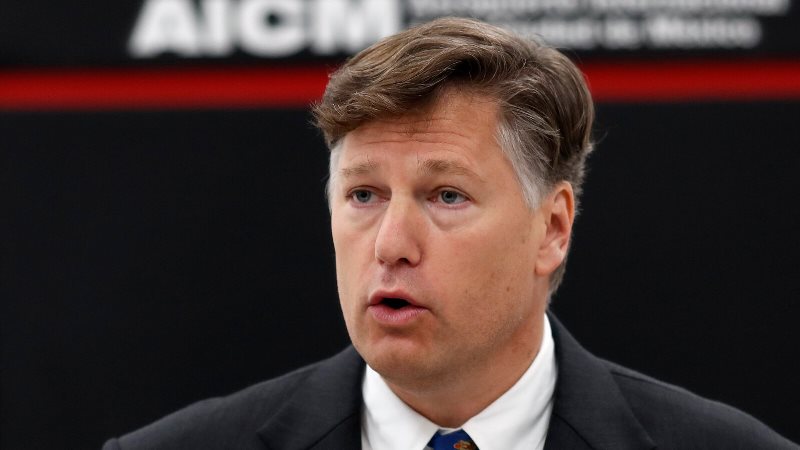
In a candid and forceful address at the Organization of American States (OAS) General Assembly, U.S. Deputy Secretary of State Christopher Landau called on the organization to demonstrate its relevance in addressing pressing hemispheric challenges, particularly in Venezuela and Haiti.
Speaking on behalf of the United States and Secretary of State Marco Rubio, Landau emphasized the need for concrete action to uphold the OAS Charter’s goals of promoting peace, justice, and sovereignty in the Western Hemisphere.
Highlighting his and Rubio’s deep focus on the Western Hemisphere, Landau recounted a conversation where Rubio insisted their shared regional expertise was an asset, ensuring the U.S. would not lose sight of Latin America and the Caribbean despite global demands.
Landau, who has lived in Canada, Paraguay, Chile, Venezuela, and Mexico, and whose family found refuge in Colombia before World War II, underscored his personal connection to the region.
However, the heart of Landau’s remarks was a pointed critique of the OAS’s effectiveness.
Citing the OAS Charter’s mission to foster peace, justice, and sovereignty, he questioned whether the organization is meeting these goals.
He noted that the U.S. is currently reviewing its membership in international organizations, including the OAS, under an executive order issued by President Donald Trump.
This review, due within six months, will determine whether continued U.S. participation aligns with national interests and whether reforms are needed.
Landau was blunt about the OAS’s shortcomings, particularly regarding Venezuela’s ongoing crisis.
He described last year’s Venezuelan election as “brazenly stolen,” with the opposition’s overwhelming victory backed by undeniable evidence that the Maduro regime did not contest.
Despite this, Landau said, the OAS has done “nothing of substance” to address the electoral fraud or the resulting poverty and repression that have driven millions of Venezuelans to flee.
He also criticized the OAS’s silence on Venezuela’s recent sham elections and its provocative claim over Guyana’s Essequibo region, questioning the organization’s purpose if it cannot respond to such violations of international norms.
Similarly, Landau addressed the crisis in Haiti, where armed gangs have destabilized the capital, and public order has collapsed.
While commending the Kenyan-led multilateral force supported by the UN and funded heavily by the U.S., he stressed that the OAS has failed to play a meaningful role in addressing Haiti’s humanitarian, security, and governance crises.
“If the OAS is unwilling or unable to play a constructive role in Haiti, then we must seriously ask ourselves why the OAS exists,” he stated.
Landau clarified that his remarks were not meant to assign blame but to extend “a hand of friendship” to the OAS, urging member states to help justify the U.S.’s substantial investment in the organization.
He expressed concern that some members view the OAS as a platform to antagonize the U.S. rather than address shared challenges.
Proposing a vision for economic collaboration, Landau suggested channeling U.S. capital to develop “Western Hemisphere jaguar economies,” akin to Asia’s “tiger” economies, to build resilient regional supply chains.
In a significant move, Landau announced the U.S. nomination of Rosa María Payá, a Cuban democracy and human rights advocate, for the Inter-American Commission on Human Rights.
He praised her “moral clarity” and “lived experience,” urging member states to support her candidacy in the upcoming election to strengthen the commission’s focus on urgent human rights abuses.
Landau concluded with a call to action, urging the OAS to move beyond rhetoric and deliver results.
“Let’s stand with the people of Venezuela and Haiti not just in word but in deed,” he said, advocating for rejecting authoritarian regimes, upholding democratic norms, and securing borders.
He expressed hope that the OAS could be “part of the solution, not the problem,” and looked forward to constructive engagement during the assembly.
Comments