



ADC and its shaky coalition


 Quick Read
But would 78-year-old Atiku, who may be thinking this is his last shot at becoming the nation's helmsman, sacrifice his interest for the likes of Peter Obi and Rotimi Amaechi, who have made known their interest to run for the most exalted position in the land? This is a question begging seriously for an answer.
By Paul Dada
“It is not debatable! And I have said this several times, even on TV, that the All Progressives Congress administration led by President Bola requires a robust opposition. It is good for Nigeria. A vibrant opposition in a democracy gives way to real checks and balances, which can prevent the ruling government from abusing its power and becoming authoritarian. It fosters accountability and transparency because it scrutinises government policies and actions. Through a good opposition, a country is given an opportunity to obtain and dissect alternative policy proposals and visions for the country, giving voters a choice and encouraging a healthy debate on important issues. It goes without saying that a lively opposition plays a vital role in shaping public opinion and encouraging citizen participation in the democratic process.
Tinubu, himself, understands the value of opposition. This is why, in his June 12, 2025 Democracy Day address, he spiritedly debunked the criticism that the ruling party was causing the country to drift towards a one-party state. He said, “We must welcome and accept the diversity and number of political parties, just as we welcome and embrace the diversity of our population. Our efforts must never be to eliminate political competition but to make that competition salutary to the national well-being by working across the political aisle whenever possible.”
Somewhere in that speech, Tinubu also said, “To those who ring the alarm that the APC is intent on a one-party state, I offer you a most personal promise. While your alarm may be as a result of your panic, it rings in error. At no time in the past, nor any instance in the present, and at no future juncture shall I view the notion of a one-party state as good for Nigeria. I have never attempted to alter any political party registration with INEC. Equally, my friends, we cannot blame anybody seeking to bail out of a sinking ship even without a life jacket.”
“Look at my political history. I would be the last person to advocate such a scheme. In 2003, when the then-governing party tried to sweep the nation clean of political opposition through plot and manipulation, I was the last of the progressive governors standing in my region.”
Unfortunately, since the APC came into power in 2019, the opposition in Nigeria has fumbled and wobbled, being bedeviled by internal wrangling, unbridled personal interests, lack of good internal democratic processes, and ineffective conflict resolution mechanisms. This is a shame.
Once upon a time, the Peoples Democratic Party was the veritable behemoth which held sway at the centre and controlled the majority of the states in the country. It then prided itself as the biggest political party in Africa. Its former Chairman, Vincent Ogbulafor (now deceased), was so confident that he boasted in a 2008 interview with a national newspaper, saying, “The PDP is a party for all and it is set to rule Nigeria for the next 60 years. I don’t care if Nigeria becomes a one-party state. We can do it and the PDP can contain all.”
Ogbulafor said this at the time the PDP had 28 state governors and a majority in the National Assembly. But the APC, by 2018, had presented itself as a credible alternative to the PDP while promising better leadership and governance. The party’s progressive agenda and commitment to democratic principles appealed to many Nigerians seeking change. Key APC leaders played crucial roles in mobilising support and navigating the party’s internal dynamics.
After the APC took power in 2015, the PDP continued to decline in strength and influence. During the 2023 elections, the Labour Party, helped by the soaring influence of Peter Obi, showed a promising potential to become a serious opposition party. But today, the party’s progress is hobbled by factionalisation and it is bereft of a clear vision. One of the factions is led by the rambunctious and querulous Julius Abure, who is now not supported by some of the party stalwarts like Peter Obi. The other faction is led by the much-favoured Nenadi Usman. The Labour Party, to all intents and purposes, now looks like a rudderless boat.
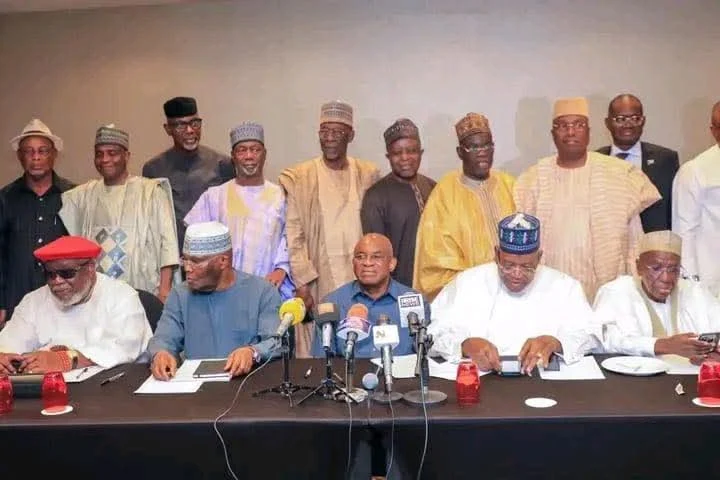
Key opposition figures in different political parties are smart enough to know that they cannot unseat Tinubu in 2027 unless they come together in a strong coalition. They have now adopted the African Democratic Party (ADC) through which they hope to send away Tinubu from Aso Rock back to his Bourdillon Road residence in Ikoyi, Lagos. But there are seeming problems with this coalition.
People have pointed to the fact that the coalition is steered by disgruntled political strange bedfellows. For example, they wonder how Nasir el-Rufai can be in the same boat as Peter Obi and Atiku Abubakar. But for me, this isn’t the major problem. After all, the APC, after it was formed, could also be described as a coalition of disgruntled strange bedfellows from ACN, CPC, ANPP, APGA, and NPDP. But somehow, they have managed to remain formidable. However, I see three major problems with the ADC.
The first is that the ADC coalition kick-started in a fractured manner. Older members of the party are already screaming blue murder. Three of its members, Adeyemi Emmanuel, Ayodeji Victor Tolu, and Haruna Ismaila, have filed a lawsuit against the party’s interim leadership led by David Mark, Rauf Aregbesola, and Bolaji Abdullahi. They are questioning the legitimacy of the appointments, alleging they violate the ADC constitution and a prior court judgement. A former presidential candidate of the party, Dumebi Kachikwu, had earlier also rejected the coalition, describing it as a backdoor deal. He questioned the intentions of the coalition leaders while doubting their commitment to genuine opposition and reform. Unless the coalition quickly extricates itself from the distraction posed by this wrangling, it may affect its chances of being a worthy opponent to Tinubu’s APC.
The second issue with the coalition is the seemingly untamable personal ambition of some of its arrowheads. Atiku Abubakar, a serial presidential contender, is believed to have the intention of running for president on the platform of the ADC. Atiku is not known to be someone who can bury his personal interest for the common good. His unbridled ambition to become president, when there was a national understanding that power should shift to the south, was part of what led to the failure of the PDP in the 2023 presidential election. The general thinking is that the south should hold onto power till 2031 before it goes back to the north. But would 78-year-old Atiku, who may be thinking this is his last shot at becoming the nation’s helmsman, sacrifice his interest for the likes of Peter Obi and Rotimi Amaechi, who have made known their interest to run for the most exalted position in the land? This is a question begging seriously for an answer.
The third problem I see with the ADC coalition is that it seems more interested in unseating Tinubu than proffering real alternatives to “rescuing” Nigeria. Beyond vilifying Tinubu and ranting endlessly on how much Nigerians are suffering under the Tinubu administration, we have yet to see them robustly tell us what exactly they will do differently and how they will do it.
The ADC needs to set its house in order to stand a chance in 2027.
Comments