


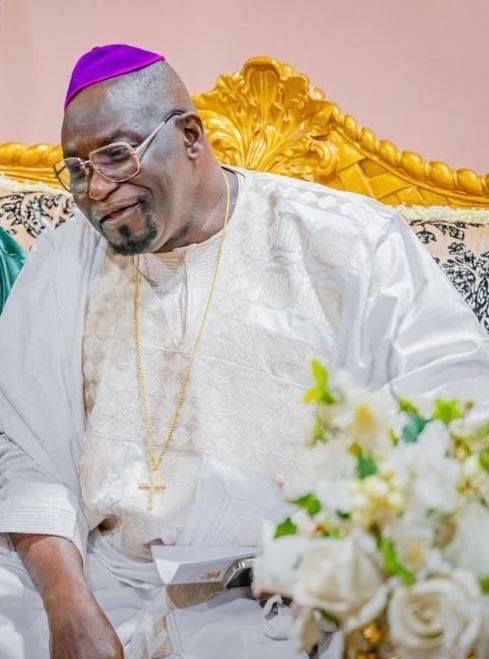
How Bishop Katung Jonas recruited victims into ‘fraudulent scheme’

 Quick Read
When the prosecution attempted to tender the payment receipts and the petition, defense counsels C.I. Nwogbo (for Jonas) and G.G. Achi (for Dayo) objected.
On Tuesday, July 22, 2025, Sulaiman Kwalla—the first prosecution witness (PW1) in the trial of Bishop Katung Jonas and Okewole Dayo (chairman and secretary, respectively, of Covenant Fadama Multi-purpose Cooperative Society in Jos, Plateau State)—testified before Justice Sharon T. Ishaya of the Federal High Court in Jos.
Kwalla stated that many victims, including himself and his wife, were persuaded to invest in the cooperative by Bishop Jonas’ church sermons and religious influence.
The Economic and Financial Crimes Commission (EFCC) is prosecuting Jonas and Dayo on a 23-count charge alleging they obtained ₦178,885,000 (₦178.9 million) under false pretences.
Guided by prosecution counsel Ibrahim Buba, Kwalla recalled investing ₦200,000 personally and an additional ₦100,000 on behalf of his wife, Halima Ibrahim Danyaro.
He explained that after hearing radio advertisements for the cooperative—primarily aired following Bishop Jonas’ televised sermons—in which viewers were encouraged to invest, they decided to join.
“Because of the Bishop’s religious standing and the promise of a 10% monthly return, I believed it was a legitimate investment. I completed a form and deposited the money into Dadin Kowa Microfinance Bank, which was supposedly owned by the cooperative. I received official receipts for both payments,” Kwalla said.
However, at the end of the first month, neither he, his wife, nor any investor received the promised dividends.
When Kwalla visited the cooperative’s office on Secretariat Road, Jos, he found it crowded with equally disappointed investors.
He testified that on June 4, 2012, a crowd of agitated investors confronted staff at the office, demanding refunds.
The situation escalated and required armed police intervention. Dayo was escorted out and later detained at Plateau State Police Headquarters.
A meeting was convened with police, investors, and Bishop Jonas, during which Jonas admitted to being the cooperative’s chairman and promised to begin repayments in July 2012—payments he never made.
“At every stage, new excuses were given. Bishop Jonas later introduced a consultancy firm, Lanre Global Concept, claiming it would recover funds from abroad—but none of us had any dealings with it. Afterwards, he launched another scheme, Global View, admitting he had diverted investments into foreign exchange trading. All promises turned out to be fraudulent,” Kwalla said.
He added that, after repeated failed attempts at repayment, the investors—through their lawyer Solomon Dalung—petitioned the EFCC, alleging a fraud exceeding ₦8 billion and affecting at least 44,000 investors.
Kwalla stated that his ₦200,000 was eventually refunded through a cooperative official, but his wife’s ₦100,000 remains unpaid.
When the prosecution attempted to tender the payment receipts and the petition, defense counsels C.I. Nwogbo (for Jonas) and G.G. Achi (for Dayo) objected.
They argued that Halima’s receipt was inadmissible since she was not present to testify, and the EFCC petition lacked certification under Section 104 of the Evidence Act and the Administration of Criminal Justice Act (ACJA).
Prosecution counsel argued that Kwalla had properly established that his wife was a victim, and the receipt—issued by the cooperative—was directly relevant to the charges. He also contended that the petition, being an original document, did not require certification; such a requirement applies only to reproductions.
Justice Ishaya adjourned the trial until Wednesday, July 23, 2025, to rule on the admissibility of the documents and to resume proceedings.
Comments