



UNICEF: Four million children experiencing multidimensional poverty in Kano

 Quick Read
UNICEF further stated that about 35 per cent of children at Primary and Junior Secondary School, schooling age are not attending schools (that is nearly 2.3 million children) in Kano
By Maduabuchi Nmeribeh/Kano
The United Nations Children’s Fund (UNICEF), has raised the alarm that no fewer than four million children in Kano are experience multidimensional poverty, lacking essential access to health, education, and nutrition services.
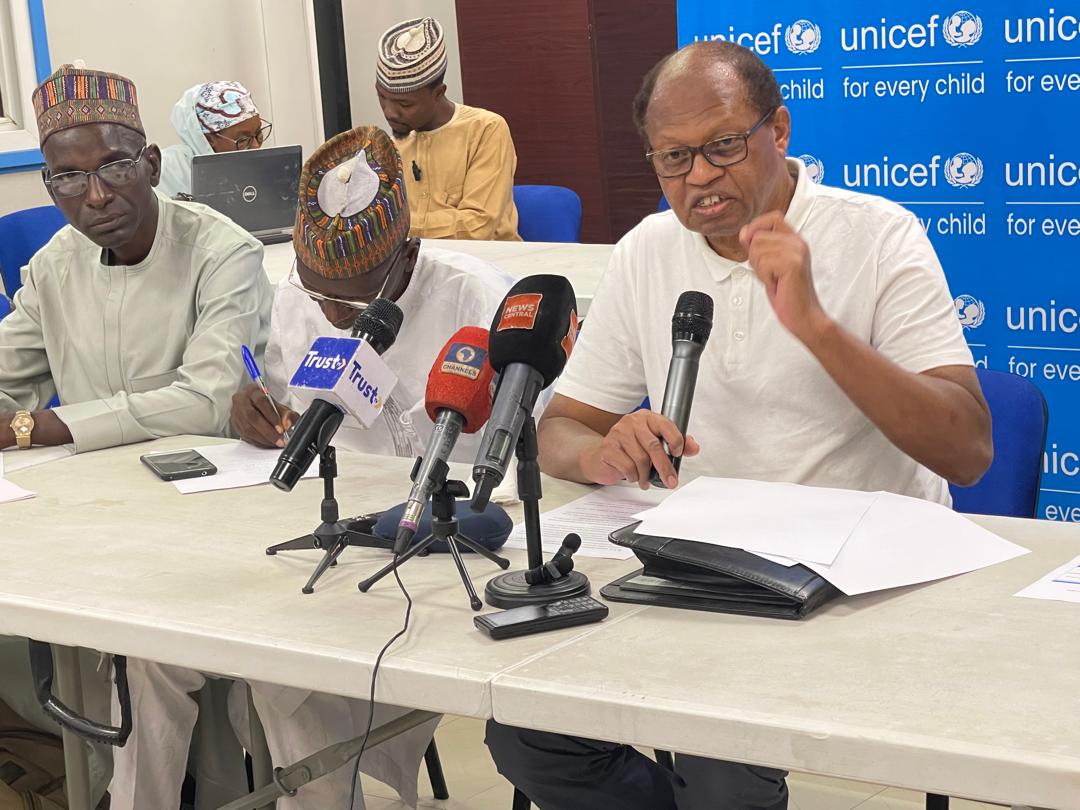
The Chief of UNICEF Field Office, Kano, Mr Rahama Rihood Mohammed Farah, stated this on Tuesday, during Media Dialogue on Child Sensitive Budgeting and Planning in Kano State, held at eHealth Africa, Nigeria, Independence Road, Kano.
According to Farah, approximately over three million children live in monetary poverty, with families severely limited in meeting their basic needs.
Farah further stated that, “of the nearly 6.5 million children, approximately 2.9 million children are not fully immunized, leaving them vulnerable to preventable and life-threatening diseases.
“About 143,000 children under five die each year before reaching their fifth birthday in Kano, based on the under-five mortality rate of 143 per 1,000 live births.”
The UNICEF Chief maintained that this is a stark reminder of the urgent need to strengthen child survival interventions.
Farah further stated that about 35 per cent of children at Primary and Junior Secondary School, schooling age are not attending schools (that is nearly 2.3 million children) are out of school, adding that, “this is threatening Kano State’s future human capital and economic development.
“Nearly 4.7 million children aged 6–23 months are not receiving the minimum acceptable diet, impeding their healthy growth and brain development.
“Leading to more than 3 million children under five are stunted, indicating chronic malnutrition with serious long-term health and productivity consequences.
“Moreover, Children in Kano continue to face the risk of the circulating polio variant. In 2025, so far three cases are reported from Kano state.”
Farah, however, insisted that child sensitive budgeting remains a non-negotiable investment for Kano State’s future, which needs urgent action.
He highlighted the need for ensuring Kano State’s budgets and plans consciously, deliberately, and effectively prioritize the well-being, development, and protection of every child.
“The child in Kano State is our present reality and our collective responsibility.
Despite ongoing efforts to improve the lives of children in Kano state, yet the data on the status of children in Kano tells a compelling and urgent story: Kano State has an estimated 6.5 million children under 18 years,” he added.
He noted that: “Despite these challenges, let us look at the response of the social sector. The social sector in Kano State has often been underfunded relative to the magnitude of these challenges.
“Between 2016 and 2020, allocations for social sectors such as health, education, and social welfare have fluctuated, sometimes declining despite increasing demands.
“Investing in children—their health, nutrition, education, protection, and participation—is not charity; it is an essential and strategic investment by Kano State.
“It is an investment in Kano’s future human capital, and most importantly it is an investment to break cycles of poverty, build resilience, and secure lasting peace and prosperity.”
Farah recalled that the Nigeria Child Rights Act 2003 which has been domesticated in Kano State as a Child Protection Law, is not just a legal instrument, “it is a budgetary imperative.
” It requires visible, deliberate budgeting that prioritizes children’s needs. What Child Sensitive Budgeting (CSB) Means: It is not only about creating line items for clinics and schools in the budget.”
According to him, “it is more than that it is an Explicit Prioritization process: Recognizing children as distinct priority beneficiaries within the State Development Plan, the MTEF, and annual budgets. Their needs must be visible and central.
“It is a targeted Allocation: Directing sufficient resources to critical programs proven to improve child survival and development: including antenatal care and skilled birth attendance, immunization, nutrition, quality basic education (especially for girls), child protection, WASH, social protection, and early childhood development.”
He added that Child Sensitive Budgeting (CSB) is also an Equity Focus: Deliberately reaching vulnerable children those in rural and hard-to-reach areas, with disabilities, or affected by conflict. While equity requires investment, exclusion costs a lot more.
“CSB also requires consistent Tracking & Transparency: Clearly tagging child-related expenditures in budgets and publicly reporting on allocations, releases, expenditures, and results for children, enabling us to follow the money to the child.
“CSB requires an Impact Assessment: Systematic evaluation of how budget decisions affect children, positively or negatively, and the impact on improving the lives of children.”
He regretted that, “unfortunately, current Gaps in Kano State Budgeting for Children exist, and they include: invisibility Gap: Children’s needs are often embedded in larger sectoral budgets, making accountability and tracking hard. How much exactly is allocated to children in Health, Education, Agriculture, and Water Resources?
“Insufficiency Gap: Critical child-focused programs such as nutrition, early childhood development, and child protection remain consistently underfunded relative to scale of current need.
“Inefficiency and Leakage: Limited resources directly reach frontline services providers, remote communities or the targeted children due to bottlenecks, weak implementation, or diversion.”
Farah noted that fragmented planning and siloed Ministries and Agencies result in gaps and duplication in child service delivery.
He said lack of coordination across the Ministries, Departments, Agencies and sectors need to be addressed, adding that failing to invest adequately in Kano’s children today embeds poverty, vulnerability, and lost potential, while increasing future social and economic costs.
UNICEF called for immediate action, advising Commissioners and MDA Heads, to turn around the trajectory.
He urged the Kano state Executive Council and Commissioners to mandate child-sensitive budgeting across all MDAs in the MTEF submissions and annual budgets and make child budgeting a standard agenda item.
UNICEF also urged Kano state government to champion increased and protected allocations for high-impact child survival, development, and protection programmes.
UNICEF also demanded transparent, regular reporting on child expenditures and their impact.
To Heads of Ministries, Departments and Agencies, UNICEF urged them to identify, define, and tag child-focused programmes and expenditures clearly using standardized budget codes.
UNICEF stressed the need to prioritize evidence-based, cost-effective interventions, collaborate across sectors for integrated child service delivery, improve efficiency and transparency in fund utilization.
To the Ministry of Finance, Budget and Economic Planning, UNICEF urged them to embed child-sensitive budgeting guidelines in core budget circulars, develop and enforce child expenditure tagging and tracking systems, publish accessible annual Child Budget Briefs showing allocations, spending, and child outcomes.
To Civil Society Organizations, UNICEF urged them to support MDAs with technical expertise on child budgeting, independently monitor budget allocations and service delivery, advocate continuously for increased investments and accountability in the social sectors.
To the media, UNICEF tasked them to report regularly on child wellbeing, budgets allocations, and service delivery gaps; translate complex budget data into compelling stories that the public understands; provide a platform for discussions, and dialogue involving government, CSOs, communities, and children.
Farah noted that: “Kano State’s children are not just beneficiaries—they are the architects of the state’s future if we invest in them wisely today.
“This requires more than goodwill; it demands deliberate, strategic, and resourced action embedded in Kano’s state planning and budgeting. As the Kano State Government prepares for the next budgeting process, we are at a pivotal moment.
“The choices we make in the next Kano State budget process will reflect our true priorities. Let us make every Naira count for Kano’s children. Let us build Kano’s future—one child-sensitive budget at a time.”
The Deputy Speaker of Kano State House of Assembly, Alhaji Mohammed Bello, in his remarks, insisted that the current administration of Governor Abba Kabir Yusuf does not play with the welfare of children.
According to him, the State House of Assembly speedily passes all bills promoting the interest of children in the state, adding that, “when we talk about the children, we talk about the future. Here in Kano, we try our best to ensure that our children have qualitative education and good health.”
Bello, however, urged heads of ministries and agencies to monitor and track their budgetary allocations, particularly, as it concerns the welfare of children.
Also speaking at the event, the Speaker of Kano state Children Parliament, Hauwa Mohammed Ibrahim appealed to donor agencies, government, and Civil Society Organizations (CSOs) to organize capacity building for the children parliament in the state to enable them understand how to track budgets for the welfare and privileges of children.
Comments