



Nigerian PhD student uncovers potential brain cancer cure

 Quick Read
thanked his mentors, lab colleagues, and family for their support and said sharing his research was not just about the science, but also about bringing hope to people fighting one of the deadliest cancers.
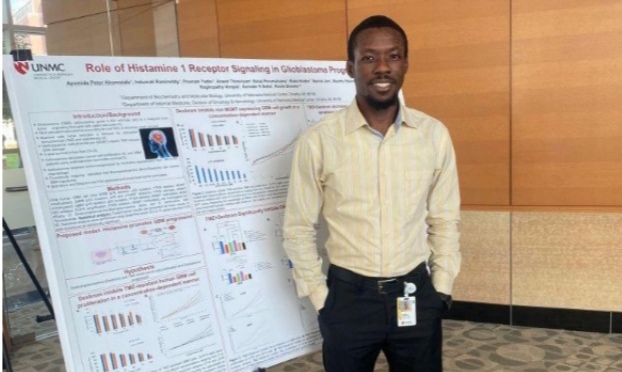
Ayomide Akomolafe, a PhD student from Ekiti State, Nigeria, studying in the United States, has amazed the medical world with a new discovery that could help treat glioblastoma the most dangerous type of brain cancer.
Akomolafe, who is from Ikere-Ekiti, shared his research at the 110th Annual Symposium of the Department of Biochemistry and Molecular Biology at the University of Nebraska Medical Center, where he is pursuing his doctorate.
His study, titled “Role of Histamine 1 Receptor Signaling in Glioblastoma Progression,” found that a common allergy drug, Dexbrompheniramine (Dexbrom), can slow the growth of glioblastoma cells. Dexbrom is already approved by the U.S. Food and Drug Administration (FDA) for treating allergies.
What makes the discovery even more exciting is that Dexbrom works on both types of glioblastoma cells those that respond to current treatment (Temozolomide) and those that do not. When used together with Temozolomide, Dexbrom was found to activate three different ways of killing cancer cells apoptosis, pyroptosis, and autophagy.
“Our research showed that Dexbrom targeted only the cancer cells and left healthy brain cells unharmed, which makes it very promising for future medical use,” Akomolafe said during his presentation.
Experts believe this is a major step forward because Dexbrom is already a safe and approved drug. This could make it faster and easier to start clinical trials and potentially help patients sooner.
Akomolafe first gained attention in 2024 when Nigerian media highlighted his early work on brain cancer. His latest research shows significant progress in both depth and potential.
He thanked his mentors, lab colleagues, and family for their support and said sharing his research was not just about the science, but also about bringing hope to people fighting one of the deadliest cancers.
“I’m driven to keep going, not just as a researcher, but as someone on a mission to help patients,” he said.
Comments