


Sanwo-Olu vows no child will be left behind in education drive

 Quick Read
Sanwo-Olu also addressed lingering issues from previous UBEC meetings, including poor utilisation of funds, challenges in unlocking matching grants, persistent infrastructure deficits, inadequate teacher capacity, and the growing number of out-of-school children
Lagos State Governor, Mr. Babajide Sanwo-Olu, has restated that his government sees education not only as a social service but as the backbone of the state’s economic future.
He stressed that investments in teachers and learning infrastructure would determine the prosperity of the next generation.
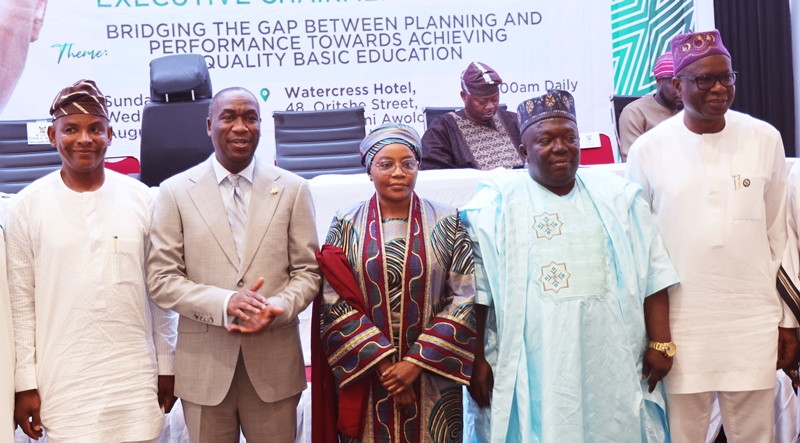
The Governor, represented by his Deputy, Dr. Kadri Hamzat, made this known at the 27th Quarterly Meeting of the Universal Basic Education Commission (UBEC) Management with State Universal Basic Education Boards (SUBEBs) held at Watercress Hotel, Ikeja.
The session, themed “Bridging the Gap between Planning and Performance towards Achieving Quality Basic Education,” brought together policymakers, administrators, and education leaders from across Nigeria.
Sanwo-Olu pointed to Lagos’ recent commissioning of ultra-modern classroom blocks, the rollout of integrated vocational training, and digital literacy projects under the THEMES Plus Agenda as evidence that the state is deliberately reshaping the learning environment.
“We understand that advancing education means equipping teachers through professional development programmes and fostering a learning environment where every child can thrive,” he said.
He described education as the cornerstone of socio-economic development, arguing that every naira invested in children’s schooling secures the prosperity of both Lagos and Nigeria.
For him, the conference must serve as more than a routine gathering; it should represent a firm commitment to bridge the dangerous gap between planning and actual performance in basic education delivery.
Sanwo-Olu also addressed lingering issues from previous UBEC meetings, including poor utilisation of funds, challenges in unlocking matching grants, persistent infrastructure deficits, inadequate teacher capacity, and the growing number of out-of-school children
“Failure to address these challenges risks depriving our children of environments conducive to learning and teachers of the resources necessary to inspire and educate,” he cautioned.
The Governor emphasised that accountability and evidence-based planning must become the backbone of educational reform.
He stressed that effective reporting and transparent data tracking are essential to monitor progress, make adjustments where necessary, and guarantee that public spending translates into measurable learning outcomes.
In her remarks, UBEC Executive Secretary, Aisha Garba, called for deeper collaboration among stakeholders, especially state and local governments, to ensure that all Nigerian children, including those in marginalised communities, have access to quality learning opportunities.
She particularly underscored the role of music education as part of foundational learning, noting that such inclusion helps build creativity, discipline, and emotional development in children.
Garba urged states to strengthen partnerships with local government education authorities to enhance supervision, accountability, and transparency.
According to her, while policies and frameworks are in place, genuine progress in achieving universal basic education will depend on consistency, inclusivity, and community-level collaboration.
She concluded with a charge that “every Nigerian child must have access to at least the minimum level of foundational learning,” stressing that progress must be measurable, inclusive, and sustained to ensure that no child is left behind.
Comments