



Sanwo-Olu unveils 420-unit Badagry Housing Scheme, creates 1,300 jobs

 Quick Read
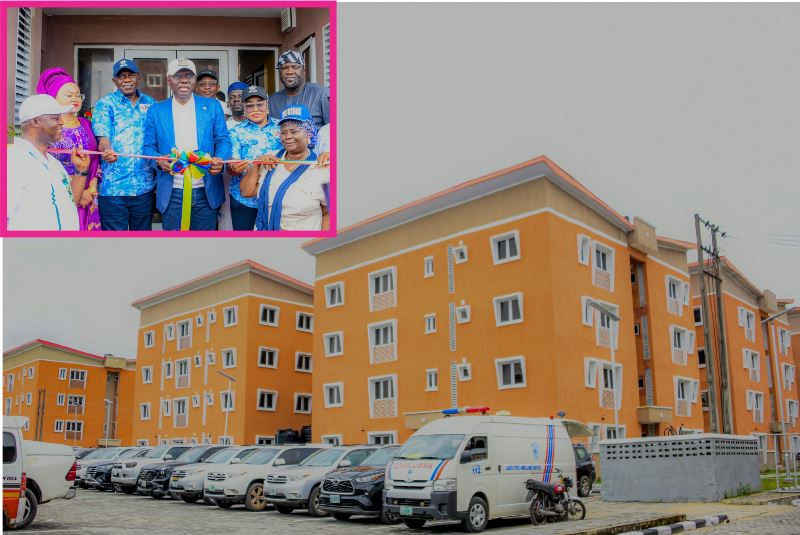
Located in Ajara, the newly completed estate comprises 420 fully built housing units and stands as a major milestone in Governor Babajide Sanwo-Olu’s housing agenda to expand access to decent and affordable accommodation for Lagosians.
By Jolayemi Alamin Olakunle
The Lagos State Governor, Babajide Sanwo-Olu on Wednesday inaugurated its 24th housing estate in Badagry, underscoring its resolve to close the state’s housing deficit and ensure affordable homes for residents across all income brackets.
Located in Ajara, the newly completed estate comprises 420 fully built housing units and stands as a major milestone in Governor Babajide Sanwo-Olu’s housing agenda to expand access to decent and affordable accommodation for Lagosians.
During the project’s construction phase, the estate generated over 1,300 direct and indirect jobs, with more employment opportunities expected to arise from facility management and other services once residents move in.
Speaking at the unveiling, Governor Sanwo-Olu said the project reflected his administration’s belief that communities thrive when citizens have access to essential needs such as food, shelter, healthcare, education, and security.
“When people have access to decent housing, it reduces poverty, improves public health, and builds safer, more cohesive communities,” the governor said.
He noted that the project is part of a broader strategy to strengthen economic growth, boost infrastructure, and alleviate poverty.
“Today, we are commissioning Phase I of this project, which consists of 420 housing units, all ready for occupation. Our administration has delivered 23 estates in six years, providing over 10,000 homes across all income categories and divisions of Lagos,” he added.
Sanwo-Olu also revealed that four additional housing schemes are currently underway, including: Lagos State Housing Estate, Ibeshe Phase II (192 units), Egan–Igando Mixed Housing Scheme, Clusters 2 and 3 (587 units), Epe Housing Scheme, Ita Marun (112 units) and LagosHOMS Sangotedo Phase II, Eti-Osa (524 units).
The Badagry estate, the governor explained, is fully equipped with modern infrastructure such as well-paved roads, an efficient drainage network, water treatment plants, secure fencing, a gatehouse, sewage systems, ample parking spaces, walkways, and full electrification with transformers.
To make the homes more affordable, Sanwo-Olu announced that the government would subsidise prices and reserve 20 percent of the units for members of the Medical Guild, the Nigeria Union of Teachers (Lagos Chapter), and other public and private sector unions.
Public servants will also receive special rebates as a token of appreciation for their service.
Acknowledging that the government cannot meet housing demand alone, the governor reaffirmed support for private developers and investors through enabling policies and favourable regulations.
He also expressed full backing for the Tenancy Bill before the Lagos State House of Assembly, which seeks to protect both tenants and landlords while promoting mass housing development.
“I encourage Lagosians to take advantage of available mortgage services to ease the burden of home ownership. We will keep building partnerships that make housing more affordable and sustainable,” he said.
Commissioner for Housing, Moruf Akinderu-Fatai, described the Ajara Housing Scheme as a landmark project under the T.H.E.M.E.S Plus agenda, designed to make Lagos a 21st-century economy.
He noted that Phase I occupies part of a 18.9-hectare land area and consists of 35 blocks of 12-unit residential buildings, offering one-, two-, and three-bedroom semi-furnished apartments equipped with kitchens, wardrobes, and lighting fixtures.
According to him, Phase II will feature high-rise buildings of up to seven floors to optimise land use through vertical development and deliver more housing options for Lagos residents.
“The Ajara Estate is a bold statement of this administration’s commitment to housing, infrastructure, and security. It is a model of sustainable urban development that embodies the spirit of a 21st-century Lagos,” Akinderu-Fatai stated.
Comments