


Ceasefire halts Gaza war as Palestinians flood back to ruins

 Quick Read
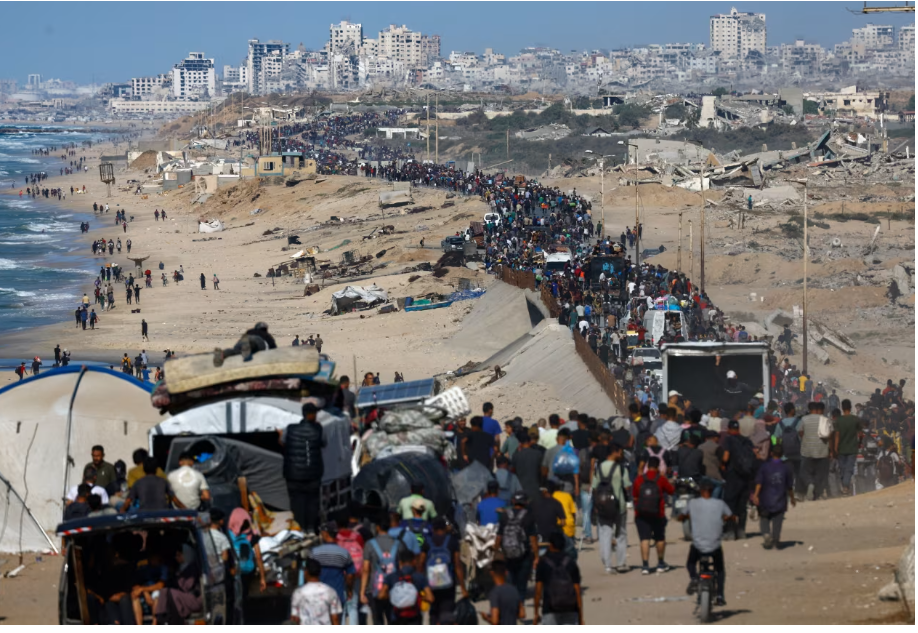
The ceasefire prompted an immediate and emotional response from Gaza's displaced population. Thousands of Palestinians, who had been ordered to flee south weeks ago, began the long journey on foot back to Gaza City and its surrounding areas.
By Kazeem Ugbodaga
A ceasefire agreement between Israel and Hamas took effect at noon local time on October 10, 2025, bringing an immediate halt to fighting for the first time since March and triggering the mass movement of displaced Palestinians returning to their homes in northern Gaza.
The ceasefire follows the Israeli government’s approval of the first phase of a U.S.-led peace plan and initiates a carefully sequenced process centered on the release of hostages and prisoners, a partial Israeli troop withdrawal, and a surge in humanitarian aid.
The activation of the ceasefire has set in motion a precise 72-hour timeline for the release of hostages and a significant withdrawal of Israeli forces.
The Israeli military stated it has pulled its forces back to new “updated deployment lines” as outlined in the agreement.
U.S. envoy Steve Witkoff confirmed the completion of this first phase of withdrawal. This new boundary, often referred to as the “yellow line” in the U.S. plan, leaves the Israeli military in control of approximately 53% of the Gaza Strip.
With the ceasefire in effect, a 72-hour countdown has begun. Hamas is now required to release all remaining hostages held in Gaza by Monday at noon local time.
Of the 48 hostages still in captivity, 20 are believed to be alive, while 28 are deceased. The release is to be conducted “without any public ceremonies or media coverage”.
In exchange for the hostages, Israel has agreed to release 250 Palestinian prisoners serving life sentences, many convicted of attacks on Israelis, and an additional 1,722 Gazans detained during the war.
An official list has been published by Israel, though it does not include high-profile prisoners like Marwan Barghouti. Concurrently, humanitarian aid is set to increase significantly, with up to 600 trucks of aid expected to enter Gaza daily.
The ceasefire prompted an immediate and emotional response from Gaza’s displaced population. Thousands of Palestinians, who had been ordered to flee south weeks ago, began the long journey on foot back to Gaza City and its surrounding areas.
Despite the bleak surroundings, the mood was jubilant. “The crowds are unbelievable,” said Shamekh al-Dibs, who was returning with his family.
“People are so happy, even if what they’re going back to is destruction”.
Many, like nursing student Mousa Rajab, were returning to see the condition of their homes for the first time.
“We just want to see if our homes are still standing,” he said, expressing a cautious hope that this ceasefire would be the last.
The Israeli military has permitted this movement along major roads but issued stern warnings for people to avoid areas where troops remain active, stating those zones are “extremely dangerous”.
Leaders on both sides and the international community have responded to the development, with U.S. President Donald Trump playing a central role.
Israeli Prime Minister Benjamin Netanyahu delivered a defiant address, stating that Hamas agreed to the deal only when it “felt the sword resting on its neck”.
He reiterated his core demands, asserting, “Hamas will be disarmed and Gaza will be demilitarized.” He added a threat of renewed force, saying, “If this is achieved the easy way, so much the better. If not, it will be done the hard way”.
A senior Hamas official, Khalil al-Hayya, stated that the group received assurances from the U.S. and mediators that this agreement means the war “has ended completely”.
President Trump’s administration was heavily credited with brokering the deal. Netanyahu’s office publicly stated that Trump “deserves” the Nobel Peace Prize, and a relative of a slain hostage said the president “deserves 48 Nobel Prizes”.
Trump is scheduled to visit Israel on Monday to address the Knesset, with thousands of officers being deployed for his security.
While the initial phase is underway, the broader U.S. peace plan outlines several challenging future steps.
The proposal calls for Gaza to be demilitarized and initially governed by a temporary committee of Palestinian technocrats, with governance eventually handed over to a reformed Palestinian Authority.
Hamas has historically refused to lay down its arms, and the extent of further Israeli troop withdrawals is vague, with the plan indicating subsequent pullbacks but no clear timeline for a full withdrawal.
Furthermore, the Israeli military has made it clear it is “well prepared to go back into combat” if Hamas retains control.
For now, the ceasefire has brought a fragile hope to a region weary from two years of war, but the path to a lasting peace remains fraught with uncertainty.
Comments