


Nigeria, EU sign agreements to boost local manufacturing, healthcare access

 Quick Read
The EU Ambassador to Nigeria and ECOWAS, Gautier Mignot, praised the partnership as evidence of a new cooperation model, reaffirming the EU’s commitment to supporting health resilience and local production through the Global Gateway Initiative.
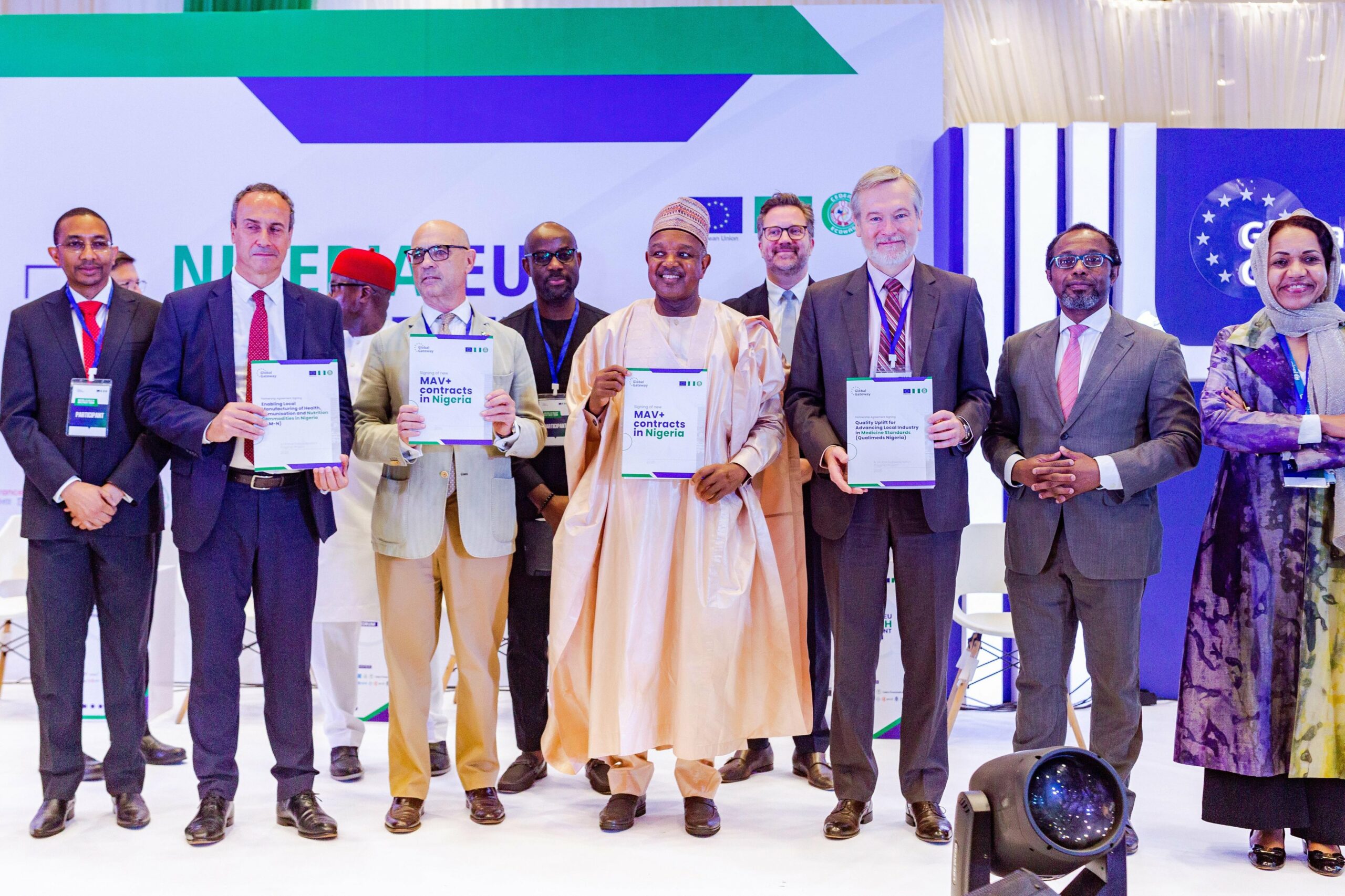
The Federal Government of Nigeria and the European Union (EU) signed three landmark agreements on Thursday to boost investment in local pharmaceutical manufacturing, broaden vaccine access, and strengthen reproductive health systems across West Africa.
Speaking at the Nigeria–EU Health Investment Forum and Signing Ceremony in Abuja, the Minister of Budget and Economic Planning, Senator Abubakar Bagudu, stated that the partnership represents “a platform that embodies our shared aspiration for a healthier, more resilient, and more prosperous world through the EU-Nigeria partnership.”
He explained that the initiative aligns with President Bola Tinubu’s Renewed Hope Agenda, adding: “Our shared vision is to build a stronger and more competitive pharmaceutical sector that drives innovation, job creation, and mutual prosperity.”
Referring to findings from the World Bank–IFC Country Private Sector Diagnostic Report (2025), the Minister emphasised Nigeria’s considerable potential for pharmaceutical growth and investment.
“Nigeria’s pharmaceutical manufacturing subsector holds enormous potential for technology transfer, value addition, and employment generation,” he said, noting that the government remains focused on policies that “encourage private-sector investment and long-term economic transformation.”
He further stated that Nigeria’s Agenda 2050 aims to build a $1 trillion economy by 2030, driven by private-sector participation and reforms that enhance stability and competitiveness.
“President Tinubu has demonstrated exceptional courage by undertaking the difficult but necessary reforms to put our economy on the right track,” the minister said.
Senior Special Assistant to the President on Health (Office of the Vice President), Dr Uju Rochas, who represented Vice President Kashim Shettima, described the agreements as “a turning point in Nigeria’s health investment journey.”
She said: “Our message is clear — Nigeria is open for health investment, innovation, and impact. The President has declared that Nigeria’s health transformation will not be driven by aid and dependency, but by ownership, accountability, and innovation — made in Nigeria, for Nigerians, and by Nigerians.”
The EU Ambassador to Nigeria and ECOWAS, Gautier Mignot, praised the partnership as evidence of a new cooperation model, reaffirming the EU’s commitment to supporting health resilience and local production through the Global Gateway Initiative.
The three agreements that have been signed are:
· ELM-N – Enabling Local Manufacturing of Health, Immunisation and Nutrition Commodities in Nigeria
· QUALIMEDS – Quality Uplift for Advancing Local Industry in Medicine Standards
· SRHR-WA – Strengthening Reproductive Health and Rights in West Africa
These agreements build upon the Presidential Initiative for Unlocking the Healthcare Value Chain (PVAC), launched in 2023, which aims to achieve 70% domestic production of essential medicines by 2030, supported by fiscal incentives such as the 2024 Executive Order waiving tariffs and VAT on pharmaceutical machinery and raw materials.
“Nigeria should be the first destination for any investor seeking growth in Africa. This partnership is a reflection of President Tinubu’s vision for a prosperous, self-reliant, and globally competitive Nigeria,” Bagudu stated at the ceremony that was attended by senior Nigerian and EU officials, development partners, and business leaders.
Comments