


Why Hungarian-British writer David Szalay won 2025 Booker Prize for “Flesh.”


 Quick Read
Szalay’s book recounts the life of taciturn István, from a teenage relationship with an older woman through time as a struggling immigrant in Britain to denizen of London high society. The author has said he wanted to write about a Hungarian immigrant, and “about life as a physical experience, about what it’s like to be a living body in the world.”
By Nehru Odeh
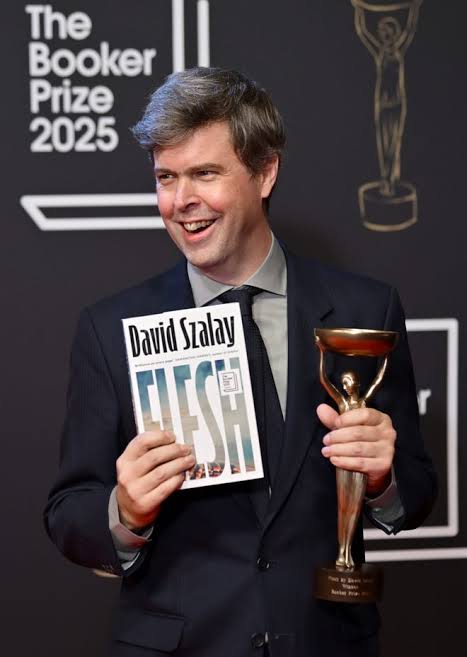
Hungarian-British writer David Szalay has won the 2025 Booker prize for his novel “Flesh,” the story of an ordinary man’s life over several decades in which what isn’t on the page is just as important as what is.
Szalay was announced as the winner of the £50,000 award at a ceremony held in Old Billingsgate in London on Monday, November 10. He was previously shortlisted for the prize in 2016, for his novel “All That Man Is.”
Szalay’s novel topped a strong shortlist which included bookies’ favourite, Andrew Miller, with The Land in Winter, and Kiran Desai, nominated for The Loneliness of Sonia and Sunny, her first novel since winning the Booker with The Inheritance of Loss in 2006. The other novels shortlisted this year were Susan Choi’s Flashlight, Katie Kitamura’s Audition, and Ben Markovits’s The Rest of Our Lives.
The decision to hand Szalay the award was “unanimous”, said panel chair Rowdy Doyle. Joining him on this year’s panel was the actor Sarah Jessica Parker, along with the writers Chris Power, Ayọ̀bámi Adébáyọ̀ and Kiley Reid.
Szalay’s book recounts the life of taciturn István, from a teenage relationship with an older woman through time as a struggling immigrant in Britain to denizen of London high society. The author has said he wanted to write about a Hungarian immigrant, and “about life as a physical experience, about what it’s like to be a living body in the world.”
Written in spare prose − characterised by brevity and a lack of unnecessary detail − the book follows a man caught in a series of events beyond his control over decades. It charts his rise from a housing estate in Hungary to the mansions of London’s super-rich.
“A meditation on class, power, intimacy, migration and masculinity, Flesh is a compelling portrait of one man, and the formative experiences that can reverberate across a lifetime,” organisers of the award ceremony in London said in a statement.
The judges had never read anything quite like it said Doyle, who won the prize in 1993. “It is, in many ways, a dark book, but it is a joy to read.”
“I don’t think I’ve read a novel that uses the white space on the page so well. It’s as if the author, David Szalay, is inviting the reader to fill the space, to observe — almost to create — the character with him.”
Asked whether any of the other novels had got close to challenging Szalay’s win, Doyle said “the answer is ‘kinda yes’,” but refused to name specific titles, saying it would be “unfair, a bit cruel”.
In his acceptance speech, a visibly moved Szalay immediately highlighted the sense of risk that had defined the book’s journey. He recalled a conversation with his editor, Hannah Weston at Jonathan Cape, “wondering aloud whether she could imagine a novel called Flesh winning the Booker Prize.”
“It felt risky to me writing it,” he told the assembled audience, his trophy held tightly. “I think it’s very important that the publisher, the novel-making community… embraces that sense of risk rather than shuns it.”
Szalay’s sixth work of fiction traces the life of one man, István, from his youth to midlife. The judges “had never read anything quite like it”, said panel chair Roddy Doyle, who won the prize in 1993. “It is, in many ways, a dark book, but it is a joy to read.”
Flesh opens with a shocking incident that unfolds while teenage István is living in an apartment complex with his mother in Hungary. Szalay then follows the protagonist as he spends time in the military before moving to London, where he begins working for the uber-rich. Written in spare prose, the novel explores masculinity, class, migration, trauma, sex and power.
For Szalay, the win is both a professional landmark and a practical relief. In his first post-win interview, when asked about the £50,000 prize money, he said with a laugh that it would “keep the wolf a bit further from the door,” though he allowed for the possibility of “a nice little holiday.”
However, the path to Flesh was not straightforward. In a revealing moment after the ceremony, Szalay shared with host Samira Ahmed that he began the novel just after abandoning another—a full-length work of 80,000 to 100,000 words that had consumed years of his life.
“This wasn’t necessarily a very easy book to write,” he admitted from the podium, dedicating his win to his wife, Oshoya, the “only real witness” to his struggles. “I’m sure she is as bewildered as I am by the fact that those rather bleak times and this glittering evening are somehow part of the same proces.
He also told the Booker Prize that he was inspired to write Flesh after his own time living between Hungary and England, and noticing the cultural and economic divides that exist within contemporary Europe. “I also wanted to write about life as a physical experience, about what it’s like to be a living body in the world.”
“Even though my father is Hungarian, I never felt entirely at home in Hungary. I suppose, I’m always a bit of an outsider there, and living away from the UK and London for so many years, I also had a similar feeling about London,” Szalay told BBC Radio.
“I really wanted to write a book that stretched between Hungary and London and involved a character who was not quite at home in either place,” Szalay said.
Writing in the Guardian over the weekend on his inspiration for Flesh, Szalay said that the novel was “conceived in the shadow of failure” – in autumn 2020 he abandoned a novel he had been working on for nearly four years that he felt wasn’t working. He wanted Flesh to “somehow express the feeling I had that our existence is a physical experience before it is anything else, that all of its other aspects proceed from that physicality”.
Born in Montreal to a Hungarian father and Canadian mother, Szalay grew up in London. He has lived in Lebanon and the UK, and now lives in Vienna. After graduating from Oxford, he worked as a financial advertising sales executive, which became the inspiration for his debut novel, London and the South-East. He is also the author of the novels Spring and The Innocent, as well as the short story collection Turbulence.
The Booker Prize is one of the most prestigious awards in literature. It honours the best English-language novels published in the U.K. Winners of the awards receive £50,000, and usually a decent bump in sales.
Comments