


Groups ask EFCC to probe financial dealings of five Kogi LGAs

 Quick Read
Comrade Taiwo Otitolaye, Executive Director, Africa, ATI, noted that Kogi state receives billions of naira annually in federal allocations, including Derivation Funds and the Local Government Share of the Federation Account. He said while the five LGAs are entitled to N3 –N5 billion each for the 2024/ 2025 fiscal year, communities under the continue to suffer from dilapidated roads, non-functional health centres, and a several lack of basic services.
By Priscilla Osaje
Two anti-graft groups have demanded immediate and full scale investigation into what they described as massive misappropriation of statutory allocations meant for the five local government areas of Kogi State.
The two groups – African Transparency Initiative (ATI) and Community Outreach for Development and Welfare Advocacy (CODWA), made the call at a news conference in Abuja on Tuesday.
Specifically, the groups asked the Economic and Financial Crimes Commission (EFCC) to investigate the 2024/2025 financial dealings of the five local government areas of Kogi.
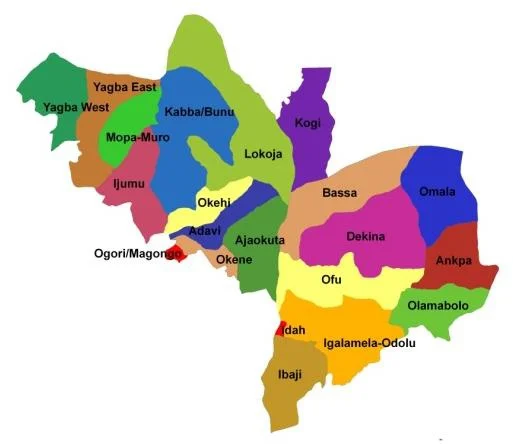
The groups listed the the five local government areas to include are Adavi, Bassa, Dekina, Idah and Yagba East.
Speaking at the press conference, Comrade Taiwo Otitolaye, Executive Director, Africa, ATI, noted that Kogi state receives billions of naira annually in federal allocations, including Derivation Funds and the Local Government Share of the Federation Account.
He said while the five LGAs are entitled to N3 –N5 billion each for the 2024/ 2025 fiscal year, communities under the continue to suffer from dilapidated roads, non-functional health centres, and a several lack of basic services.
“We organise this press conference to place the facts before the public, demand urgent EFCC intervention, and mobilise media and civil society to act,” ATI boss said.
According to him, our research on the piloted five local governments areas revealed that the total allocation for the five LGAs for the 2024/2025 fiscal year was N15 – N25 billions.
“Salary and statutory overheads consume only 15 per cent – 26 per cent leaving 74 per cent – 84 per cent, equivalenting to N11 – N21 billion unaccounted for.
“87 per cent of 1,200 residents rate service delivery very poor while 20 per cent describe the councils as non existent.”
Otitolaye said field verification shows poorly functional primary health centres, zero tarred roads, and only 3 per cent of water projects in place.
He alleged that the allocations have been systematically diverted by former and current local government chairmen, treasurers, and associated officials.
According to him, the EFCC has that mandate to investigate and prosecute those found corrupt.
“At the helm of the local government is the local government chairman and treasurers. So, these are the financial stakeholders in the local government.
“So, if the EFCC can go to those local governments and investigate and invite those chairmen and treasurers, it will be good.
“Our call also goes to the citizens, because the people of any country deserve the type of leaders that govern them through their action and inaction. So, the citizens should wake up and ask questions.
“There is what we call demand side of accountability and supply side of accountability. It is the responsibility of the citizens to demand and strengthen the demand side of accountability. So, we are asking Kogi people, we are asking all Nigerians to rise up and demand accountability.
“Because there are 174 local governments. So, our pilot of five local governments is just a stinch of the south. So, what we are doing, and also the Physical Responsibility Commission must wake up to their oversight function.
Also speaking, Comrade Lukman Adefolahan, Chief Operating Officer, 21st Century Community Empowerment for Youth and Women Initiative, said the group submitted the petition to the EFCC to assist and request it to take action.
“We want EFCC to take action and list it to citizens of Nigeria, and let them take this as a pilot to give them the true picture of what is happening across the 774 local government in terms of spending of public resources
“Yes, the call still stands because we want the anti-corruption agencies including the Office of Auditor General for the Federation to work collaboratively with other anti-corruption agencies and be steadfast in their auditing process, not to delay the auditing process.
“And we want EFCC to play that active role by supporting the Office of Auditor General for the Federation so that it can deliver on that mandate, being the mother of all anti-corruption agencies.
“If they can be supported in terms of administrative and financial and they will deliver their work and audit within the release cycle, not after damages have been done. The latest audit report from that office should be 2022, and we are in 2025 now.
“So, we don’t even know what happened to the auditing of 2022, 2023, 2024. So, we want National Assembly and other government agencies to support the Office of Auditor General for the Federation and the anti-corruption agencies.
“We are also calling on Technical Unit of Governance and Anti-Corruption Reform that is saddled with the responsibility of coordinating of Inter-Agency Tax Reform to support anti-corruption agencies to deliver on their mandates by way of welcoming petitions from Nigerians.
Comrade Shina Loremikan, Country Director (Nigeria), ATI, who said confronting corruption could be done horizontal and vertical, said he expected the EFCC to review the petition and take immediate action.
“We know there is a means of communication with the EFCC and that is what we are engaging. We have written a petition.
“We have submitted to the office of the Chairman. We expect it to be reviewed and immediate action to be taken because the whole world is watching us,”
Loremikan said. (NAN)
PO/ADA
Comments