



G20 Summit: Ramaphosa hails success despite tensions with U.S.

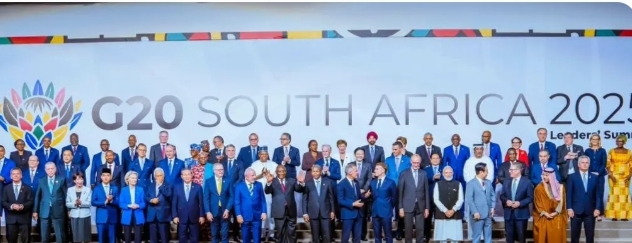
The G20 summit in Johannesburg ended on Sunday, with South Africa declaring it a diplomatic success.
Despite the United States boycotting the meeting, South Africa said all members agreed on a major declaration that shows a renewed commitment to global cooperation.
President Cyril Ramaphosa said the final document proves that world leaders still share important goals, even when they disagree.
As host, he pushed for the G20 to address problems like climate change and global inequality.
Why the U.S. Boycotted
The Trump administration refused to attend. It claimed—based on false accusations—that South Africa’s black-led government is mistreating white citizens. It also opposed South Africa’s focus on climate action and trade cooperation.
In a rare move, South Africa released the summit’s 122-point declaration on the first day. This broke G20 tradition and angered the U.S.
Tensions increased on Sunday when South Africa refused to perform the normal handover of the G20 presidency, which is supposed to go to the United States in 2026. President Trump wants to host that meeting at one of his golf resorts in Florida.
What the Declaration Says
The declaration calls for more support for poor countries, especially those suffering from climate disasters, heavy debt, and the need to switch to clean energy.
Leaders from 19 countries, the EU, and the African Union said climate financing must increase “from billions to trillions.” They also called for fairer access to development and better protections for countries rich in minerals critical for modern technology.
On security, the G20 promised to work for long-lasting peace in Sudan, the Democratic Republic of Congo, Palestine, and Ukraine.
Africa’s Big Moment
More than 20 African countries attended the summit. African issues were at the centre of discussions.
Germany announced new investments through a pan-African insurance group. The UAE pledged $1 billion to develop artificial intelligence infrastructure across Africa. The Compact with Africa initiative received new commitments.
Ramaphosa said South Africa used its G20 leadership to push Africa and the Global South’s priorities to the top of the agenda.
However, not all of South Africa’s ideas made it through. A proposal to tax billionaires more strongly was weakened.
Global Tensions Still Visible
The summit took place while the world is divided over Russia’s invasion of Ukraine and during difficult climate talks in Brazil.
The declaration made only one brief mention of Ukraine, simply calling for a “just and lasting peace.”
French President Emmanuel Macron said meeting in Africa was historic but warned that the G20 is struggling to agree on major global conflicts. UK Prime Minister Keir Starmer said the world faces “a very difficult road ahead.”
China’s premier Li Qiang said global unity is under pressure because of rising protectionism.
Even with the tensions, many observers said the summit was symbolic and meaningful. It was the first G20 meeting where “the inequality crisis” was a major focus.
Comments