


Inside the Defection Trend: Why PDP keeps losing governors ( Full List)

 Quick Read
While no official, uniform explanation has been offered for these defections, their frequency and timing have fuelled strong concerns that the country is gradually tilting toward a de-facto one-party state.
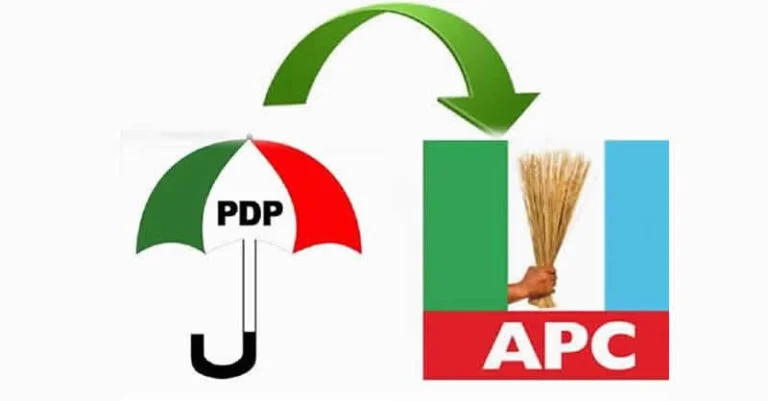
Since 2023, a remarkable political shift has swept across Nigeria as several governors elected under the platform of the Peoples Democratic Party (PDP) have defected to the ruling All Progressives Congress (APC).
While no official, uniform explanation has been offered for these defections, their frequency and timing have fuelled strong concerns that the country is gradually tilting toward a de-facto one-party state.
The latest chapter in this unfolding political realignment is the defection of Rivers State Governor, Siminalayi Fubara.
His exit from the PDP has widened speculation that more governors are preparing similar moves, particularly with Governor Agbu Kefas of Taraba State reportedly set to defect by January 2026.
Observers suggest that political protection, strategic alignment with federal power, and access to national resources ahead of the 2027 elections may be motivating factors.
Political analysts warn that if the trend continues unchallenged, the opposition’s relevance may be severely weakened in the coming election cycles.
Below is the list of governors elected on the PDP platform between 2023 and 2025 who have now crossed or are on the verge of crossing to the APC:
Full List of Defected PDP Governors Since 2023
Umo Eno – Akwa Ibom State (South-South)
Elected as a PDP governor in 2023, Umo Eno’s quiet political style did not stop behind-the-scenes lobbying which eventually positioned him for a defection. His switch is regarded as strategic in consolidating his relationship with major federal actors.
Sheriff Oborevwori – Delta State (South-South)
The Delta governor, widely perceived as loyal to established political blocs, joined the ruling party amid speculations that he needed federal alignment to stabilise internal political threats.
Peter Mbah – Enugu State (South-East)
Mbah’s defection shocked the South-East bloc where the PDP still retains grassroots loyalty. Analysts interpret his move as an effort to secure stronger federal ties as political realignments continue ahead of 2027.
. Douye Diri – Bayelsa State (South-South)
Despite previously enjoying strong PDP backing in an oil-rich state, Governor Diri reportedly defected to ensure political survival and access to federal leverage in infrastructure funding and security-related matters.
Siminalayi Fubara – Rivers State (South-South)
The most dramatic of all defections, Fubara’s move followed prolonged political hostilities in Rivers State.
His defection marks a major turning point in South-South politics, shifting power dynamics in a state traditionally regarded as a PDP stronghold.
The Broader Implications
Political commentators argue that defections of this magnitude threaten democratic plurality.
A dominant ruling party without strong opposition checkscould reduce accountability and weaken policy debate.
Already, voices within civil society have warned that Nigeria risks slipping toward an era where elections become symbolic rather than competitive.
For now, what remains uncertain is whether the PDP will attempt a strong reorganisation or accept further erosion of its influence.
What is clear, however, is that Nigeria’s political landscape is entering a critical period where shifting alliances may determine the future of multi-party democracy.
Comments