



Lagos, UNICEF move to deepen Diversion Programme for vulnerable children

 Quick Read
She stressed that the adult justice system frequently becomes the first responder to issues that require social rather than punitive solutions.
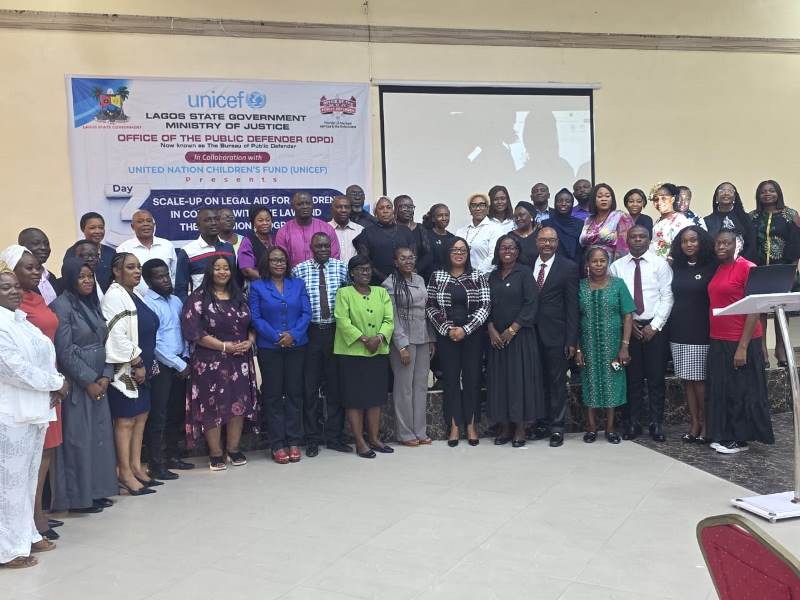
The Lagos State Government, in partnership with the United Nations Children’s Fund (UNICEF), has concluded a three-day capacity-building programme aimed at deepening the implementation of the state’s diversion framework for children in conflict with the law.
The training, themed “Scale-Up of Legal Aid for Children in Conflict with the Law and the Diversion Programme,” brought together lawyers, social workers, child protection officers, and justice-sector practitioners to strengthen child-friendly justice delivery across the state.
Speaking at the opening session, the Director of the Office of the Public Defender (OPD), Mrs. O. Adesomoju, said the initiative reflected more than institutional reforms, noting that it speaks directly to the future and wellbeing of vulnerable children whose lives may be shaped by decisions made within the justice system.
“We are here because the lives and future of some children depend on the decisions we make, the systems we design, and the integrity with which we uphold justice,” she said.
Adesomoju described children in conflict with the law as a highly vulnerable group, often coming from environments marked by poverty, trauma, neglect, or lack of supportive family structures.
She stressed that the adult justice system frequently becomes the first responder to issues that require social rather than punitive solutions.
“We are here because every child, without exception, has the right to legal assistance. They deserve a fair opportunity to be heard, understood, and supported,” she added.
She explained that the diversion programme, an approach that channels first-time child offenders away from formal prosecution, promotes rehabilitation, community safety and cost-effectiveness, while preventing the long-term stigma of criminal records.
“Diversion is not about excusing wrongdoing. It is about recognising that criminalising childhood behaviour often does more harm than good,” she said.
“It offers rehabilitation instead of punishment, community-based solutions instead of confinement, and support services instead of stigma.”
Also speaking, UNICEF Child Protection Specialist, Dennis Onoise, traced the origins of the diversion programme to UNICEF’s 2016 assessment across six states, where Lagos was found to have the highest number of children detained, many held for years in adult correctional facilities.
“These findings were deeply concerning. Children cannot spend two or three years in detention with adults they do not know,” Onoise said.
“We strongly advocated for their release and pushed for the establishment of diversion programmes and community rehabilitation centres.”
He noted that since the programme began, UNICEF and the Lagos State Government have successfully implemented diversion initiatives in Mushin Local Government Area and Ojuwoye Local Council Development Area, where over 200 children have been rehabilitated and reintegrated into their communities.
“We are very encouraged by the results and want the state to invest further in expanding this model,” he said.
Onoise also urged other local governments and LCDAs across Lagos to adopt the diversion programme to ensure that vulnerable children receive appropriate support rather than punitive treatment.
Comments