



Super Eagles Soar, Then Stagger: Seven Lessons From Nigeria’s Thrilling AFCON Win Over Tunisia

 Quick Read
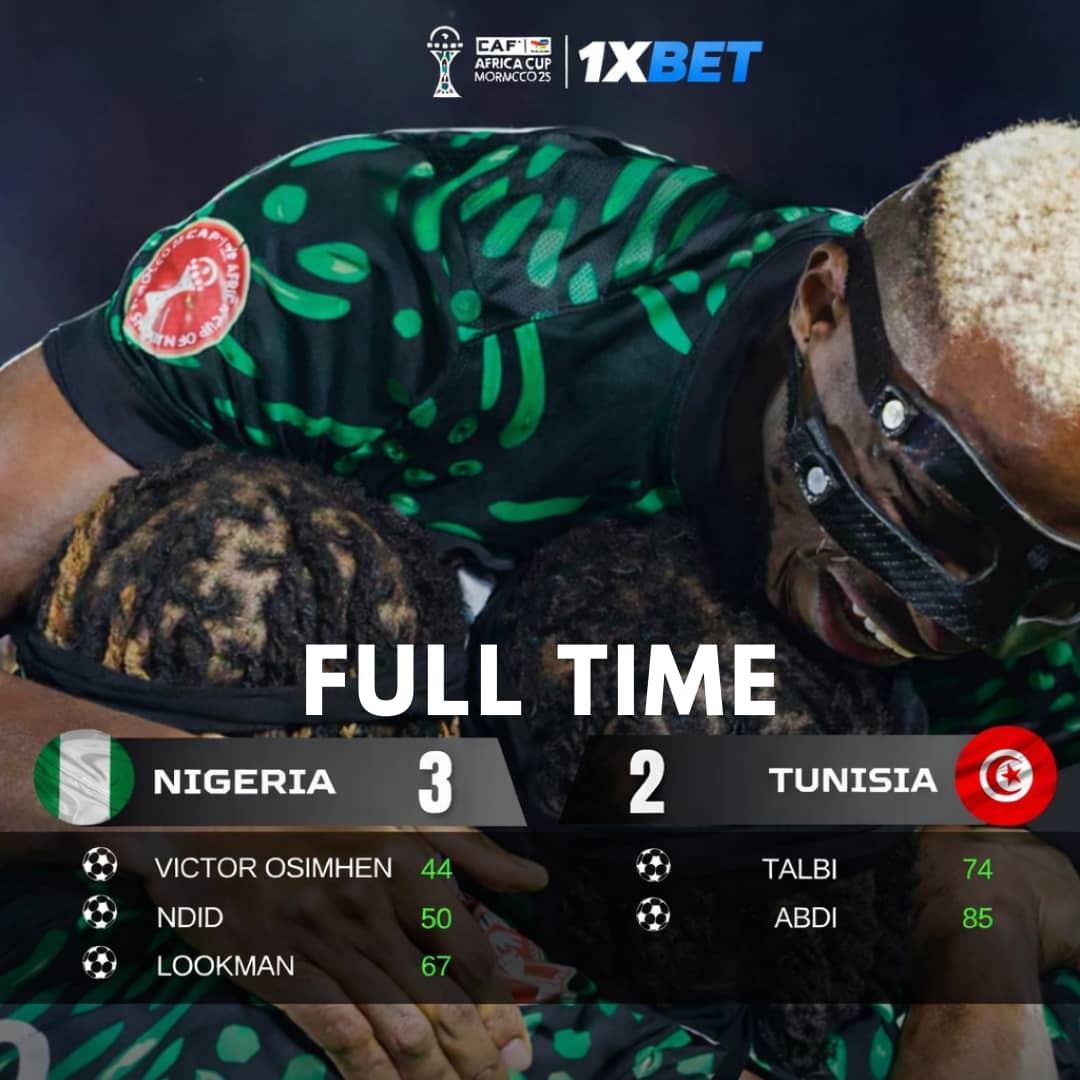
Nigeria’s 3–2 victory over Tunisia on Saturday night in Fès will be remembered as one of the most dramatic matches of the 1xBET AFCON 2025 group stage.
By 1XBET: Official sponsor of AFCON 2025
Nigeria’s 3–2 victory over Tunisia on Saturday night in Fès will be remembered as one of the most dramatic matches of the 1xBET AFCON 2025 group stage.
The match showcased the Super Eagles’ attacking brilliance, exposed their lingering flaws, and underlined why they remain both a feared contender and a tactical puzzle.
Under the floodlights at the Fez Stadium, Eric Chelle’s side tore into one of Africa’s most organised teams, scoring three times and securing qualification for the knockout rounds with a match to spare. Goals from Victor Osimhen, Wilfred Ndidi and Ademola Lookman confirmed Nigeria’s dominance in Group C, but the narrow margin of victory told a deeper story.
Nigeria were irresistible for long stretches, yet fragile when the momentum shifted. Tunisia, battered and breathless for much of the game, nearly escaped with an unlikely result after exploiting Nigerian lapses late on.
As the Super Eagles prepare for the knockout phase, the performance raised as many tactical questions as it answered. Here are seven major talking points from a night that could shape Nigeria’s AFCON journey.
1. VAR once again steals the spotlight
Tunisia’s second goal came from the penalty spot, following a decision that immediately split opinion inside the stadium and across social media.
During a crowded moment in Nigeria’s penalty area, Bright Osayi-Samuel and a Tunisian forward tussled for position as the ball dropped awkwardly between them. Contact was inevitable. After a VAR review, the referee judged that the ball had made sufficient contact with Osayi-Samuel’s arm to justify a penalty.
Ali Abdi made no mistake from 12 yards, but the controversy lingered long after the final whistle. The incident once again highlighted the uncomfortable reality of VAR at AFCON: decisions are technically correct, yet emotionally divisive, often changing the tone of matches in seconds.
For Nigeria, it was another reminder that concentration inside the box must be absolute. Marginal errors now carry maximum punishment.
2. Nigeria’s press overwhelms — then collapses
Eric Chelle has clearly stamped his identity on this team. Nigeria pressed high, squeezed Tunisia’s midfield, and forced turnovers in dangerous areas for over an hour. The Super Eagles played with aggression, verticality and confidence, repeatedly suffocating Tunisia’s build-up play.
But by the final 20 minutes, the cracks appeared.
The press lost its bite. Distances between midfield and defence grew wider. Tunisia, previously starved of space, suddenly found freedom to run at Nigeria’s back line. Long balls and direct play caused panic, and Nigeria’s dominance evaporated.
This is the modern football dilemma: high intensity wins games, but only if managed wisely. In tournament football, fatigue is ruthless. Chelle may need to rotate earlier, slow the tempo when leading, or introduce more control-oriented midfield patterns to protect his team late in matches.
3. Nwabali’s shaky night raises questions
Stanley Nwabali has enjoyed praise in recent months, but this performance placed him firmly under scrutiny.
The goalkeeper struggled to deal with Montassar Talbi’s header for Tunisia’s first goal, allowing the ball to slip beneath his body. His handling under crosses was uncertain, and his distribution at times invited unnecessary pressure.
At AFCON level, goalkeepers are often the difference between glory and heartbreak. Nigeria’s attacking quality is beyond doubt, but defensive security starts at the back. Nwabali must rediscover composure quickly, because the margin for error only shrinks in the knockout rounds.
4. Three goals against Tunisia send a continental warning
Tunisia arrived in Morocco with a fearsome defensive record, having gone ten World Cup qualifying matches without conceding. Nigeria tore that reputation apart.
Osimhen’s movement unsettled defenders throughout, Lookman’s pace and intelligence caused constant problems, and Ndidi’s set-piece goal highlighted Nigeria’s growing threat from dead-ball situations — an area that has traditionally separated champions from nearly-men at AFCON.
Few teams left in the competition will relish facing a Nigerian attack firing with this level of confidence. The Super Eagles have now scored six goals in two matches, underlining their status as one of the tournament’s most dangerous attacking sides.
5. Qualification achieved — but first place still vital
With six points from two games, Nigeria are safely through to the Round of 16. However, finishing top of Group C remains crucial.
Avoiding defeat against Uganda in their final group match would secure first place and likely deliver a more favourable knockout draw. History has shown that group winners often avoid early clashes with tournament heavyweights.
Rotation will be tempting, especially with fatigue already evident, but Chelle must balance rest with rhythm. AFCON momentum is fragile; lose it, and recovery is difficult.
6. Defence remains the missing piece of the title puzzle
Despite the attacking fireworks, Nigeria have now conceded three goals in two matches — a statistic that should concern the coaching crew.
Championship-winning sides at AFCON are built on defensive authority. Tunisia’s late comeback attempt exposed Nigeria’s vulnerability when pressed, especially in wide areas and during defensive transitions.
The Super Eagles’ ceiling is undoubtedly high. But unless they tighten up defensively, even their attacking brilliance may not be enough against more clinical opposition in the knockout rounds.
7. Osimhen and Lookman: brilliance still waiting for perfect chemistry
Victor Osimhen and Ademola Lookman both scored and shone individually, yet their partnership remains a work in progress.
At times, their movements overlapped rather than complemented. On other occasions, promising counter-attacks broke down due to mistimed runs or delayed passes. The potential is enormous — one thrives on chaos, the other on precision — but cohesion is still developing.
If Eric Chelle can unlock a more fluid understanding between his two star forwards, Nigeria’s attack could become truly devastating. The best teams are not just collections of talent; they are synchronised machines.
Final analysis
Saturday night in Fès was thrilling, chaotic and revealing. Nigeria showed why they are contenders, but also why the road to the AFCON title remains perilous.
The Super Eagles can outscore anyone. Whether they can outlast everyone is the question that will define their tournament.
Comments