



Where Clay Becomes Light: Umar Abdulrasheed’s Sculptural Lamp, Sage

 Quick Read
Umar Abdulrasheed's Sculptural Lamp Sage provides a unique and purposeful counterbalance in a time where speed, spectacle, and digital excess are becoming more and more prevalent.
By Olu Ajayi
Umar Abdulrasheed’s Sculptural Lamp Sage provides a unique and purposeful counterbalance in a time where speed, spectacle, and digital excess are becoming more and more prevalent. The piece makes no effort to compete with the visual cacophony of modern society. Rather, it asserts its existence through formal constraint, material intelligence, and a demand for deliberate, gradual engagement. Despite being identifiable as a lamp, the work defies classification as a utilitarian object. It functions with the spatial authority and conceptual weight of sculpture, straddling the line between architectural form, contemplative artefact, and household utility.
A critical reassessment of function itself lies at the heart of this work. While Abdulrasheed does not discount usefulness, he also does not let it to take precedence over the object’s purpose. Function is one component of a broader constellation of issues in Sculptural Lamp Sage, which also addresses memory, material behaviour, presence, and the emotional life of objects. According to the work, an object’s actions and its communication are inextricably linked, and communication is not just visible but also tactile, spatial, and affective.
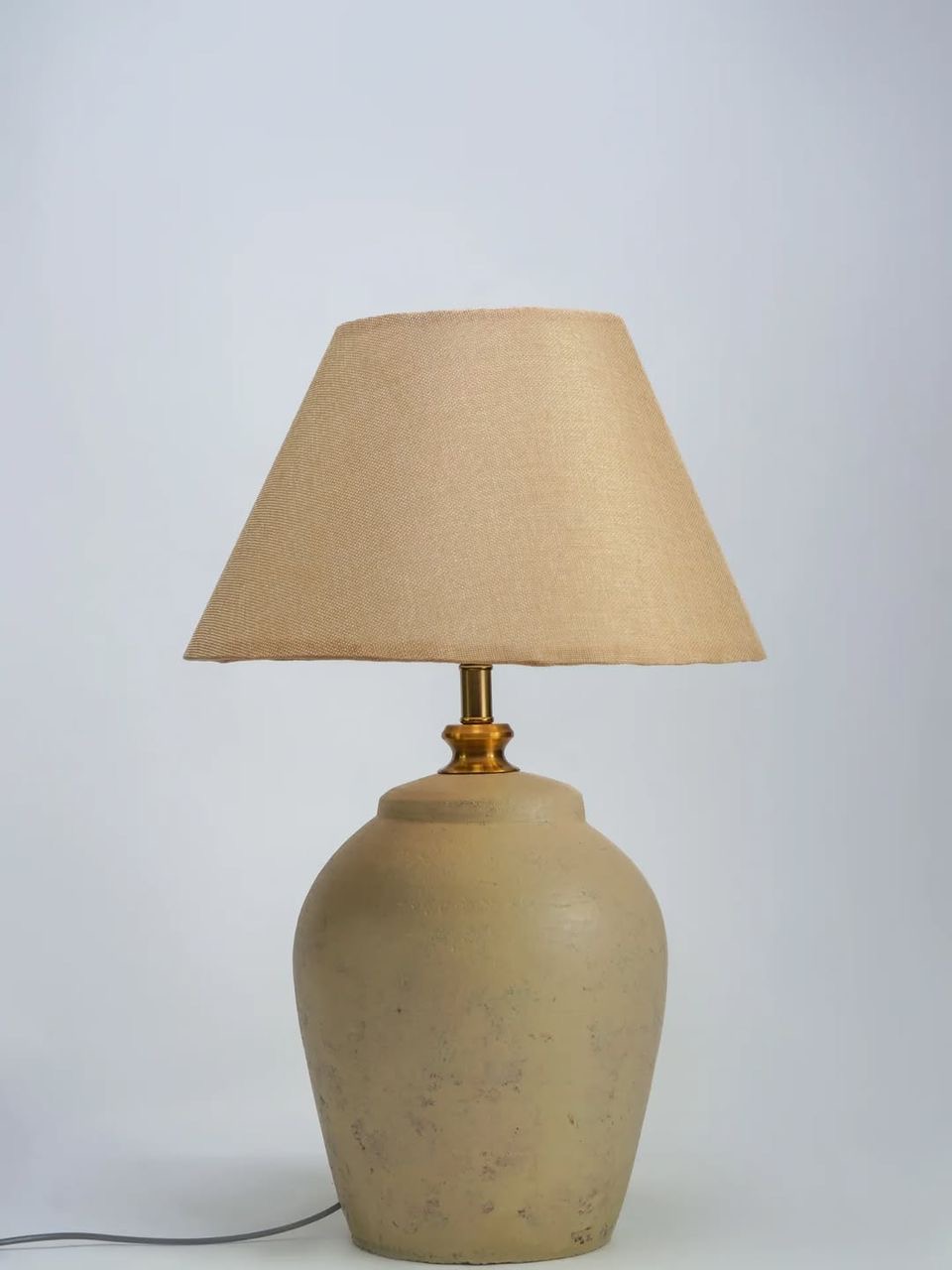
A large rectilinear ceramic mass supports the form, and its surface is painted a subdued sage green that instantly conjures up images of aged stone, mineral deposits, and the gradual passage of geological time. There is a purpose behind this chromatic constraint. By emphasising texture, weight, and surface above ornamentation or visual flourish, the muted colour scheme draws attention to the object’s physicality. Reminiscent of erosion, sedimentation, and the silent labour of natural forces, pale tonal fluctuations reverberate throughout the body. These surface characteristics come from the behaviour of the material itself and the artist’s awareness to its reactions; they are not added as adornment.
Abdulrasheed purposefully keeps the clay’s imperfections intact. Textural irregularities, faint distortions, and finger markings are still discernible, creating a record of the creation process. By doing this, the piece challenges the polished anonymity that design products frequently evoke. Rather, it welcomes the proof of time, pressure, and touch. The surface turns into a record of the interaction between the body and the material, placing the piece in a tradition of material-led sculpture that recognises the connection between meaning and process.
A precisely crafted curving void breaks up the form’s rigidity. A dynamic tension between weight and absence is produced by this aperture, which also destabilises the mass. The emptiness serves as both a conceptual halt and a physical aperture. It encourages the observer to actively participate in the composition by looking through the object rather than just at it. This negative area turns into a place of contemplation where silence and stillness are incorporated into the work’s language. The sculpture is breathing right now.
A spherical bulb enclosed in a restrained brass fitting sits above the ceramic body. The interaction of industrial metal and raw clay creates a silent yet potent conversation between the engineered and the handcrafted. The ceramic surface’s haptic intricacy is sharpened by the precise and simple brass element. Light manifests as a sculptural force rather than just as illumination. It introduces a temporal dimension that changes with the surroundings, activates the shape, and expands its presence into the surrounding area. The illumination is steady, warm, and measured. It accompanies rather than dominates.
Abdulrasheed’s oeuvre is in line with broader trends in contemporary ceramics, where artists are increasingly emphasising material intelligence, embodied production, and affective presence over ornamental presentation, thanks to this meticulous orchestration of form and illumination. Here, clay once marginalised in discussions of fine art is reclaimed as a key sculpture media that can retain conceptual depth while staying rooted in physical process. Lamp Sculpture Sage thoroughly engages in this trend, showing how ceramics can function as both an argument and an object.
Another level of intricacy is introduced by the work’s connection to the home. The lamp defies the assumptions of convenience and consumption that frequently characterise residential products, yet belonging to a well-known functional category. Rather, it suggests a slower, more contemplative approach to interaction. The item becomes a companion rather than a commodity, serving as a presence anchor in the lived environment. In this conversation, the exposed electrical cord is quite important. It anchors the sculpture’s subdued grandeur to the present and strengthens the mutually reinforcing relationship between environment and object.
An understated but enduring environmental conscience is woven throughout the piece. Clay bears the burden of biological and geological history because it is an earth-based substance. Abdulrasheed’s focus on durability, tactility, and self-control suggests a caring ethic. The piece doesn’t use overt iconography to express its environmental concerns. Rather, it represents them through its emphasis on slowness in a culture that values acceleration, its rejection to excess, and its dedication to tangible reality.
Sculptural Lamp Sage’s conceptual reach is further strengthened by its receptivity to various readings. The form’s monumentality and structural clarity reveal architectural allusions. Its stance and posture reveal bodily links. The interaction of mass, light, and emptiness gives rise to symbolic meanings. Abdulrasheed doesn’t force a story. He establishes circumstances that allow meaning to progressively build up via repeated interaction. Without becoming indeterminate, the piece maintains its porosity.
Sculptural Lamp Sage’s restraint becomes a daring gesture in a modern environment full of innovation and visual stimulation. The work invites the audience to stay rather than to devour. It encourages an attention-oriented ethic that values presence over performance and duration over immediacy. Its power comes from its refusal to vie for attention. Rather, it provides a subdued counterpoint to the excess hyperbole that pervades a large portion of modern visual culture.
Abdulrasheed expresses a disciplined and very compassionate ceramic practice through this work. His method shows a deep comprehension of formal composition and material behaviour while staying rooted in sensory and emotional experience. The light does not aim to impress through conceptual declaration or technological demonstration. Care and the gradual accretion of shape, memory, and significance allow it to endure.
Sculptural Lamp Sage endures as a remnant of its existence long after the light has been extinguished. Instead of brightness, what remains is the feeling of having come upon something that has been moulded with tolerance, wisdom, and self-control. The calm power of Abdulrasheed’s work and the possibility of a methodology that views sculpture as a place for introspection, connection, and sustained attention—rather than as a spectacle are found in this perseverance.
Comments