


MY FATHER’S FARMLAND: A MORAL INQUIRY INTO WHAT WE LEAVE BEHIND

 Quick Read
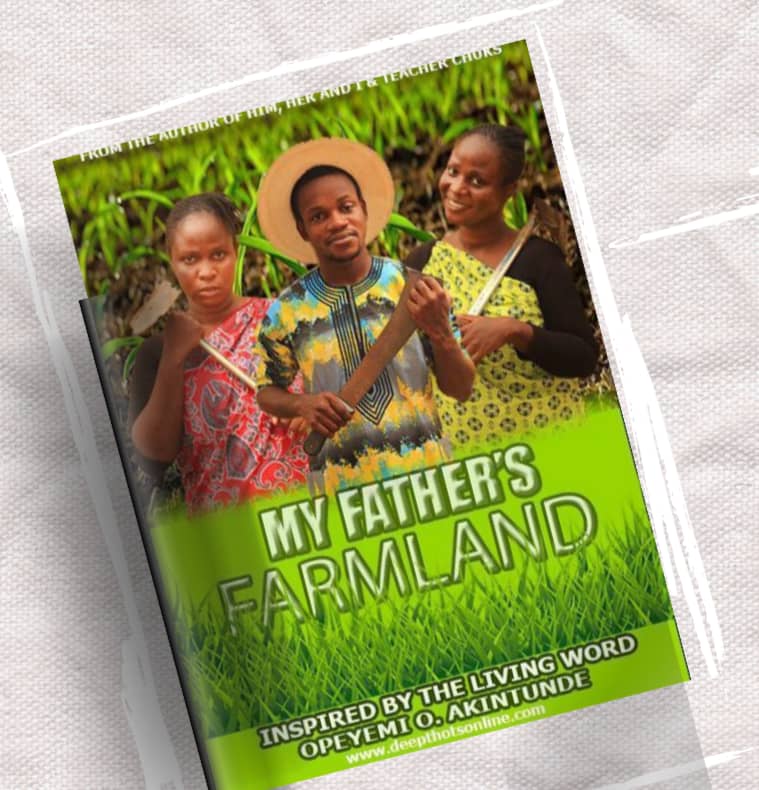
In the Novel, My Father’s Farmland, Novelist and filmmaker Opeyemi Akintunde employs allegory to interrogate one of humanity’s oldest questions: what do we truly leave behind? Using the metaphor of a farmland entrusted to human beings, the novel explores accountability, stewardship, and the unseen consequences of personal choices.
Benson Michael
In the Novel, My Father’s Farmland, Novelist and filmmaker Opeyemi Akintunde employs allegory to interrogate one of humanity’s oldest questions: what do we truly leave behind? Using the metaphor of a farmland entrusted to human beings, the novel explores accountability, stewardship, and the unseen consequences of personal choices.
The narrative unfolds around three siblings whose lives are examined beyond death. Guided by a father figure representing ultimate authority, each character is confronted with the actual state of their farmland. The imagery is stark and unflinching; lush lands masking rot beneath the soil, blood-stained earth, abandoned fields, and wasted harvests. These farmlands become metaphors for neglected responsibilities, unresolved trauma, abuse, and wealth hoarded rather than shared.
Akintunde’s strength lies in her willingness to confront uncomfortable realities. The novel addresses themes such as sexual abuse, emotional neglect, addiction, moral hypocrisy, and social inequality, not as isolated experiences but as choices that shape communal outcomes. Pain, in this narrative, is not an excuse for destruction; rather, it is presented as a crossroads where one either nurtures healing or perpetuates harm.
The prose is deliberately simple, avoiding ornate language in favour of clarity and accessibility. This stylistic choice allows the symbolism to remain central and ensures the novel’s message is not lost in abstraction. The simplicity, however, does not dilute the weight of the themes. On the contrary, it sharpens them. Characters who appear successful by conventional standards…wealth, status, influence ..are revealed to have barren or poisoned farmlands, while others, outwardly flawed or overlooked, are shown to have cultivated lives of impact through compassion and responsibility.
Though rooted in faith-informed storytelling, My Father’s Farmland avoids overt didacticism. Instead, it functions as a moral mirror, inviting readers to reflect rather than prescribing easy answers. Its central questions linger long after the final page: What did you do with what you were given? Who benefited from your harvest? And who paid the price for your neglect?
In a society wrestling with inequality, silence around abuse, and the glorification of unchecked success, Akintunde’s novel feels timely.
My Father’s Farmland is not merely a story about judgment, but about legacy; quietly insisting that every life, like every field, ultimately reveals what it was cultivated for.
Rating: ★★★★☆
⭐ 4.5 / 5
A powerful and thought-provoking allegorical novel that confronts stewardship, trauma, and moral accountability with rare clarity.
Highly recommended for:
Readers who appreciate symbolic storytelling, reflective fiction, and narratives that explore the consequences of personal choices, legacy, and responsibility.
Best for:
Adults, young adults, educators, faith and social-impact readers, and book clubs interested in conversations around accountability, healing, and purposeful living.
Comments