


Egwu Onye Mụtara Amụta:Confidence, Cultural Memory, and Elvira Onyemegbulem’s Performance in Swansea

 Quick Read
Mobility plays a key role here. Music travels with people. Elvira’s performance shows how migrant voices can enrich public spaces rather than remain hidden. Academic work on migration often highlights the importance of cultural contribution.
By Motolani Alake
There is a well-known Igbo saying that states, Egwu onye mụtara amụta, ọ naghị atụ ya egwu (meaning, a skill that has been properly learned no longer frightens the person who practises it). That is, confidence grows from long familiarity, not from chance or excitement. This saying offers a good window into exploring, engaging with and interrogating Elvira Chioma Onyemegbulem’s work.
Elvira’s performances do not rely on spectacle or force. They carry the calm assurance of someone who has lived inside music for many years. She does not try to sing. She simply sings. The best cue for this is how her voice flows with ease and freedom. This all depends on how she takes care of her singing and the stories she carries, and how much she trusts her body and her voice.
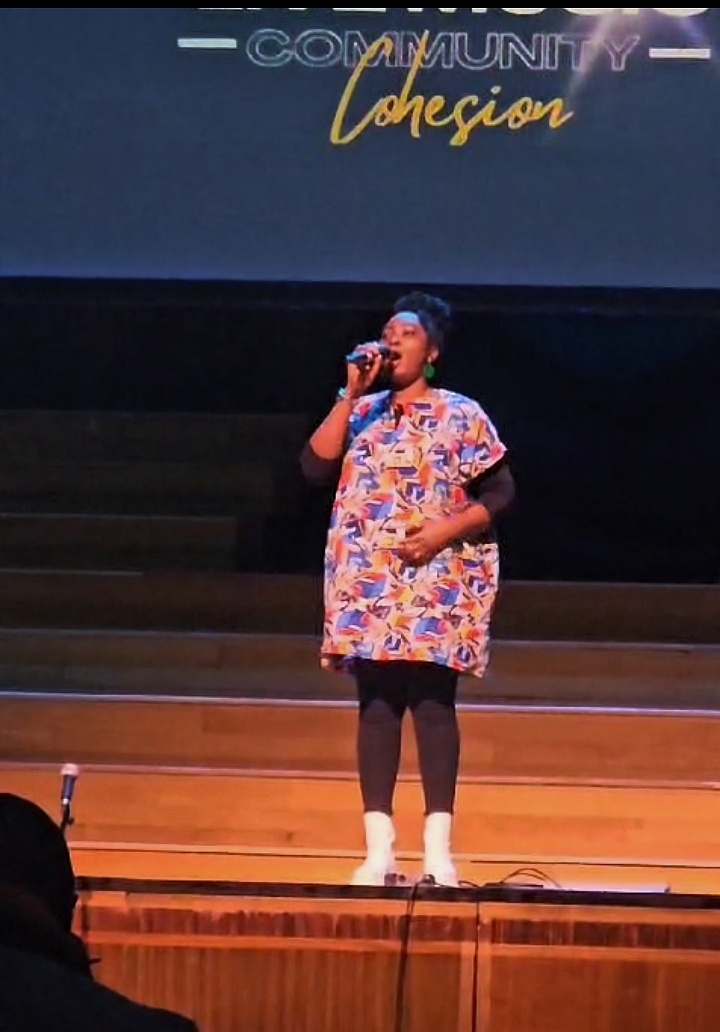
So, when Elvira had the chance to perform at the Life Community Cohesion Music Event in Swansea in February 2024, she took it with both hands and ensured that confidence and calm was seen very clearly during her performance. Then Elvira walked onto the stage and began to sing The Prayer, made famous by Céline Dion and Andrea Bocelli.
Even the children and teenagers in the audience could sense something was special. The room grew quiet. People stopped shifting in their seats and whispering. Everyone leaned in to listen to her voice.
The song’s opening line invited the audience into something slower and deeper. Elvira did not rush the words. Her voice sounded steady and warm. Listeners could hear care in how each line was shaped. Singing in this way requires patience from both the singer and the audience. Academic writing on performance often describes this as presence. Presence means being fully there, not distracted, not performing for approval. Elvira’s presence allowed the audience to relax and listen properly.
The song is not an easy one to sing. It asks a lot from the voice, from how high and low it goes to how carefully the singer must control their breathing and feelings. Many singers end up concentrating mainly on getting the notes right. Elvira focused on meaning. When she sang lines about guidance and grace, the words felt directed at the people in the room. Silence followed each phrase.
That silence mattered. Performance scholars often note that silence is not emptiness. Silence is a sign of attention. The audience did not grow quiet because they were told to. The audience grew quiet because they were held. As the song went on, a feeling of hope seemed to fill the room.
The words about peace and a world without fighting felt extra powerful, especially at a time when many young people carry worries and stress from the news or school. Elvira asked the audience to hold hands with the people next to them. Fingers linked, and everyone felt a little closer.
There are normative scholarly reflections which articulate that moments like this break down the invisible wall between the stage and the audience. Indeed, singing became more than something to listen to, as it took on a more embodied experience – as something everyone shared. For a few minutes, music turned the room into a space of connection, care, and quiet togetherness.
Elvira’s singing skills helped everyone share that moment together. She could sing both high and low notes clearly, without strain. She knew when to sing softly and when to sing louder. Everything flowed smoothly. Her skill was not there to show off. It was there to help the song tell its story. And because her voice was strong and well-trained, people could understand and feel the song’s meaning. Her emotions did not interfere with her singing. They worked together with her skill to make the music clear and beautiful.
This performance also showed how music can travel between cultures. Elvira is Nigerian, but she sang a song that comes from Europe and America in a British community space. The song did not lose its meaning. It became richer. Cultural sharing does not mean pretending to be someone else. It means recognising what connects people while remaining rooted in where you come from.
Elvira’s grounding in choir and church music clearly shaped her singing. Her voice carried the feeling of a prayer, something listeners across cultures could recognise and feel.
Mobility plays a key role here. Music travels with people. Elvira’s performance shows how migrant voices can enrich public spaces rather than remain hidden. Academic work on migration often highlights the importance of cultural contribution.
Singing in this context was not about fitting in quietly. Singing was about offering something valuable to a shared space.
People believe that no matter how good you are, you can always keep learning and getting better. In the same way, it is nice to see Elvira growing and trying new things. Trying music from other cultures might also give her new ideas, while keeping her unique style.
It should be noted that this careful examination of her performance does not detract from what has been achieved. It shows respect for the work and its impact. Elvira’s singing in Swansea showed confidence built from many years of practice.
There is embedded memory (if one can say that) in her voice. One can argue that voice equally carries care and careful attention. Singing did not scare her because music feels like home. The suspicion, therefore, is that everyone in the room felt relaxed and welcomed because there was something very reassuring about her performance. It showed (young) listeners that music can bring people together and help us share feelings in a simple, powerful way.
Comments