


How the gun changed course of Nigeria’s history – Ayo Opadokun

 Quick Read
Opadokun stated this at the public presentation of his book, "The Gun Hegemony", which held on Thursday 15 January at MUSON Centre, Onikan, Lagos. The date of the book launch is symbolic enough as it took place exactly 60 years after the military first struck and tasted political power in Nigeria in January 15, 1966.
By Nehru Odeh
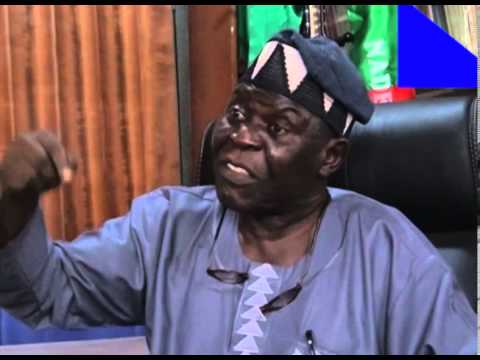
Chief Ayo Opadokun, a chieftain of the National Democratic Coalition, NADECO, has said that had the Nigerian military not seized power in January 1966, Nigeria would not have been where it is today. The elder statesman stated that not only has the military been involved in the politics of the country since then, influencing who gets what and how, it is also chiefly responsible for the ills that have bedeviled it.
Opadokun stated this at the public presentation of his book, “The Gun Hegemony”, which held on Thursday 15 January at MUSON Centre, Onikan, Lagos. The date of the book launch is symbolic enough as it took place exactly 60 years after the military first struck and tasted political power in Nigeria in January 15, 1966. And since then Nigeria has never been the same.
“It tackles all these posers as a historical, educative, and informative book. It attempts to provide answers and responses to the Posers. The book also challenges other interested observers to write on the consequences of military dictatorship on our body politics and its enduring negative legacies,” Opadokun noted.
As the title of the book suggests, Opadokun used the gun as a metaphor for the military, militarist power and its hegemony in Nigeria, stating that the military has had a holistic influence in Nigeria’s politics, social and civic space till date. That explains the title of the book, “Gun Hegemony.”
He started his discourse by asking some rhetorical questions which he called posers. However he also stared that the readers will not only find the answers to those critical questions in the book, but will discover things they haven’t known about Nigeria’s politics.
“Could there have been Nigeria without the discovery of the gun? Could there have been military intervention without the gun? Could there have been an imposition of military dictatorship that arrested Nigeria’s manifest hopes and aspirations as well as stunted its growth and development without the gun?
“Did the Nigerian army script a creation of Nigeria or that of imperialist Great Britain to suppress, intimidate, hound, repress, and emasculate Nigerian ethnic groups in order to force the over 350 ethnic groups into cohabitation so as to achieve the so-called amalgamated Nigeria in 1914?
“Why was the composition of Nigeria disproportionately dominated sectionally? Who were the principal promoters of the force or the vehicle? Did the cabinet of prime minister of Tafawa Bulewa, voluntarily hand over power to the army? Who were the principal advisers of Major General Aguiyi- Ironsi in 1966, after supplanting the democratically elected government?
“What were the main events that led to the civil war? What were and are still the consequences of the civil war on the Igbo nation and Nigeria generally? Furthermore, when Major Kaduna Nzeogwu declared publicly that the execution of the coup in the South was tribalistic and he was collaborated by Captain Emmanuel Nwabosi, leader of the operation in the western region, that the operation in Lagos was compromised by nepotism, Why did General Aguiyi Ironsi dither for about six months without convening the appropriate military bodies to decide the fate of the coup plotters?
“Why did General Aguiyi Ironsi insist on the promulgation of Decree 34 of 24 May 1966, despite the advice and suggestion to him by many officers, particularly Lieutenant-Colonel Hassan Usman Katsina and others? ”
However, Opadokun bemoaned the fact that the questions he asked have not been adequately responded to by various writers, even though the general public is repeatedly asking the questions as to:
“A. When and how did Nigeria start getting it wrong? B. Where would Nigeria have been today without the January 15, 1966 military coup? C. What are the impacts of the military dictatorship on the country’s socio-economic, political, social services, infrastructure and public institutions, (like the police and the Nigerian army itself?
“D. Why has Nigeria lost a cherished national ethos value system, standards, rules of engagement? E. And why has Nigeria remained an underdeveloped country, while a number of those countries with which we were relatively at par at our political independence in 1960 have become developed countries – the Asian Tigers – Malaysia, Indonesia – despite Nigeria’s quantitative and qualitative natural and human resources advantages?
Still, Opadokun stated without mincing words that the military did not decide the fate of Nigeria alone, without the support and collaboration of the elites, which he described as alternative locus of power. And they include the academia, public servants, traditional rulers. According those alternative locus of power collaborated with the military for their private rather than public Interest.
“What are the alternative locus of power? who collaborated or acquiesce to sustain military dictatorship in Nigeria for so long, and for their private rather than public interests, and the consequences of their actions? This includes the academia, public servants. traditional rulers. There were locus of power who could speak truth to power but acquiesced,” Opadokun maintained.
Dignitaries at the event included Mr. Femi Gbajabiamila, Chief of Staff to President Bola Tinubu, who represented the president; Chief Sam Amuka-Pemu, Publisher of Vanguard Newspapers and the Chairman of the occasion; Chief Emeka Anyaoku, former Secretary General of the Commonwealth; Sen. Otunba Gbenga Daniell who was the Chief Launcher; Aremo Olusegun Osoba; and Chief JK Randle, who was the Principal Launcher at the event.
Comments