


Princess Oyefusi Urges Tinubu to Sign Electoral Act Amendment Before Party Primaries


 Quick Read
The memorandum, dated February 2, 2026, and issued from the Royal Castle of Mercy, Lowa, Ikorodu, frames the proposed amendment as a constitutional and democratic imperative rather than a matter of administrative timing...
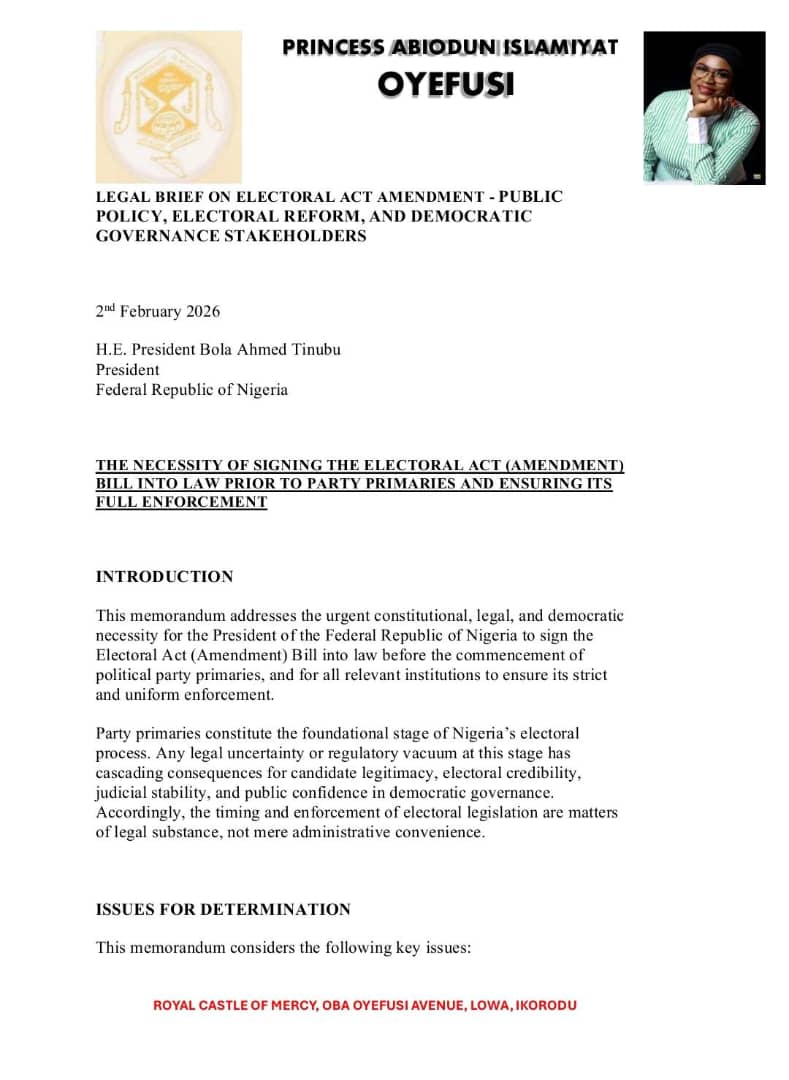
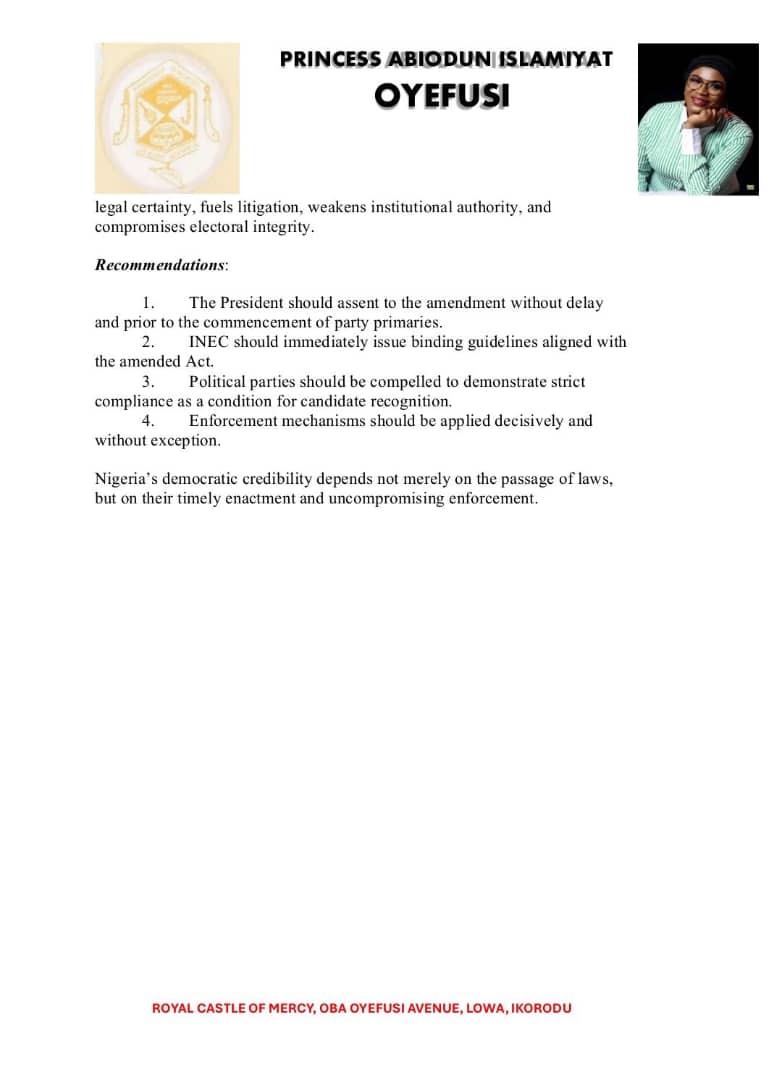
Princess Abiodun Islamiyat Oyefusi has formally written to President Bola Ahmed Tinubu, submitting a detailed legal brief in which she urges him to assent to the Electoral Act (Amendment) Bill before the commencement of party primaries and to ensure its strict and uniform enforcement across the political system.
The memorandum, dated February 2, 2026, and issued from the Royal Castle of Mercy, Lowa, Ikorodu, frames the proposed amendment as a constitutional and democratic imperative rather than a matter of administrative timing.
Oyefusi warned that proceeding with party primaries under an outdated or uncertain legal framework could undermine the legitimacy of candidates, trigger extensive pre-election litigation, and erode public confidence in Nigeria’s democratic process.
In the legal brief addressed to the President, Oyefusi raised three central questions: whether failure to enact the amendment before party primaries undermines legal certainty and the rule of law; whether legislative delay heightens the risk of pre-election disputes capable of disrupting the electoral calendar; and whether strict enforcement of the amended Act is essential to safeguarding internal party democracy and overall electoral integrity.
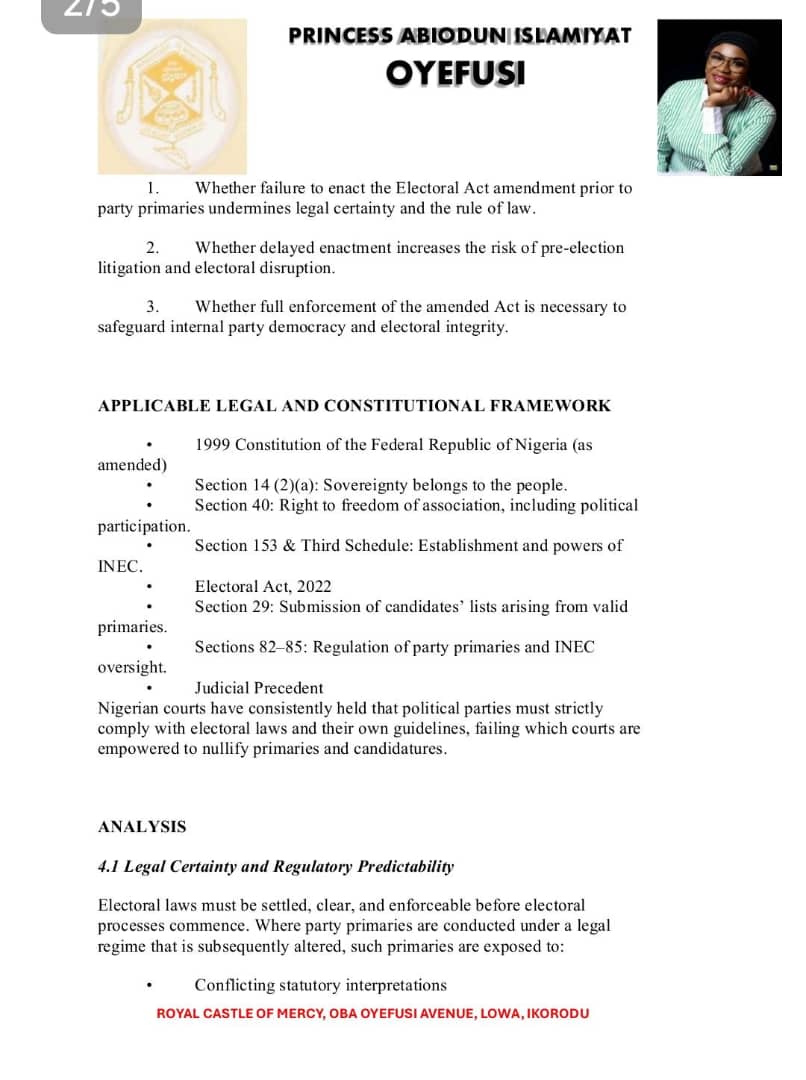
Anchoring her arguments on provisions of the 1999 Constitution, including the sovereignty of the people and citizens’ right to political participation, Oyefusi also referenced the constitutional mandate of the Independent National Electoral Commission (INEC) and the existing framework of the Electoral Act 2022.
She argued that electoral laws must be settled, clear, and enforceable before political parties begin their nomination processes.
According to the brief, primaries conducted under a legal regime that is later amended are vulnerable to conflicting interpretations, disputes over retrospective application of the law, and possible judicial invalidation of nominations.
Such uncertainty, she noted, offends the doctrine of legal certainty and destabilises the entire electoral process.
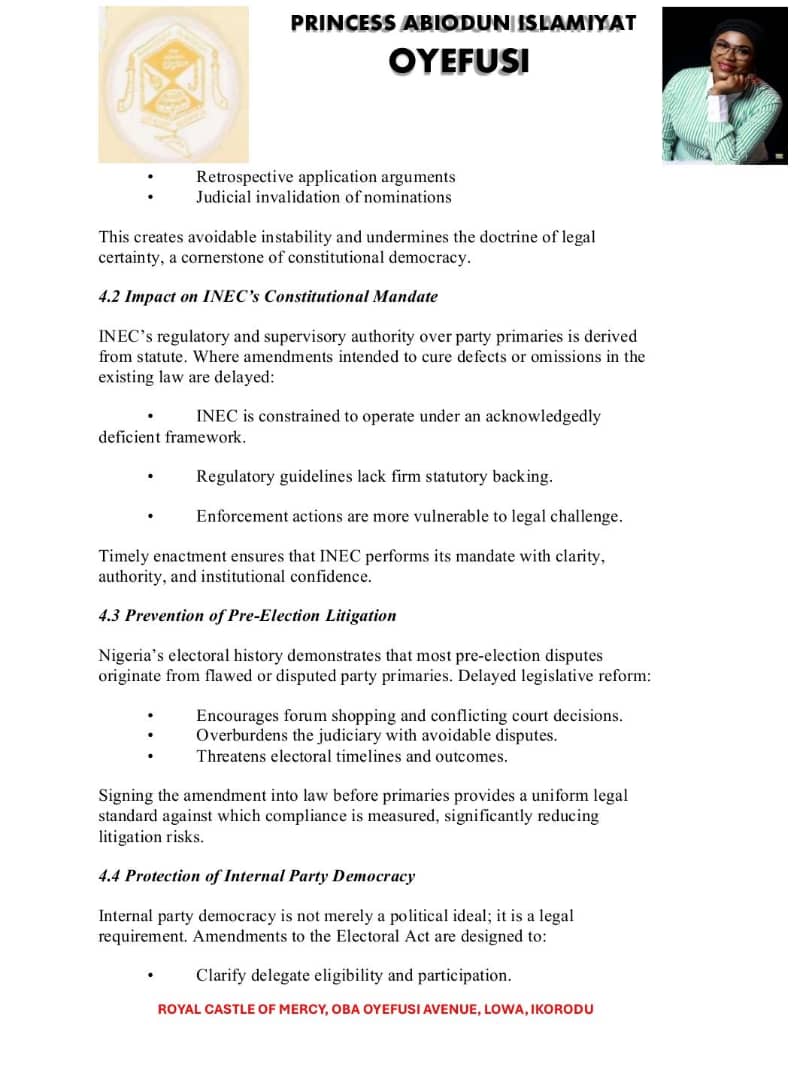
Oyefusi further contended that delay in enacting the amendment weakens INEC institutionally, forcing the commission to operate within what she described as an “acknowledgedly deficient framework.”
She warned that in such circumstances, INEC’s guidelines lack firm statutory backing, while its regulatory and enforcement actions become more susceptible to legal challenge.
Timely assent to the amendment, she argued, would empower INEC to regulate party primaries with greater clarity, authority, and confidence.
Drawing from Nigeria’s electoral history, the brief linked a majority of pre-election disputes to flawed party primaries. Oyefusi cautioned that legislative delay encourages forum shopping by aggrieved aspirants, produces conflicting court decisions, and places additional strain on the judiciary, with potential consequences for electoral timelines and outcomes.
She maintained that enacting the amendment before primaries would establish a uniform legal standard applicable to all political parties, thereby significantly reducing litigation risks.
On the issue of internal party democracy, Oyefusi described it as a legal obligation rather than a political ideal.
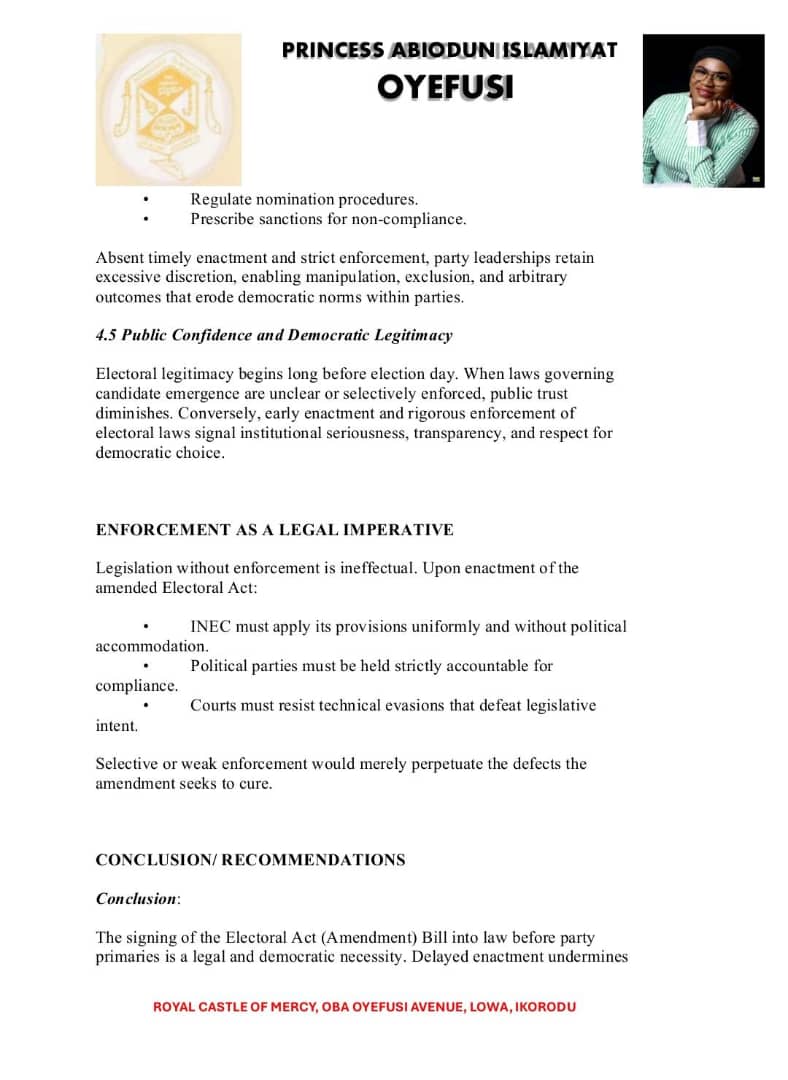
She noted that the proposed amendments seek to clarify delegate eligibility, regulate nomination procedures, and prescribe sanctions for non-compliance by political parties. Without timely enactment and firm enforcement, she warned, party leaderships would continue to exercise excessive discretion, enabling manipulation, exclusion, and arbitrary outcomes that undermine democratic norms within parties.
The brief also linked early and even-handed enforcement of the amended law to public trust and democratic legitimacy.
Oyefusi argued that electoral credibility begins long before election day, at the stage where candidates emerge from party processes.
She warned that unclear or selectively enforced rules diminish public confidence, while rigorous and uniform enforcement signals transparency and respect for voters’ choices.
Emphasising that “legislation without enforcement is ineffectual,” Oyefusi called on INEC to apply the amended provisions uniformly and without political accommodation.
She also urged that political parties be held strictly accountable for compliance and that the courts resist technical manoeuvres that defeat the clear intent of the legislature.
Selective or weak enforcement, she cautioned, would only perpetuate the systemic defects the amendment seeks to address.
In her conclusion, Oyefusi described the signing of the Electoral Act (Amendment) Bill before party primaries as a legal and democratic necessity.
She warned that any delay could undermine legal certainty, fuel avoidable litigation, weaken institutional authority, and compromise the integrity of the electoral process.
She therefore urged President Tinubu to assent to the bill without delay, called on INEC to immediately issue binding guidelines aligned with the amended Act, and demanded that political parties be compelled to demonstrate strict compliance as a condition for candidate recognition.
According to her, decisive and uniform enforcement of the amended law is critical to safeguarding Nigeria’s democratic credibility ahead of future elections.
Comments