


Forfeiture Fight: Malami moves to unblock three properties

 Quick Read
Justice Nwite granted the order following an ex-parte motion moved by the EFCC’s lawyer, Ekele Iheanacho, SAN.
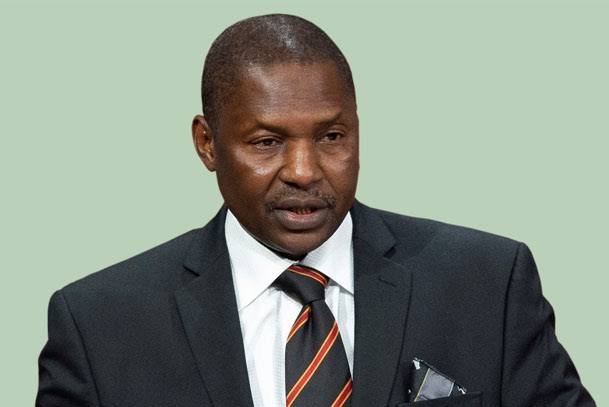
Former Justice Minister Abubakar Malami, SAN, has prayed the Federal High Court in Abuja to vacate the interim order made against three of the 57 properties listed by the Economic and Financial Crimes Commission (EFCC) for forfeiture to the Federal Government.
Malami, former Attorney-General of the Federation (AGF) under the Muhammadu Buhari administration, is challenging the EFCC over the properties listed as Nos. 9, 18 and 48 in the ex-parte motion brought before the court on Jan. 6.
The three properties sought to be discharged include Plot 157, Lamido Crescent, Nasarawa GRA, Kano, purchased on July 31, 2019, with no specific amount stated in the schedule as No. 9.
They also include a bedroom duplex with boys’ quarters at No. 12, Yalinga Street, off Adetokunbo Ademola Crescent, Wuse II, Abuja, purchased in October 2018 for N150 million, and the ADC Kadi Malami Foundation Building, bought for N56 million, listed as Nos. 18 and 48.
The News Agency of Nigeria (NAN) reports that Justice Nwite, who sat as vacation judge, had on Jan. 6 ordered the temporary forfeiture of 57 properties suspected to be proceeds of unlawful activities linked to Mr Malami.
Justice Nwite granted the order following an ex-parte motion moved by the EFCC’s lawyer, Ekele Iheanacho, SAN.
The judge then directed the commission to publish the order in a national daily for interested person(s) to show cause, within 14 days, why all the properties should not be permanently forfeited to the Federal Government.
The multi-billion-naira landed properties are located in Abuja, Kebbi, Kano and Kaduna States.
However, in a motion on notice filed on Malami’s behalf by a team of lawyers led by Joseph Daudu, SAN, the former AGF alleged that the anti-corruption agency obtained the interim order through suppression of material facts and misrepresentation.
Malami, who urged the court to dismiss the suit to prevent “conflicting outcomes and duplicative litigation,” argued that the proceeding was an assault on his fundamental right to own property, his presumption of innocence, and his right to live in peace with his family.
In the application dated Jan. 26 but filed on Jan. 27 by Daudu and marked FHC/ABJ/CS/20/2026, Malami sought two orders:
“An order of this honourable court vacating, setting aside and/or discharging the interim order(s) of this honourable court made on the 6th of January, 2026, against the respondent/applicant’s (Malami’s) properties listed as Nos. 9, 18 and 48 in the schedule of properties attached to the interim order of forfeiture of 6th January, 2026, the said properties having been duly declared in the respondent/applicant’s asset declaration forms throughout his tenure as a public officer, and No. 48 being held in trust for the estate of late Kadi Malami Nassarawa.
“An order of this honourable court restraining the applicant/respondent (EFCC), acting by itself or through its servants, agents and proxies, from interfering with the respondent/applicant’s (Malami’s) properties in issue or disturbing the respondent/applicant’s ownership, possession and control thereof in the course of purportedly giving effect to the order of this honourable court made on the 6th of January, 2026.”
In a 14-ground argument, Daudu contended that assets Nos. 9, 18 and 48, which are the subject of interim forfeiture, particularly those declared in Malami’s asset declaration forms, are not linked by prima facie evidence to any unlawful activity or specific offence.
He said Malami declared the assets listed as Nos. 9 and 18 in his asset declaration forms filed with the Code of Conduct Bureau (CCB) in 2019 and 2023, respectively.
He added that property No. 48 is held in trust by the former AGF for the benefit of the estate of his late father, late Kadi Malami.
“These assets, their value and their root of title have been clearly stated and specifically demonstrated in the various asset declaration forms spanning from 2019 to 2023.
“The declaration above is prima facie evidence of the legitimacy of the acquisition and ownership of the properties,” Daudu said.
The senior lawyer submitted that Malami comprehensively declared his sources of income in his asset declaration filed with the CCB to include N374,630,900 from salaries, estacodes, severance allowance and others;
“Sitting allowances as a board/committee member of the Federal Judicial Service Commission, Federal Capital Territory Judicial Service Commission, Legal Practitioner Privileges Committee and a high-powered presidential committee;
“N574,073,000 (Five hundred and seventy-four million, seventy-three thousand naira) as income generated through disposed assets;
“N10,017,382,684 (Ten billion, seventeen million, three hundred and eighty-two thousand, six hundred and eighty-four naira) turnover from businesses;
“N2,522,000,000 (Two billion, five hundred and twenty-two million naira) being loans to businesses;
“N958,000,000 (Nine hundred and fifty-eight million naira) as a traditional gift from personal friends.”
Daudu further explained that a total sum of N509,880,000 (Five hundred and nine million, eight hundred and eighty thousand naira) was realised as income from the launch and public presentation of a book titled “Contemporary Issues on Nigerian Law and Practice, Thorny Terrains in Traversing the Nigerian Justice Sector: My Travails and Triumphs” by Malami.
“These streams of income, and the continuing profits generated from the businesses over the years, sufficiently show that the properties sought to be forfeited were acquired through legitimate and lawful means, as stated in the asset declaration forms,” he said.
According to the senior lawyer, the interim forfeiture order was not based on any prima facie establishment of unlawful purpose and is therefore liable to be set aside.
He submitted that the court wrongly granted the interim forfeiture order against the properties,
“which were lawfully acquired post-appointment of the respondent/applicant and declared with the Code of Conduct Bureau as legitimate assets of the respondent/applicant, in compliance with the Fifth Schedule to the Constitution of the Federal Republic of Nigeria, in 2019 and 2023.
“The interim order was obtained ex-parte by suppression of material facts and misrepresentation.
“The interim order for forfeiture was obtained by manifest exaggeration, malicious inflation of the value of the assets, and unreasonable and incompetent valuation deliberately manipulated to mislead the court, negatively affecting its discretion in granting the order based on manipulated facts and conclusions deliberately concocted by the applicant/respondent (EFCC).
“There is no prima facie evidence placed before this honourable court by the applicant/respondent (EFCC) to warrant the properties linked to the respondent/applicant (Malami) being liable to forfeiture to the Federal Government of Nigeria.
“The proper remedy for preventing conflicting outcomes and duplicative litigation is for this honourable court to dismiss or strike out this suit.
“This proceeding is an assault on the applicant’s fundamental right to property, his presumption of innocence and his right to live in peace with his family,” counsel submitted.
NAN recalls that Justice Nwite had on Jan. 6 adjourned the matter until Jan. 27 for a report of compliance on the publication of the interim forfeiture order.
However, the matter could not proceed because it was not listed on the day’s cause list, having been heard during the vacation period. The judge, having concluded vacation cases, remitted the case file to the Chief Judge for re-assignment.
It was also observed that several lawyers were present in court on Jan. 27, having filed processes on behalf of their clients to stop the court from proceeding with the final forfeiture of the assets.
Malami, who is facing a money-laundering charge preferred against him by the EFCC, is also presently detained at the Department of State Services (DSS) facility over another offence bordering on alleged terrorism financing.
(NAN)
Comments